

Unlock the Editor’s Digest for free
Roula Khalaf, Editor of the FT, selects her favourite stories in this weekly newsletter.
Today, it’s a fair bet that Ralph Fiennes is more famous than Tchaikovsky. Presumably even the Opera de Paris needs big names to sell tickets and, as film stars go, Fiennes is better-placed than most to direct Eugene Onegin. He has loved Pushkin’s verse novel since his student days, played the title role in a film adaptation directed by his sister, has directed both cinema and theatre, and has a keen interest in music. None of these things are a substitute for time spent learning the complex craft of opera direction, but everyone has to start somewhere, and if you’re a celebrity, you can take your first steps at the Palais Garnier.
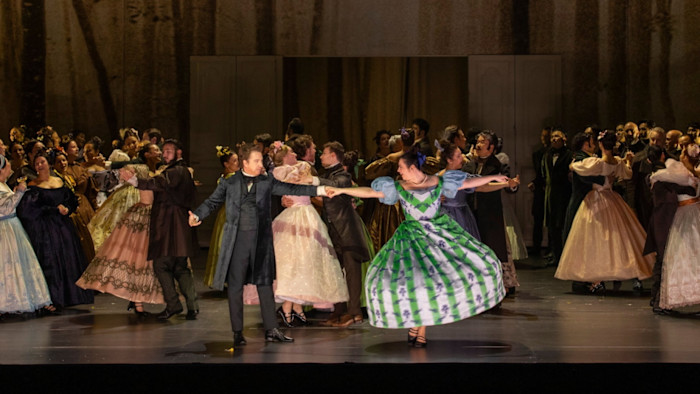
Fiennes has avoided a number of first-timer pitfalls. By working closely with conductor Semyon Bychkov, he has made something consciously structured around the music. Choreographers Sophie Laplane and Kim Brandstrup have clearly shaped the chorus scenes. This new Onegin reads like a costume drama — full of cinematic detail, lavish outfits made with sumptuous fabrics (Annemarie Woods), and historical precision. Fiennes’ efforts never get in the way of the music, and he trusts his singers to do their thing.
Which they do, superbly. Ruzan Mantashyan’s poised, likeable Tatiana has both vocal refinement and polished passion; Boris Pinkhasovich’s Onegin is magnificently supercilious, driven more by Pushkin’s ennui than Tchaikovsky’s tormented anguish. Bogdan Volkov’s Lensky is honest and embodied, stealing the show with his heartfelt final aria; Susan Graham and Elena Zaremba are sheer luxury in the roles of Madame Larina and the nanny Filipyevna. The utter security of their performances owes much to the steady support they get from Bychkov on the podium. He is a singers’ conductor, unflappable and generous, with a fine sense of the score’s inner terrors and a charmed ability to stop just short of pathos. The orchestral musicians respond with audible pleasure; his appointment to the role of music director from 2028 must be welcome news for them.
If you like your opera stagings to come with social awareness, contemporary references, critical subtext or intellectual surprise, this Onegin is not for you. The production won’t date: Fiennes clearly believes that it is sufficient to tell the story as it is written, without having metabolised the potential of music theatre to relocate old stories in ways that might still unsettle the audience as much as Pushkin and Tchaikovsky once did. For those who want ravishing frocks and apolitical entertainment, this will be perfect — and the warmth of the audience at Monday evening’s premiere was a reminder that visual seduction and interpretive safety remain powerful currencies in today’s operatic economy.
★★★☆☆
To February 27, operadeparis.fr
Read the full article here