

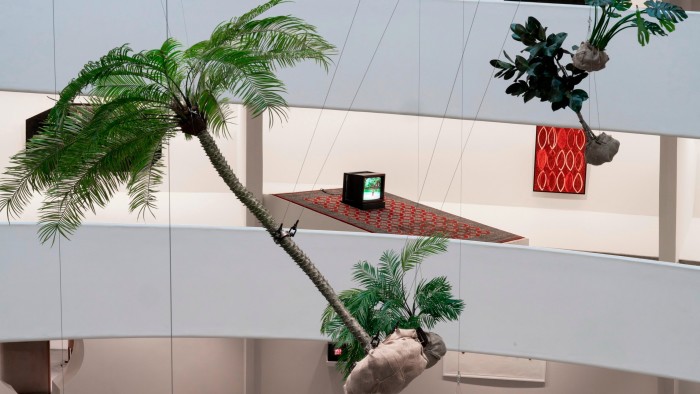
Greenery whirls through the atrium of the Guggenheim Museum. Plants dangle in the void, as if a tornado had scooped them skyward and stranded them aloft. We earthbound creatures trundle up the ramp, observing the hanging garden from various angles, framed by the architecture and refracted by the multifarious work on the walls. The initial impression of tempest-tossed chaos dissipates, replaced by an orderly procession through Rashid Johnson’s profuse imagination and erratic career.
Born in Chicago in 1977, Johnson first became famous for photographs he produced at the age of 21, a series of technically accomplished, large format close-ups. If the Guggenheim had limited its retrospective to those pictures and the intricate, layered collages he started assembling around 2018, the show would have been a study in brilliance.
Instead, this is a show that also covers years of searching, conceptual cogitating and dead ends pursued by an artist who didn’t always trust his talent and who second-guessed his instinct to please. The result is A Poem for Deep Thinkers, an exhibition that’s fitfully alluring and often frustratingly opaque, wrapped in jargony abstractions.
Johnson’s early breakthrough was a set of hyper-traditional photo portraits made with a 19th-century printing process known as Van Dyke brown, which renders reality in earth-coloured monochrome and extremely fine detail. In “Michael” and “Jonathan’s Hands”, both from 1998, he zooms in on men who shield themselves from the lens’s intrusion.
Jonathan presses gnarled fingers to his face, leaving the camera to fix on the grooves with which time marks the body. Michael, eyes closed, tilts his head back and raises his chin in a pose that evokes ecstasy, exhaustion or even martyrdom. Traces of suffering mix with fluid beauty in these pictures, and when Thelma Golden, the director of the Studio Museum in Harlem, selected them for her influential 2001 group show Freestyle, they secured Johnson a coveted spot in the art world hierarchy.
Even as collectors were catching up to his first public work, he was moving on to poetic quasi-abstraction. In “Manumission Papers (In Circles)”, prints of bare feet form closed patterns on a dirt-hued ground, suggesting that being released from slavery involved other forms of bondage. To achieve the scatterings of tiny white shadows in a series called “Chickenbones and Watermelon Seeds: The African American Experience in Abstract Art”, Johnson placed granules on photosensitive paper before exposing it to light, so that the record of their presence reads as an absence. Photographers such as Man Ray and Robert Rauschenberg had experimented with similar techniques, but Johnson’s images exude a distinctive compound of nostalgia, elegance, and historical grief.
But the series’ subtitle, which reads like a conference paper, hints at a preoccupation with academia, and Johnson stepped away from success to enrol in a Masters of Fine Art at the School of the Art Institute of Chicago. Thus began a time in the barren wilderness of conceptual art, when he elevated irony and self-consciousness above aesthetics.
In one nervy provocation, he posed for a colour “Self-Portrait with My Hair Parted Like Frederick Douglass” (2003). It’s a glossy gimmick, and it makes Johnson look more like a model in a men’s magazine than an intellectual force behind the fight for civil rights. He also stretched out across the tomb of Jack Johnson, the first Black heavyweight boxing champion. That 2006 photograph is another bit of self-aggrandising humour: the artist as effigy of himself, recumbent above his own surname carved in stone.
The desire to be protagonist as well as auteur led him down byways of self-regard. One of his best-known video works, “Me, Tavis Smiley and Shea Butter”, has him perched on the toilet, smearing goop on his skin and listening to a talk-show host on National Public Radio. Not much happens, and there’s not much to look at, but the occasion evidently means a lot to him. “That’s who I am, and it’s incredibly contemporary and it’s incredibly complicated, and I thought it was this really honest moment,” Johnson told an interviewer.
From then on, he used shea butter regularly in his sculpture, smushing, carving, smearing or melting the stuff, and occasionally leaving it in un-manhandled lumps. He offers an art-historical pedigree for its use: Joseph Beuys, who used ox fat in his performances, and Bruce Nauman, who, in his “Art Makeup” series (1967-68), applied assorted pigments to his face and body.
Shea butter and Johnson’s own face are two of the recurring elements that run through a discontinuous career, unifying disparate methods and styles. He returns often to materials that have the look of dark skin and hard experience, such as black soap mixed with melted wax, or scarified and branded wood. House plants have by now lived in his work for decades, typically housed in a tall, grid structure, like a cross between a bower and a skyline. The Guggenheim exhibition’s strength lies in its ability to present Johnson’s zigzagging through phases as an organic evolution, a process of growing and branching.
But at some junctures, the artist seemed to defy that interpretation — as in his abrupt turn to oversized abstraction with the “Cosmic Slops” of 2008. Johnson placed wood panels on the floor and slathered them with melted black soap and wax. Then he hoisted them up, allowing the pigment to drip down in expressively random patterns. Sometimes he scored them with a stick. It’s hard to focus on the individual works through the forest of allusions to Ad Reinhardt, Jackson Pollock and Frank Stella. Ambitious yet inert, they aspire to more significance than they deliver, and it takes a prodigious squint and a leap of faith to nod along with the text panel elucidating the “alchemy of materials that hold significance for the everyday lives of Black people globally”.
The “Cosmic Slop” process did, however, have the happy effect of nudging Johnson back to a more intuitive, less ironic form of art-making. Beauty beckoned. And, in 2018, he found it again in a set of large-scale collages on the theme of “Escape.” Oozing black ghosts flit across a landscape of African masks, palm trees, and jungle. You can pick out whispers of solidity and refuge in the allusions to architecture: the harlequin patterns of square bathroom tiles and lengths of oak flooring. You might call this Johnson’s White Lotus period, when carefree tropical fantasies are replete with menace, and sensual indulgence creates an inescapable friction with death.
To January 18 2026, guggenheim.org
Find out about our latest stories first — follow FT Weekend on Instagram and X, and sign up to receive the FT Weekend newsletter every Saturday morning
Read the full article here