

Unlock the Editor’s Digest for free
Roula Khalaf, Editor of the FT, selects her favourite stories in this weekly newsletter.
A man discovers an eyelash beneath his foreskin. Rebecca Saunders’ new opera, Lash — Acts of Love, might have the most bizarre pretext of the genre this century — and the bar is high. Ed Atkins’ libretto should win a version of Douglas Adams’ award for the most gratuitous use of the F-word in a serious screenplay. There is stiff competition for the prevalence of expletives in contemporary opera, but Atkins uses it more than a dozen times, which is an achievement in a text that eschews both dialogue and narrative.
The eyelash, if we are to believe the synopsis, used to belong to a lover who is now dead — represented on stage by four women, denoted as K, A, N and S. Who she is, how her hair ended up there, why she died — none of these questions are answered. In the end, this could equally well be Atkins (a successful visual artist in his day job) musing on mortality after finding a hair of his own.
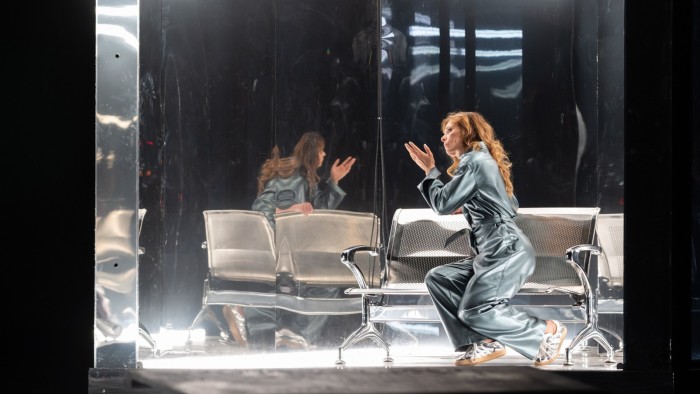
Perhaps none of this matters. Saunders has never shown any interest in narrative content, and Lash stringently avoids straight storytelling. Berlin’s Deutsche Oper lavished resources on Friday’s world premiere, with directing collective Dead Centre, designer Nina Wetzel and video artist Sébastien Dupouey doing their damnedest to fill in the story’s blanks with opulent imagery.
And the result is engrossing. Wetzel’s three mirrored cubes glide soundlessly around the stage, Dupouey’s poetic combination of live and prepared video images moves with the music like a fourth dimension, and the four women (singers Anna Prohaska, Noa Frenkel and Sarah Maria Sun and actor Katja Kolm) perform with phenomenal grace and poise.
Even so, it is Saunders’ extraordinary score that dominates the evening. Her music grabs you by the shirt-front and holds you in a vice-like grip until the final note has died away, two solid hours after the first hesitant whisper. There are no tunes to speak of, and even fewer clichés. Saunders is wildly inventive and yet absolutely assured in her craft, with a mastery of orchestral and vocal writing that is breathtaking. Time and again sounds emerge from the orchestra pit that defy categorisation — how does she do it? The entire audience leans forward, as if a few centimetres’ more physical proximity would help us fathom the spellbinding complexity of the music. The orchestra plays for conductor Enno Poppe with dazzling precision; they must have rehearsed for weeks.
The fact that the singers achieve such virtuosity is equally astonishing; but they do. Lash is a musical triumph, received with rapture and a handful of boos. In music history, only a few composers — Bach and Wagner among them — have managed to write great music to mediocre texts. Lash succeeds despite a libretto that is as pretentious as it is vacuous; perhaps this is not an opera at all, but rather a gigantic symphony with singers and a handful of words. Hear it if you can.
★★★★★
To July 18, deutscheoperberlin.de
Read the full article here