

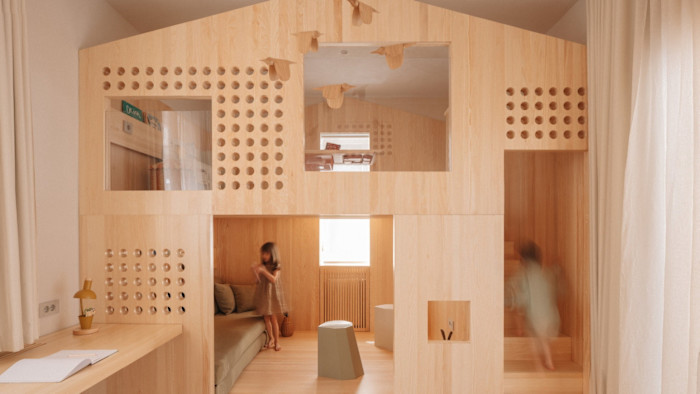
“It’s a haven, a refuge,” says Vernes Causevic. The architect is describing an unexpected feature of the Sarajevo apartment he renovated for clients with his partner Lucy Dinnen: an indoor children’s playhouse. Made from local spruce, it is designed to ignite the imagination, says Causevic.
This miniature home within a home might be all fun and games but, as with everything else in this serene, minimal space lined in local woods, natural stone and sweeping linens, it embodies the couple’s belief in using homegrown, sustainable materials, and traditional craftsmanship and design.
The duo co-founded their practice Project V Architecture in 2017, having met at London Metropolitan University during the late 2000s. At the time, the aim of architectural education was changing. “We were being encouraged to think about the architect’s wider, civic responsibilities,” says Dinnen. “To see architecture not simply as a product but a tool that we could use to tackle global problems — sustainability, pollution, climate change” and, in an increasingly homogenised world, a “loss of local identity and traditions”.
This eco-minded, “place-centric” approach appealed to the owners of this 19th-century apartment block in central Sarajevo. The “progressive” couple with two young children encouraged Causevic and Dinnen to “push our ideas, innovate and finesse the details”, he says. “They wanted it to feel like a sanctuary . . . a place to escape from an occasionally chaotic city.”
For Causevic, the project has personal resonance. He was seven when he and his family were evacuated to Britain during the 44-month-long siege of the Bosnia and Herzegovina capital in the mid-1990s, during the Bosnian war. In 2017, he returned to the city that had haunted his imagination. The couple now divide their time between bases in London and Sarajevo, working on projects across Britain and in south-eastern Europe.
One of these is the Most Mira Peace Centre, a Balkan-British initiative in Prijedor, where young people from across the republic will be able to meet in a restored house. “We’ve used soil from divided places to symbolise the idea of bringing people together again,” says Causevic.
In this private apartment, the couple began by removing the walls to open up the fusty and dark layout of small rooms peeling off from the long corridor. Now you step into a light hallway flanked by smooth cherry wood cupboards and a travertine floating bench. A tall door leads to a large, open-plan central space that’s flooded with light. Bedrooms and bathrooms at either end are separated by pocket — or sliding — doors. Gauzy linen curtains are a “fluid and elegant” way to divide the kitchen from the sitting room, says Dinnen.
The floor plan feels contemporary but is in fact based on traditional Ottoman houses, says Causevic, where large communal spaces have smaller, private rooms leading from them. The new, lattice-effect, secessionist-style fanlight above the front door is another nod to history: the late 19th-century period when Sarajevo was ruled by the Austro-Hungarians.
Weaving these multicultural layers of history into the design was important for both architect and client. The war in Bosnia and Herzegovina ended in 1995; in Sarajevo alone, around 35,000 homes, public buildings and historic sites were damaged or destroyed. But since then, there has been no “coherent strategy” to restore its architecture and infrastructure, says Causevic. Repairs to the city have been “ad hoc — and intermittent” — often using cheap, imported materials such as laminates, composite stone or plastics. All things that Dinnen (who is British) and Causevic avoid.
“After a conflict, when a society is reduced to basics, it can lead to a loss of identity and local heritage,” he says. “Architecture can help to repair that feeling of belonging.”
Their quest to find local materials led them to workshops, craftspeople, factories — and sawmills. Around 53 per cent of the country is forested. “Most of our timber is now exported,” says Causevic. “But there’s a long tradition of using wood for construction.” Here, the cherry chosen for doors, storage and the skirting that wraps around the apartment — in varying heights — looks like a rosy-hued ribbon.
Causevic and Dinnen had trialled some of these ideas in their own apartment in the city. Their 50 sq metre home was awarded the Grand Prix at the 2024 Collegium Artisticum BiH awards in 2024 for its imaginative, resourceful use of space and materials — including spruce window frames, clay-plaster walls and furniture, which they made themselves from rammed earth. The balcony, damaged during the war, was rebuilt in local wood. Internal walls were replaced by woollen curtains that separate the rooms like “soft architecture”, says Causevic.
In their client’s home, they were able to be even more ambitious. The two-storey playhouse capitalises on the 3-metre-high ceilings. Made by Krivaja Homes, a local timber construction company, it has a bedroom tucked under the eaves like in a rustic cottage. Child-sized windows offer views of the quiet courtyard behind, a typically 19th-century feature. When the family moves, they can dismantle and reassemble it.
Elsewhere, the flat, architrave-less wooden doors are the result of exhaustive experimentation. The owners also gave them free rein to choose the furnishings and objects. There is not much of it, but that is the point. “We like to find one large piece of furniture and use it to anchor a room,” says Causevic. Most were made by local artisans.
The sculptural “Koba” kitchen table, made of a dark-stained maple, was designed by the French architect Jean-Marie Massaud for Zanat. The Konjic-based, family-run woodworking and furniture-making company, established in the 19th century, has recently started collaborating with a host of contemporary designers including Michele de Lucchi. The low bed is by emerging, craft-led maker Artisan; a cascading mobile is by local furniture maker Gazzda.
A “sense of place” stretches to the artworks. Paintings by Bosnian artists Muhamed Bajramović and Kemil Bektesi depict the country’s natural and more gritty industrial landscapes.
They are displayed on walls painted in soft clay. The swirling, light-reflecting surfaces feel modern but, says Causevic, they incorporate “earth . . . which is as old as Bosnia itself”.
projectv-arch.com
Find out about our latest stories first — follow @ft_houseandhome on Instagram
Read the full article here