

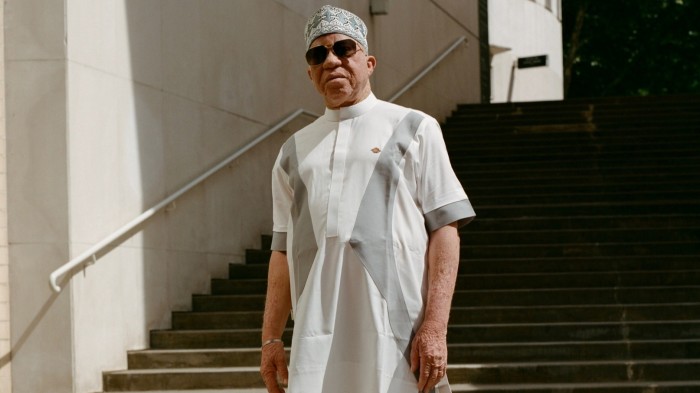
“I wanted to put some distance between me and music. I was bored, perhaps?” In the mouth of Mali’s most-storied living singer, these sentiments sound close to heresy. Salif Keïta battled parental disapproval and societal stigma to become the mainstay of two of his country’s most celebrated post-independence groups, the Rail Band and Les Ambassadeurs, and then enjoy a flourishing solo career that spanned Africa and the rest of the world.
In 2018, he announced that his new record would be his last before he retired to play draughts under his mango trees. And yet the 75-year-old has now returned with a new album, So Kono, and is embarking on a comprehensive tour that reaches Koko in London on May 29 and sweeps through Europe and on into 2026. The “golden voice of Africa” has not, after all, reached its swan song.
Speaking in French by video link from Mali’s capital Bamako, Keïta is in reflective mood. Born in 1949, he faced two challenges to a career as a musician. First, he has albinism, a condition poorly understood (“How can you be white if both your parents are black?”) and frightening. Second, he was a Keïta, from a ruling caste, not a musical one. “The Keïtas are noble and nobles don’t sing. That’s how society was divided up. Chacun à son travail.”
As a teenager, he left his village and moved to the capital, where he greedily listened to every cassette he could scrounge from the markets, from reggae to rock, on top of traditional Malian music. He moved from club to club as a troubadour, sleeping in doorways, spending his time with other outcasts.
Saxophonist Tidiani Koné enlisted him as a co-founder of the Rail Band, state-backed musicians based at the main railway station hotel. This pricey club became a magnet for Malian elites. After three years, Keïta was lured away to join a rival supergroup. “There were lots of nationalities,” recalls Keïta, “Senegalese, Guineans, Ivorians, Malians. That’s why they were called Les Ambassadeurs.” The group’s repertoire was the classic 1970s west African repertoire of Cuban ballads, salsa and funk; Keïta was brought in for his traditional Malian singing.
They became regional favourites, especially of Guinean leader Sékou Touré, in whose honour Keïta improvised and later recorded “Mandjou”. He remains an unapologetic supporter of the president, under whose administration thousands and possibly tens of thousands of political prisoners died. Touré, who ruled for 26 years until his death in 1984, declared his own Democratic Party of Guinea the country’s only legal party and was elected — unopposed — to four seven-year terms.
“He was a revolutionary president,” says Keïta. “Ahead of his time. He was in advance of his people. He knew where he wanted to go. I admired him a lot.” This weakness for strongmen extends to Mali, where in recent years Keïta has been a vocal supporter of the military regime that seized power in 2020, in the wake of a political emergency sparked by an Islamist revolution in the north and disenchantment with the lingering impact of France, the former colonial power. Keïta served on the National Transitional Council and is now a special adviser to Colonel Assimi Goïta, the transitional president who has expelled French troops and replaced them with Russian mercenaries.
“In all sincerity,” Keïta says, “I love the transitional government. They are brave and want to take the country forward, unlike the politicians who got us into this state.” When will new elections take place? “The task of making the country secure still isn’t finished; jihadis are still disturbing the peace.” But years or decades? “The time it takes to make the country peaceful and safe.”
In an interview a few years ago, he was quoted as saying that democracy does not work in Africa. Grumbling about having been misinterpreted, he embarks on a history lesson, culminating in the constitution set out by his ancestor Sundiata Keïta, founder of the Manding Empire. “We can’t teach democracy as an imported social doctrine, to a people that already has its own way of functioning. The first democracy in the world was the Kouroukan Fouga in 1236. Everyone had their own place. And it worked well.”
In the early 1980s, Les Ambassadeurs splintered undiplomatically into rival factions and then fizzled out. Keïta moved to Paris. France was becoming a centre of African music, with resident stars such as Manu Dibango and Touré Kunda bolstered by innovations such as Radio Nova (every taxi driver’s favourite station, with its cab-shaking diet of raï and rumba), the Musiques Métisses festival and record labels such as Indigo and Celluloid.
It was here in 1986 that he recorded a solo album, Soro, with former colleagues from both bands and the cream of French producers. Keïta’s previous recordings had seemed timeless, their slow grooves harking back to an imagined Afro-Cuban or Manding golden age; now, with the synthesiser sheen of Jean-Philippe Rykiel, the album sounded sharply and freshly contemporary. It set the palette for western-friendly world music for decades to come. Not only Keïta himself but his contemporaries, including his Senegalese neighbours Baaba Maal and Youssou N’Dour, would spend years chasing to recapture its sound.
Keïta luxuriated in the freedom of Paris recording complexes — to make their albums Les Ambassadeurs had often had to bribe their way into unused radio studios in Abidjan in the dead of night — and in his generous budgets from the impresario Ibrahima Sylla. (Keïta imperiously breezed through all the allocated money and more.) But he had not anticipated the reaction to the resulting album. “I was doing my best, song by song. I didn’t know it would be such a success. In the west, it was a great calling card.”
It was this pumped-up sound that formed the basis for his subsequent 30 years of touring and recording, which won him four Grammy nominations and multiple awards. In 2018, with the release of Un Autre Blanc, he called time on this career. “At my age . . . ” he says, and stops. “It’s the travel. Each time you make a record, you have to tour.” At the time he was insistent that this would be his final album. “I was sincere, because that is what I wanted.”
Accident and opportunity turned out differently. In 2023, the Kyoto-based photographer Lucille Reyboz, who had taken the cover photo for Keïta’s 2002 album Moffou, invited Keïta to Japan to play her Kyotophonie festival. For budgetary reasons and because the concerts were held in Shinto shrines, he was restricted to two bandmates, Badie Tounkara on ngoni and Mamadou Koné on calabash.
Laurent Bizot, a longtime associate who runs the No Format record label and has joined us on the call, leapt at the opportunity to record this line-up in Keïta’s hotel room, a far cry from his high-tech heyday. “We kind of trapped Salif to record this acoustic album. He had no idea when he came to Japan that he’s gonna record an album there. We really caught him off guard.” The result is a delight, intimate and subtle and free from bombast.
Keïta, however, is indifferent to the record’s reception. “If people like it, that’s fine.” Will there be more in this vein? “Can you trap someone twice?” muses Bizot rhetorically. Keïta mutters about this being a “truc exceptionnel”. He has learned, clearly, never to say never.
‘So Kono’ is out now on No Format; tour dates at salifkeitamusic.com
Read the full article here