

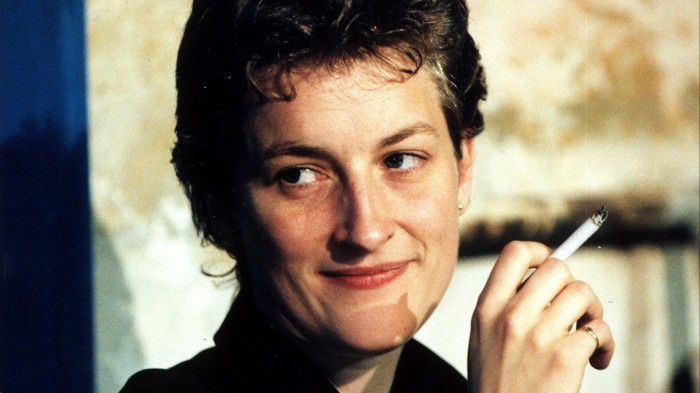
As director Sean Holmes left the theatre after seeing Sarah Kane’s first play Blasted in 1995, a friend asked what he thought of it. “I said: ‘I don’t know, but I feel like we’ve just seen something really important.’”
Holmes, a friend of Kane’s who is now associate artistic director of Shakespeare’s Globe, reflects: “There are not many things I’ve seen in the succeeding 30 years where I’ve felt that.” The shock of the radical British playwright is encountering theatre that is visceral, felt, both intimate and interrogating. Her language is electric — poetic, surprising, forceful — while the tone veers from dark to ribald, loving to furious.
Kane went on to write four more plays and a short film before her death in 1999, becoming one of the most influential playwrights of her generation. Yet her plays are infrequently performed.
Next week, her final work 4.48 Psychosis returns to London’s Royal Court theatre 25 years after it premiered, with the same director and cast in a co-production with the RSC. It is a formal and linguistic feat, switching between dialogue and interior monologue; devastation and punchlines; between the rhythm of desperation and the parlance of a doctor’s prescription. It is also the story of a woman who contemplates suicide.
Blasted initiated Kane’s manipulation of form. What is seemingly a parlour play — two people in a hotel room, talking — is disrupted by a soldier with a rifle and, shortly afterwards, a mortar bomb. To borrow Holmes’s summary, it “starts like Rattigan with swearing, then it goes Orton, Pinter, Bond, Shakespeare, Greeks, Beckett . . . yet it is its own unique, powerful, unseen-before thing.”
Kane’s understanding of form was acute from the start, and her invention only intensified. In 1998, when she was writing 4.48 Psychosis, she described the project as what happens when “you no longer know about the difference between waking life and dreaming life”. She set aside dialogue cues and stage directions to focus instead on the structure and sound of consciousness.
Playwright Simon Stephens recalls seeing the original production at the Royal Court in 2000. “It remains . . . as startling a piece of theatre as I’ve seen,” he tells me. “The linguistic suppleness of it, the wit of it, the deep sadness.” 4.48 Psychosis is a singular work about a mind alert to the prospect of death. Between the play’s completion and its staging at the Court, Kane had died by suicide aged 28.
I was born the year Blasted was first staged, which means I didn’t experience Kane’s original productions. It also means that I’ve had few opportunities to see her plays.
Although continental Europe, particularly Germany, has embraced her work — director Thomas Ostermeier and Berlin’s Schaubühne theatre were advocates from the beginning — the UK, especially England, is a different story. When Katie Mitchell staged Cleansed at London’s National Theatre in 2016, it was the first time it had put on a Kane play. Chichester Festival Theatre live-streamed Crave during the pandemic. Holmes directed Blasted at London’s Lyric Hammersmith in 2010. Sheffield’s Crucible ran a season of Kane’s work in 2015, a gesture of faith in the playwright that paid off.
But why have so many other theatres kept a cautious distance? “Do people want to escape the brutal realities they’re living surrounded by, or do they come to be confronted with them in the theatre?” wonders Mitchell. “If you’re going to schedule Kane, it’s confrontation the whole way . . . maybe people feel cautious.”
“We are in a time where we can take less risk,” says Holmes. “Probably the way Blasted would be done now is with a Hollywood star in the West End . . . If you look at Elektra [starring Brie Larson] or Oedipus [led by Rami Malek], there’s a real strand of experimental or radical provocative work that’s happening more in the commercial sector, led by actors, than it can in the subsidised sector.”
Playwright Anthony Neilson came to prominence at the same time as Kane, and was grouped alongside her and Mark Ravenhill as makers of “in-yer-face-theatre”.
“It was based on a desire to make theatre a more visceral experience,” he says. “[Critics] didn’t have a road map to discuss it . . . they’d seen 15 productions of Othello, and so they were an authority on the 16th. This was something different.”
From the get-go, Kane’s work caused a sensation in Britain’s tabloid press. Partly, this was related to the shock factor. In Blasted, a man has his eyes sucked out and, out of desperation, eats a baby. In Cleansed, a tongue is cut off; later a man’s feet. It certainly sounds shocking to list selectively from Kane’s work — there is incest, murder, mutilation, rape. But literalising can be a form of wilful misinterpretation.
One of the only recordings available online of Kane speaking is a 1998 talk she did at Royal Holloway, University of London, interviewed by theatre professor Dan Rebellato. It’s a remarkable insight into her technique, ambition and opinion of other artists, all of which she discusses with clarity, humour and exactitude. During that conversation, she says of being branded a violent writer: “What drives people is need, not the obstacle. It’s not about the obstacle.” Love is the recurring theme when I speak to others about her plays. As she says in that talk: “I write about love almost all the time.”
“There’s an extraordinary tenderness in the writing”, Stephens says, “and a genuine faith in the possibility of beauty.” Her plays have a startling emotional intensity; they point at the world and demand you don’t look away from the violence of war and inequality; they make you laugh; they centre love and purity; and they digest the history of western theatre in order to travel radically beyond it.
Kane’s use of violence or taboo always had political or metaphorical significance, drawing on accounts of football hooliganism and the horror of the 1992-95 Yugoslav war. “What, do you think I make this stuff up?” she says in the conversation with Rebellato. “When it comes to the acts of violence . . . I just read the newspapers.” The reaction against her work can be seen as part of our tendency to look away from pain and injustices that do not affect us directly.
Mitchell, who has directed Cleansed and 4.48 Psychosis, suggests that cordoning Kane off as a violent writer is a gendered act. “If a woman writes something violent, it’s different than if a man writes something violent . . . which maybe clouds a steadier view of what she was about.”
What drew her to directing Kane? “Form and content, perfect”, she says, enunciating the words with satisfaction. “Very difficult to do, almost impossible to stage.”
As history often shows, when art is doing something different, outrage ensues. (Even knowing that, it’s still astonishing to rewatch the 1995 episode of Newsnight in which presenter Jeremy Paxman asks the Court’s then artistic director Stephen Daldry, “What are you doing spending taxpayers’ money on this kind of filth?”) “Mediocrity has always been praised,” Kane said in 1998, “that’s simply what happens. Most good plays are only liked in retrospect.”
The 4.48 Psychosis revival quickly sold out. Last week, London’s Almeida Theatre announced that it will be staging Cleansed next year, in Rupert Goold’s final season as artistic director. “Kane is studied more than watched,” Goold says, when I ask him about the revival, “and it felt important to remind people of the theatrical qualities of her plays.
“Would I have done Sarah Kane in my first season? Maybe not,” he says. “One has to lay the groundwork for it. But I think she’ll be read in hundreds of years, I really do. And hopefully performed as well.”
Maybe more revivals are around the corner. But the return of Kane brings its own clarion call. Much has changed since her plays premiered during an intense half-decade of extraordinary output. Critics have less power; subsidies have shrunk; costs have risen; fringe theatre is depleted; the scope for risk has narrowed. Where is the space now for an artist like Sarah Kane to be discovered?
‘4.48 Psychosis’, June 12-July 5, Royal Court, London, royalcourttheatre.com, then July 10-27, The Other Place, Stratford-upon-Avon, rsc.org.uk
Find out about our latest stories first — follow FT Weekend on Instagram, Bluesky and X, and sign up to receive the FT Weekend newsletter every Saturday morning
Read the full article here