

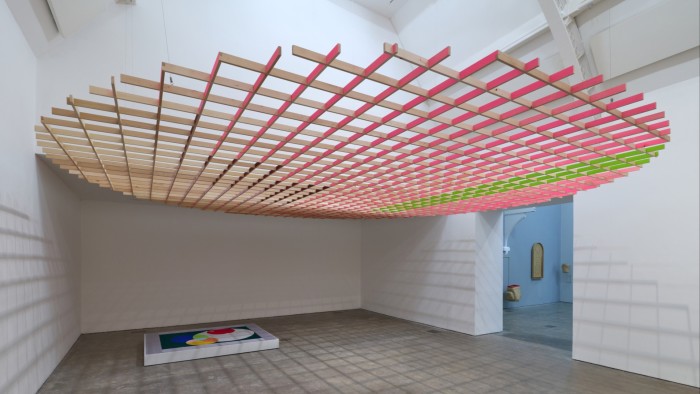
In a world so often bent on stiffening the borders between us, Span is an exhilarating subversion. A new exhibition by Seulgi Lee at Birmingham’s Ikon gallery, it unfurls as a fluid universe where line, colour and curve flow across ceiling, wall and floor through a cornucopia of materials including paint, basketweave, wood and glass. Frontierless yet profoundly rooted in the specific genus loci of its various crafts, it feels like a humane, exuberant utopian template for dystopian times.
Officially, Span starts on the second floor in Ikon’s lucent, neo-Gothic galleries. However, when I visit three days before the inauguration, it is alighting elsewhere as Lee and her collaborators, South Korean mural painters Suyeon Kim, Jaewoo Park and Jin Mo Kim, have decided to make an intervention in the reception area.
As I watch, the painters hold up a drawing on paper of a lotus flower between two rippling banners. “Here or here?” they say to Lee, moving their drawing to the left and right against the wall next to the receptionist’s desk. Once they have decided on the position, they will paint directly on to the wall. Lee turns to me: “What do you think?”
This collective, democratic spirit is the heartbeat of Lee’s practice. Born in South Korea in 1972, she has been based in Paris since 1992 but is still grounded in the cultural vernaculars of her birthland. Over the years, she has exhibited widely including at Paris’s Palais de Tokyo (2012), the Gwangju Biennale (2014) and earlier this year at Manarat Al Saadiyat in Abu Dhabi. Crucial to Lee’s process are collaborations with artisans who specialise in arts and crafts handed down through generations.
Ikon’s lotus flower, for example, has blossomed out of dancheong, a traditional style of Korean painting used to decorate wooden palaces and temples with intricate, radiant patterns inspired by plant and animal imagery.
Lotus flowers aside, Lee has radically pared down dancheong’s flamboyance. The centrepiece of the show is “Slow Water” (2022). A wooden lattice suspended from the ceiling, its visual inspirations encompass Korean munsal doors and windows, and the mashrabiyas which screen projecting windows in Islamic communities. When Lee asked the dancheong artisans to paint the slats in different colours, their work transformed the canopy into an ethereal chameleon which changes hue depending on the visitor’s viewpoint.
That protean pulse beats on through “Flying Buttons” (2025). These wraith-like trellises, painted by the dancheong practitioners, have the air of giant, abstract moths that have briefly touched down on walls and ceilings but may take flight at any moment. One impeccably extends a grid of small window panes that fills one of Ikon’s lofty Victorian arches to suggest that the architecture itself is on the move.
The gossamer-light geometries are a delicate counterpoint to “Blanket Project U” (2014-ongoing), which emerged out of Lee’s quest to find a Korean nubi blanket to gift to a friend. After struggling to find any craftspeople who practised the style she desired, which requires strips of fabric to be stitched together line by laborious line in different directions, she finally encountered Sungyoun Cho, a nubi maker in the southern coastal city of Tongyeong.
The quilt’s rigorous linear patterns and bold, saturated colours struck Lee as a potential code, its meaning tantalisingly indecipherable. Working with Cho, she developed the designs for the quilts on show in Birmingham to encode proverbs. The title of a 2018 quilt patterned with a tall lilac cone against a taupe ground gives the Korean proverb, and explains it: “My three-foot nose — I’m too ground down to help anyone else.”
More familiar to a British audience is “A piece of cake = Easy” (2025), which sees an upside-down triangle of chocolate silk wedged between a golden V with a candy-pink arch.
Lee doesn’t confine her artisanal collaborations to her birth country. From Mexico comes “W” (2017-18), a constellation of baskets whose palm-leaf thatch has been woven by female members of the Xula co-operative in the village of Santa María Ixcatlán, Oaxaca. With soft bellies and cylindrical mouths protruding from their bodies, the baskets are intimate, material expressions of local knowledge, skill and loss. Although the village was once inhabited by 10,000 people, today just four elders remain who can speak their native language of Ixcatec. “I had to create something that honoured them,” says Lee, who discovered the collective as she travelled around the region.
An artist who is profoundly attuned to the rapport between local and global, Lee has also stitched Span into Birmingham’s own cultural fabric through a partnership with jewellery-makers at Birmingham City University. The fruit of their effort is “Six Pence” (2025), a cluster of buttons fashioned from mother-of-pearl which were a staple artefact of the city’s renowned Jewellery Quarter.
Derived from oysters and mollusc shells from Asia and Australia, these lustrous hybrids remind Lee of “stars walking on clothes”. For “Six Pence”, she has embedded a constellation into the wall on which the dancheong painters have painted one of their vibrant webs. However she has also set them free. The title of her painted grids, “Flying Buttons”, evokes those murals as cartographies charting the flight of a flock of imaginary buttons from gallery to gallery.
Span, then, is a show that travels far beyond Ikon’s walls. At once grounded in material craft yet untethered to space, time or tradition, it is the vision of an artist determined to pay homage to the work of others’ hands. Unlike many conceptual artists who outsource making, Lee takes pains to credit and contextualise every artisan and collective with whom she works.
Yet for all her many collaborators, Lee’s show is resolutely her own. Choreographed like a ballet, the various works dance with each other in rhythmic equilibrium. Visitors must keep their eyes peeled for hidden treasures such as “Espan” (2024) — a silk ball embroidered by Japanese temari artisans that Lee has tucked in a ceiling niche — while “Han” (2024), lurking on a plinth beneath a window, is a diminutive glass sphere blown by Seoul glassblower Jongin Kim, who specialises in test tubes, in which a few drops of water from the eponymous Korean river have been sealed, apparently by magic as there is no join to be seen.
Such clandestine miniatures give the show a gnomic playfulness in keeping with Lee’s own beguiling personality. Although named after that time-honoured, pre-metric form of measurement between our thumb and forefinger, Span expands beyond its boundaries to open up our hearts and minds. As I leave, I notice the lotus flower at reception in full bloom.
To September 7, ikon-gallery.org
Read the full article here