

Unlock the Editor’s Digest for free
Roula Khalaf, Editor of the FT, selects her favourite stories in this weekly newsletter.
Simpson’s, the dining institution founded in 1828 and renowned for its British roasts, has reopened on the Strand. For the restaurateur Jeremy King, it’s not before time.
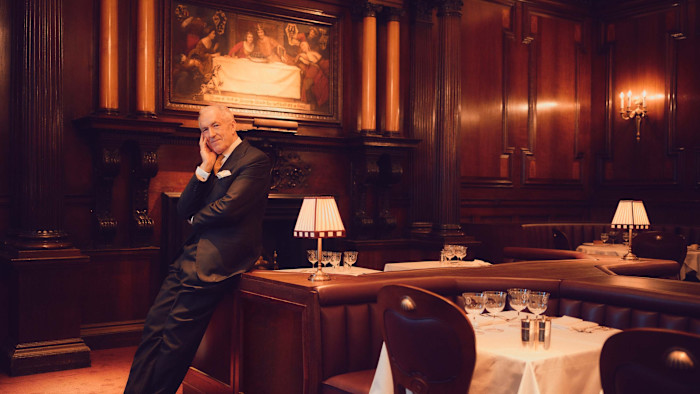
King is behind some of London’s most celebrated restaurants including The Wolseley, The Delaunay and most recently Arlington and The Park. He first made a bid to take on Simpson’s in 2000, then again in 2008 and 2015. By the time his offer was finally accepted in 2022, Simpson’s had been closed for two years. “It’s the last of the grande dame restaurants to retain its original features,” the 71-year-old explains. “Simpson’s excited me because it’s a level of restaurant that nobody could afford to do these days if starting from scratch.”
The original plan to reopen by Christmas 2024 was scuppered by a litany of problems. But today’s Simpson’s has been brought back to life spectacularly – for an undisclosed sum. Spanning 21,500sq ft, the building contains two restaurants (the Grand Divan, Romano’s), two bars (Simpson’s Bar, Nellie’s Tavern) and a private ballroom (the Assembly Room).
“The beautifully ornate mouldings, columns and mosaic flooring bring an Edwardian grandeur that feels instantly generous,” designer Shayne Brady says of the lobby. Design features draw on its history: the space features a series of new cubist-inspired murals depicting chess players that, alongside the chequerboard motifs throughout the building, nod to the venue’s role as the 19th-century home of British chess.
Directly opposite the entrance stands the famous Grand Divan dining room (where Churchill celebrated VE Day), now restored in an Edwardian style. The chandeliers, wall lights and clock are among the original fixtures that have been refurbished, while the fireplaces and grates were rescued from auction. “You’re sitting in history,” says Brady, “and it’s important that as much of that heritage be retained as possible.” Spotlight tracks add more modern touches. Says Brady: “In a Jeremy King restaurant, it is so important to make sure the tables are beautifully lit.”
The silver-domed trolleys are back in the dining room, as are the toque-hatted Master Carvers. “The Hot Trolley” roast (at £39.50) will be rib of beef, one of the more expensive orders on a “Bill of Fare” that includes pies and savoury puddings, comfort dishes such as fishcakes and bubble and squeak, and Simpson’s staples including mulligatawny soup, “tongue in cheek” (ox cheek and tongue), mutton and game. Honouring Edwardian tastes, the wine offering includes house hock, chablis, burgundy and claret. And for breakfast, kippers, kedgeree and the mother of Full Englishes, the “Ten Deadly Sins”, which includes Cumberland sausage, “eggs any style”, streaky bacon, black pudding and plenty else besides.
It’s a boon for new openings in London despite the costs and closures: according to a 2025 survey by UKHospitality, one-third of hospitality businesses are operating at a loss. Whatever the state of the dining scene in this tough economy, King has enough of a loyal following and Simpson’s a nostalgic footprint that stands it as a food and drink destination in its own historic category. At a time when London embraces cosier, more contemporary spots such as The Hart, The Devonshire and Mountain, Simpson’s is unusual. But King insists there’s room for old school glamour and theatre in London’s dining scene, and has introduced a more accessibly priced menu to bring in a mix of clientele.
The Assembly Room (a private-event space) offers the pomp of a Regency ballroom with high ceilings, large windows and murals in the style of 18th-century Swiss painter Angelica Kauffman. The neighbouring all-day restaurant Romano’s reflects a romantic scheme of faux-marble painted columns, lace plasterwork and a more relaxed menu of British classics – pork pies, scotch eggs, and smoked eel – with French accents such as veal and crayfish Marengo.
“Highlights from the Grand Divan menu include the Woolton pie, a vegetable dish that appeared on The Savoy menu during the second world war,” says group executive chef David Stevens. “And faggots, a great British dish.” Beef Wellington is also available, pre-cut, in the Assembly Room.
In the dark, art deco Simpson’s Bar, the British theme continues with classic cocktails mixed using homegrown gins, vodka, whiskies and sparkling wines. On the lower ground floor, a late-night bar for the theatre crowd (open 5pm until 3am) promises even more decadence and camp. Nellie’s Tavern takes its name from opera diva Dame Nellie Melba, whose life-size portrait hangs by the entrance. “The notion that she might have been the proprietor was my jumping-off point,” says Brady. He became convinced the legendary performer (who gave her name to both the Toast and Peach Melba) would have “loved every animal print going”. Hence the riot of animal-print velvets as well as dark burgundy leathers, oxblood panelled walls and draped fabric pendants with blue tassels. Don’t miss the house signature cocktail, a Peach Melba Sling.
@ajesh34
Read the full article here