

Unlock the Editor’s Digest for free
Roula Khalaf, Editor of the FT, selects her favourite stories in this weekly newsletter.
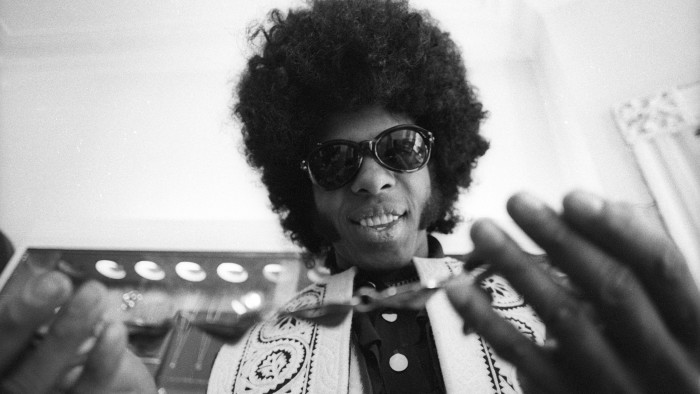
Sly Stone was a visionary musician who became trapped by his liberated lifestyle. The leader of Sly and the Family Stone, who has died at his home in Los Angeles aged 82, devised a utopian crossover between psychedelic rock and soul in the 1960s. Formed in the countercultural haven of San Francisco, his multiracial band showed straight America the funky logic of its cherished melting pot. But Stone’s brilliance dimmed as drug addiction took hold in the 1970s.
He was born as Sylvester Stewart in 1943 in Texas and grew up in northern California. Raised by devout Pentecostal parents, he formed a childhood gospel quartet with three of his siblings, cutting a record in 1956, and joined doo-wop group The Viscaynes as a high-schooler in 1961. Their racially diverse, male-female membership inspired Sly and the Family Stone’s integrated make-up.
He recruited the band in 1966 after working as a radio DJ and record producer. They were initially called Sly and the Stoners (“Sly” derived from a schoolmate’s misspelling of his first name). Prodigiously talented, Stone wrote songs, sang, played multiple instruments, did the arrangements and produced the music. His bandmates included his brother Freddie Stone and sister Rose Stone. Cynthia Robinson’s presence in the ensemble caused a British music weekly to marvel: “It’s not every group that can boast a girl trumpeter.”
During the same 1968 tour of the UK, Stone described Sly and the Family Stone’s stage act as “the spontaneous actions of people who just naturally groove together”. Based in Haight-Ashbury, the hippy movement’s San Francisco birthplace, he straddled the racial divisions scored into American music. When it was put to him that his band represented “the first fusion of psychedelia and rhythm and blues”, Stone responded: “If it has to be categorised that’s as close as it will come.”
Their first hit, “Dance to the Music”, came out in 1967. Untethered in spirit but tightly packed, it unleashes three minutes of contagiously orchestrated mayhem, with blaring soul horns, doo-wop harmonies, psychedelic guitar licks, four sets of lead vocals and heavyweight funk rhythms. In the background lay the wilder shores of the late 1960s, when Motown’s efficient production line was disrupted by raw Southern soul and long-haired underground rock displaced mop-top pop.
Sly and the Family Stone stood at the confluence of these forces: they captured lightning in a bottle. “Everyday People” reached US number one in 1969 with a flower-power message of live-and-let-live, set to the unflowery certainty of a straight-ahead drumbeat and horn fanfares. They also topped the US charts with “Thank You (Falettinme Be Mice Elf Agin)” in 1969 — a hard-grooving funk classic with innovative slap-bass by Larry Graham and another message of living as one wants.
Stone and his band were at the peak of their powers at that point. They ended the decade with their best album yet, Stand!, and a show-stealing performance at the Woodstock festival. Taking to the stage at about 3.30am after a rainstorm, Stone and his bandmates forced the bedraggled masses to their feet with a different kind of storm. “I Want to Take You Higher” barrelled from the stage in the all-instruments-blazing fashion of Fela Kuti, marshalled by a tempestuously driven Stone in bug-eyed glasses, gold chains, white jumpsuit with fringes and furry boots.
Drugs, especially cocaine and PCP, aka angel dust, were a self-destructive fuel. In interviews, the bandleader — handsome, bored or contemptuous, flamboyantly attired in red rhinestone suits and white feathery concoctions — gave monosyllabic answers in a deep, unhurried voice. He became notorious for lateness at shows, or not turning up at all. To the consternation of his label, new records dried up. But then came Sly and the Family Stone’s masterpiece.
Released in 1971, There’s a Riot Goin’ On swapped good-time funk for a bluesier, denser style. Followers were perplexed: underground magazine Creem reviewed it three times, at first dismissively, later with the highest praise (“The words on this album are better ‘poetry’ than anything the ‘rock poets’ have written”). Its songs were dredged from the failure of the counterculture in a violently divided America. Intolerance came from all sides: the Black Panthers wanted Stone to fire his white instrumentalists.
The album’s darkness also emerged from intra-band discord, exacerbated by Stone’s drug use and the gangsterism infesting his entourage. Fresh (1973) showed that his creative tank was not yet empty, but thereafter lay slim pickings. The records that followed under the Family Stone name were increasingly solo efforts of declining quality. Meanwhile, Stone’s personal life was chaotic. In 1974, he married Kathy Silva in front of 20,000 fans at Madison Square Garden, but they separated two years later when his dog mauled their son, Sylvester Jr. (Stone also had two daughters with different mothers: his three children survive him.)
Subsequent decades were dominated by the time-sapping indignities of addiction. There were arrests and periods of reclusion. Sporadic efforts at comebacks came and went. But he remained a crucial influence for younger musicians, notably Prince. Samples of Sly and the Family Stone are threaded throughout hip-hop in much the way that sayings from Hamlet or the Bible turn up in common speech. “They get uptight when you get too bright,” Stone sang in his group’s 1967 debut, A Whole New Thing. He burned too brightly and too briefly, but what he lit up was immense.
Read the full article here