

Unlock the Editor’s Digest for free
Roula Khalaf, Editor of the FT, selects her favourite stories in this weekly newsletter.
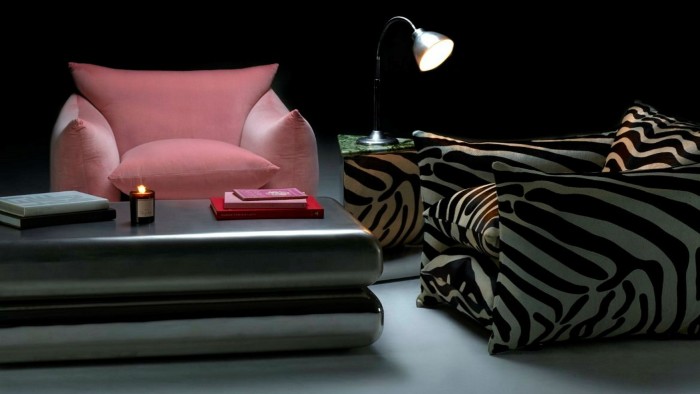
In Angus and Charlotte Buchanan’s light-filled studio there is a surprising new addition. Squeezed in between a pair of the husband-and-wife design duo’s signature voluminous and squishy sofas, in punchy stripes and faded floral linen, is a similarly curvaceous ottoman — it’s not fabric-covered, however, but made from stainless steel. Built in two tiers, the lower layer has a mirror polish that “delivers distorted reflections of the room in a slightly surreal way”, says Angus. “The finish transforms a quite classic shape into something more sculptural and unexpected.”
Stainless steel and its sibling silver-toned metal, aluminium, have become de rigueur in smart kitchens. Now they are increasingly making their way into more cosy spaces — as standout pieces of furniture as well as edgy focal points, from fire surrounds to huge sweeping staircases.
“Raw metals like aluminium stand in contrast to conventional interiors,” says Basel-based French designer Raphael Kadid. It’s a metal he has used repeatedly in his industrial-style lamps and bookshelves, citing its “pragmatic beauty”. That’s a sentiment reflected in the French designer Pierre Lacroix’s inaugural furniture collection with Etēline; called Timeless, it features an elegant steel dining table and stools, and a sleek, boxy steel sofa.
While aluminium was discovered in 1825, and English metallurgist Harry Brearley is widely credited as having invented the first stainless steel alloy in 1913, it was during the art deco period that designers really began to explore their aesthetic potential.
The 38-metre spire of the Chrysler Building is famously clad in stainless steel, and the material became a signature of the modernist movement, embraced by designers such as Marcel Breuer, whose Wassily chair was inspired by the tubular steel of his bicycle, and Eileen Gray, whose Table E 1027 combines steel and glass. In the 1960s, French designer Maria Pergay pioneered the use of stainless steel in more sculptural ways — folding and manipulating sheet metal into sinuous chaise longues and bowlike seats.
Steel has been a feature of striking interiors ever since. Natalie Sytner, founder of homeware brand Bettina Ceramica, remembers the 1970s stainless steel teacups that her Italian mother owned and loved, and has recently created her own version: the Gia cappuccino cups. “They were commonly used in Italian family-run cafés and now feel like a fresh and contemporary addition to my kitchen at home,” she says. “They’re a perfect contrast to traditional ceramics.”
In the 1990s, German designer Andreas Weber’s apartment in Munich featured an austere-looking steel side table rising spaceship-like in the corner of a room, while a futuristic bathroom created by architecture studio Tsao & McKown in 1995 featured a stainless steel toilet and sink inside a tent-like room. Calvin Tsao, one of the founders, says they drew inspiration from early Bauhaus designs, but instead of “everything being hard, we contrasted hard and soft”.
Many fear that metal can have a cold look, but the key, says Niels Strøyer Christophersen, is in how you style it. The founder of the multidisciplinary Danish design brand Frama suggests that pieces like its stainless steel Shelf Library System and its Rivet Box (which can be used as a bedside cabinet) work best mixed into “a more messy and chaotic atmosphere full of books, incense, sculptures, objects, or mixed with vintage and pieces in warm and dark brown woods or stone”.
It’s a combination that has recently been mined by interior design outfits such as Los Angeles-based Studio Preveza, which paired a sleek steel bed with burl wood side cabinets in the bedroom of an LA home, and New York’s Bond design studio, which steel-clad an original fire surround in a 1920s Chelsea apartment.
Others are integrating metal features into the fabric of a room. While wall panels have been used by Ukrainian architect Nastia Mirzoyan to line a Kyiv hallway, and by Milanese interior designer Fabrizio Casiraghi in a Parisian living area, Brazilian designer Marina Cardoso de Almeida installed a central steel column in a São Paulo apartment.
The raw silvery finish is certainly most popular, but it’s not the only option. At Milan Design Week in April, Kadid displayed an anodised aluminium shelving system in a swirl of bright colours.
The material’s benefits aren’t only aesthetic. It’s incredibly durable and hard-wearing, as well as endlessly recyclable. Plus “it’s hard to believe, but in New York stainless steel work is less expensive than millwork”, says Noam Dvir, co-founder of Bond.
“It’s just a really cool material,” says British interior designer Hollie Bowden, whose steel features range from statement staircases to subtle wall lights. “I’m always keen to juxtapose something romantic and something more masculine, and steel really beefs up a space. It just makes it more interesting.”
Find out about our latest stories first — follow @ft_houseandhome on Instagram
Read the full article here