

Unlock the Editor’s Digest for free
Roula Khalaf, Editor of the FT, selects her favourite stories in this weekly newsletter.
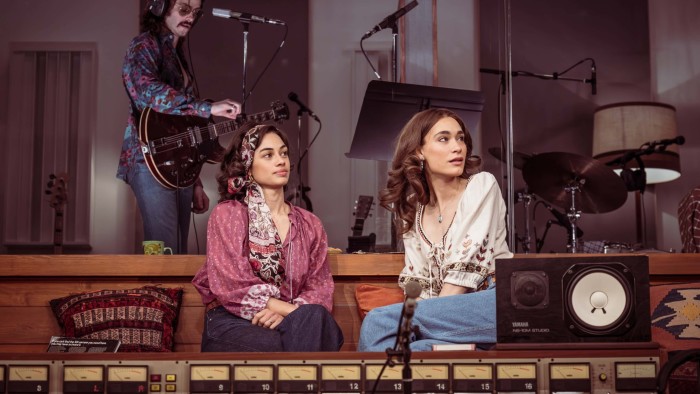
The coffee machine is broken, the bassist is drunk, no one has slept in weeks and the sound engineer faked his résumé to get the job. You can almost smell the stale cigarette smoke and tired air in the 1970s Californian studio. And yet the band — whose name we never learn — are climbing the charts; the record company, encouraged, extends the studio rental. They have all the time in the world to record their new album. Paradise? Or purgatory?
David Adjmi’s superb, gorgeously textured drama — which scooped a hatful of Tony Awards after its first New York run and is brilliantly staged here by Daniel Aukin and an outstanding cast — sinks us into the creative fever dream that follows, as weeks spool into months and the makeshift family of artists tears itself apart in pursuit of perfection.
Fame snaps at the heels of the five-strong British-American band, the pressure of success sucking the joy out of music-making and shredding already tense relationships. Boozing, philosophising bassist Reg (Zachary Hart) and his exasperated wife Holly (Nia Towle) are splintering; drummer Simon (Chris Stack) misses his family. Most problematically, the controlling perfectionism of lead guitarist Peter (Jack Riddiford) is driving a wedge between him and his partner Diana (Lucy Karczewski), a gifted but vulnerable singer-songwriter. The hermetically sealed studio becomes a microcosm — of the era, the music industry, sexual politics — and much more besides.
The natural comparison is Fleetwood Mac, but the play’s scope is bigger than that. And while sagas of backstage bust-ups and troubled artists are nothing new, Adjmi brings something deeper, steeping us in the granular detail of the creative process: the craft and the graft, the exhausted wrangling and the sudden soaring ecstasy of the perfect take.
It’s not a musical, although Will Butler (formerly of Arcade Fire) creates several songs that could grace a hit album, including the fabulous, driving “Masquerade”. Rather, it’s a drama about music — what it means to us, why we care — including that strange alchemy by which personal pain and discord can produce extraordinary art. The first half ends with the hauntingly lovely “Bright”, sung exquisitely by Karczewski, which transmutes all the torment into something transcendent and beautiful.
None of it would work without an exceptional cast, all of whom play or sing, and all of whom trace their characters’ shifting emotional states in incremental, often understated detail. In Riddiford’s Peter we see the damage behind the drive and the exact moment when he realises Karczewski’s Diana will leave him. In her there is steel beneath the fragility; in Towle’s Holly, insecurity behind the breeziness. There’s wonderful comic work from Hart as Reg, from Andrew R Butler as assistant engineer Charlie, and from Eli Gelb as chief engineer Grover, who quietly becomes the hero of the piece.
Adjmi’s script comes in somewhere between Chekhov and the slow-burn dramas of Annie Baker, gradually building towards something much greater than the sum of its parts. Ryan Rumery’s sound design is meticulous; Enver Chakartash’s 1970s costumes are a joy and David Zinn’s tan and tangerine set brims with lovely period detail.
Central to that set is the huge manual mixing desk, where sits the long-suffering Grover, trying to find something listeners can lose themselves in. It takes time to realise that his view is our view. And in the end, this is a drama about the very human search for something bigger than ourselves.
★★★★★
Booking to September 20, stereophonicplay.co.uk
Read the full article here