
Style icon Farida Khelfa: ‘It’s so crazy to have all those clothes sleeping in the closet’

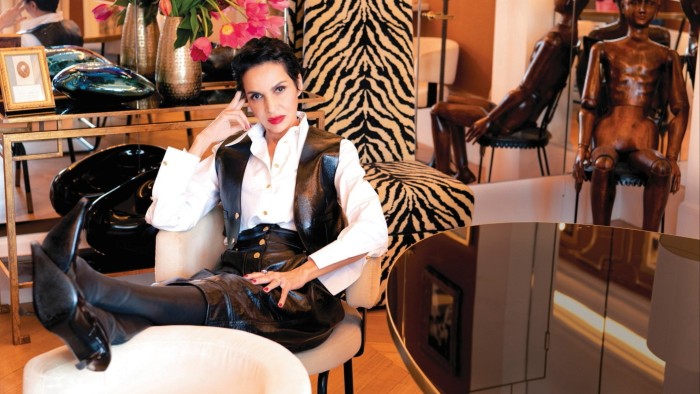
Farida Khelfa is laughing. She’s remembering her late friend, the great designer Azzedine Alaïa, specifically his obsession with clothes. “He was sneaking outside, saying ‘I’m going to see the dentist’. He was going to the dentist three times a week. And he was coming back with all these dresses and hiding them.” She’s amused, and incredulous. “I don’t have the same bond with clothes.”
Nevertheless, the 65-year-old former model and style aficionado has amassed a significant fashion collection, to be auctioned by French auction house Maurice Auction. The 182 pieces reveal her intimate relationship with some of Paris fashion’s greatest houses — including Alaïa, Jean Paul Gaultier and Schiaparelli — illustrating both the evolution of French style and her own place at its epicentre. “I’ve had some pieces for 40 years,” Khelfa recalls. “So it’s nearly a history of fashion.”
Many of the pieces are jaw-dropping, a sweep through some of the greatest hits of the past half-century — Khelfa’s Alaïa collection alone totals 92 lots. “I know there are some museums who are interested by certain pieces,” she says — which could be items like a Gaultier haute couture bodysuit from his 2012 “Hommage à Amy Winehouse” collection (lot 115), or a one-off Alaïa ballgown worn to a dinner at the Élysée palace (lot 86). There are also curvaceous suits by that designer, and a brightly coloured houndstooth-print jacket and jersey body with the cut-price, mass-market French retailer Tati for the spring/summer 1991 collection, over a decade before H&M teamed up with Karl Lagerfeld.
Given Alaïa’s collaboration with Tati, I couldn’t help but wonder about her thoughts on the physical retail debut of Chinese mega-mass retailer Shein in the French capital. “Let’s say Shein is the Tati of today. It’s fast fashion, but it’s also cheap fashion. And people don’t have money to buy expensive things,” she says, magnanimously. Khelfa was, after all, an official witness to the Bruni-Sarkozy wedding, so diplomacy is natural. “I cannot say I’m against fast fashion because I was living in fast fashion. So yes, people have to be dressed.”
Why did she decide to sell her clothes now? “I did a photo shoot for a magazine with my collection, two, three pieces, not a lot. And when I saw it, I thought — oh, it’s so crazy to have all those clothes, they’re sleeping in the closet. Sleeping beauties. I thought, I have to do something. I released a book, my personal book last year. And it was all about my childhood and of course my beginning in the fashion world. And it was a way of getting rid of my past.”
If Khelfa’s collection illustrates a life entwined with fashion, she was actually born far away from it, to parents recently immigrated from Algeria in north Africa and living in the Minguettes, a social housing project in Vénissieux, a suburb of Lyon. Known for high poverty rates, the Minguettes was also the birthplace of the March for Equality and Against Racism that swept across France in 1983 in response to an outburst of racially motivated crimes in the country. It was the first time vehicles were burnt as a protest in France. It’s also an ideological million miles from the influential circles she moves in now: she is married to Henri Seydoux, founder and CEO of French drone company Parrot, with whom she had two children and two stepchildren, including actress Léa Seydoux.
Khelfa’s debut book, Une enfance française (A French childhood), explores her memories of that place. And, in connection, Khelfa has elected to donate the proceeds of the auction to the charity Fond RIACE France. “They help refugees,” says Khelfa. “Especially the children, they’re taking care of them. So for me this was also to give back, what was given to me. I feel I was very, very lucky in life.”
Khelfa’s luck began in the 1970s, when she left Lyon and came to Paris. Her towering presence — literal, and ideological — and sense of personal style attracted the attention of Fabrice Emaer, the owner of Le Palace nightclub: “The French Studio 54,” in Khelfa’s words. Thierry Mugler designed the waiter’s uniforms and Khelfa ran the door at the club, deciding who would be admitted and who excluded based on style. Those allowed in included Mugler, of course, alongside Yves Saint Laurent, Karl Lagerfeld and a young designer named Jean Paul Gaultier, who met Khelfa there in 1979 and recruited her to model for him.
“Jean Paul Gaultier saw me at Le Palace, and Thierry also, and they loved the way I was dressed. I was always wearing huge earrings, my hair with a big bandana in front, very curly. Wearing ski pants with high heels, and the jacket of the American Marines.” I tell her I know a Gaultier collection that looks just like this. “Exactimo! So it was very funny because he loved the way I look, and he was inspired. When I did my first show, suddenly I was panicked. I said, ‘What should I do? I don’t know what to do?’ He replied ‘Just walk. Walk as if you are in the street.’ And I walk like if I was on the street — I walk really sort of badass that I was at the time. I still have a little of that,” she laughs. “I was chewing gum. He loved it. We were exactly the opposite of couture.”
Khelfa’s instantly identifiable style — later cemented by images of her created by her one-time partner, French photographer Jean-Paul Goude — became an emblem of anti-establishment French chic for the upstart crop of fashion enfants terribles. Gaultier, Alaïa, Mugler — now all household names. Laughing again, she reflects on a moment of travelling with Gaultier to Japan for a fashion show in 1986, where every model had been made up like her, with curled hair and full red lips.
A coat by Alaïa was worn at a show at the Palladium nightclub in New York in 1985. “And that coat was inspired, at least the short version, from Les Enfants du paradis, the dress of Arletty,” Khelfa recalls. “It’s the history of French cinema, too, of the world of cinema.” Indeed, for her each piece is imbued with a specific memory. “Fashion is a bit different today. It’s not the same. It was more artisanal. Today, it’s an industry, you have to sell bags, you have to sell leather goods. It’s very important. There is not so much space for the fantasy, for the creativity, because you have to sell. You have to think about the economy,” Khelfa says.
She betrays her insider status there — after leaving modelling, she became the head of the Alaïa studio under the founder for seven years starting in 1996, then the director of Jean Paul Gaultier’s haute couture salons in 2003. Latterly she has transitioned to film, making documentaries that have examined stereotypes of women in the Middle East, the fall of Tunisian president Zine el-Abidine Ben Ali, and about friends such as Gaultier and the shoe designer Christian Louboutin.
“I don’t look at the past with nostalgia. For me, the past is the past. And today is today. And we will find some new ways of doing fashion and express ourselves. And of course, the young people, I’m very impressed. There is so many people [who] really love their fashion.” Indeed, this auction is being released at a time when interest in vintage is at a rampant high and red carpets are filled with archival gowns.
Khelfa mentioned museums wanted to snap her looks up. Does she prefer the notion of institutions and couture collectors buying her clothes, or them being worn on the street? She purses her lips. “I remember Jean Paul, someone asked him, ‘what was your worst show?’ He said, ‘when I show only the clothing, no models, any models.’” That was a reference to Gaultier’s autumn/winter 2004 collection, shown on dangling life-sized marionettes. “And he said it was horrible. It was the worst. And I feel the same way. I think the clothes have to be worn, because otherwise it’s just a dead piece of fabric.”
And would she like people to be dressed in her clothes? “Certainly. C’est la vie. I love the idea that someone else is going to wear it.”
Online Auction from November 20 to December 11, 2025 at 2pm, mauriceauction.com
Follow us on Instagram and sign up for Fashion Matters, your weekly newsletter about the fashion industry
Read the full article here