

Lee Miller was sensational, on both sides of the camera, on both sides of the Atlantic, in war and peace. Fate gave her all the gifts — beauty, brains, bravery, and an acute eye. She used them to the hilt in a career that began in New York aged 19 as Vogue’s cover model, then took her to Paris as a surrealist artist, Cairo as a businessman’s wife (that didn’t work out), London as a photojournalist during the Blitz, and Europe in ruins, from Brittany to Buchenwald to Budapest, as one of very few women war reporters.
She is fortunate, too, in her largest ever UK retrospective, at Tate Britain. Incisive and sensitive, it celebrates the multi-faceted richness of her work, the powerful vision unifying its different strands, and her vitality as a female pioneer exhilarated to portray her friends similarly breaking barriers. Pilot Anna Leska in the cockpit of a Spitfire, war photographer Margaret Bourke-White, grinning under the wing of a bomber aircraft, novelist Colette in recently liberated Paris, “the last glimmers of light . . . imprisoned . . . in the glistening whites of Colette’s eyes”, are among her liveliest portraits.
Miller met desolation with wit and recorded daily life with an inventiveness that still unnerves. Breasts severed in a mastectomy are served up on dinner plates. A crucifixion column covered in mangled wire against a dull Strasbourg sky is titled “Hotline to God”.
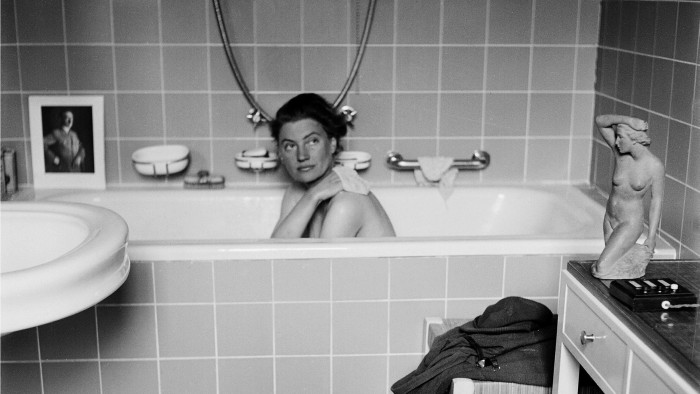
Fingers pushing the glass doorknob of a Paris parfumerie become, in a close-up trick of light, “Exploding Hand”. She staged her own portrait washing off the dirt of Dachau while lying in Hitler’s bathtub. The showerhead is just visible, alluding to Dachau’s gas chambers disguised as bathrooms: the banality of evil.
In the London Blitz, Miller photographed a smashed stone angel, brick crushing breast, neck cut by a metal bar, and called it “Revenge on Culture”. She had a lot to avenge, for fate balanced its bounty with terrible misfortune. At seven Miller was raped by a family friend and infected with gonorrhoea, painfully treated for years. During her teens, she modelled nude for her amateur photographer father, images which, her son Antony Penrose wrote, “definitely transgress the child-parent boundaries”.
She was a young teenager when she saw her boyfriend drown in a boating accident, 17 when her mother attempted suicide, and 22 when she turned up in Paris and announced herself to Man Ray as his new student. “Man said, ‘I don’t have students.’ He was leaving for Biarritz the next day, and I said, ‘So am I.’ I never looked back!” She became famous as his muse, collaborator, lover and, Time magazine wrote in 1932, “the possessor of the most beautiful navel in Paris”.
Tate’s opening galleries show Miller the ravishing model, androgynous looks, chiselled features and cropped blonde hair making her an ideal shape-shifter between many (male) 1920s fantasies: classical statue for Edward Steichen, art deco yachtswoman for Vogue’s George Hoyningen-Huene (“Lee Miller wearing Yraide sailcloth overalls”), “a sun-kissed goat-boy from the Appian Way” for Cecil Beaton.
That playfulness and flexibility informed her own photographs in the 1920s and 1930s as she mastered the incongruous compositions, irrational juxtapositions and distorting angles with which surrealism made the everyday strange and threatening. An upside-down limbless body seems about to dissolve in “Nude Bent Forward”. A close-up finger and thumb jab through an inflated latex bubble in “Condom”. A pair of shoes and oozing tar puddle evoke the shadow of death on a quiet Paris street. The desert near Siwa, Egypt, is seen through a veil of ripped mosquito netting resembling jagged glass in “Portrait of Space”.
In the second world war, when the horror of reality outdid surrealism’s most violent imaginings, Miller redeployed those techniques. An accredited photojournalist for British Vogue from 1940, she was expected to prove that “Vogue’s entire world [can] carry on even amid such wreckage”. “Model wearing Digby Morton suit” stands trim in an arch framing collapsing buildings. Her editor approved: “the skirt is straight and narrow, as we feel all skirts will be in the future owing to the rationing of materials.”
But asked in 1944 to record resurgent modish Paris, Miller offered “Bullet-splintered glass in a café”, a young woman with bouffant coiffure and manicured nails at a bar where “the bullet holes in the windows were like jewels, the barbed wire in the boulevards a new decoration”.
So, inexorably, the chronicler of fashion became the chronicler of fascism and its aftermath in 1945-46. With her Rolleiflex, which had no zoom lens, Miller shot close-up and intimate: “Dead deportee beside the rail track” in Dachau; the slumped corpse of Regina Lisso, dead by suicide, still sporting Nazi insignia, in “The deputy Bürgermeister’s daughter” in Leipzig. Miller climbed on a train piled with corpses for “US soldiers examine a rail truck load of dead prisoners”; the soldiers are proxies for our own shocked gaze, questioning the making and viewing of such spectacles.
“I IMPLORE YOU TO BELIEVE THAT THIS IS TRUE,” Miller cabled Vogue. The most surreal thing about her career was that her Holocaust pictures were published there. Afterwards, frighteningly, the need to uncover horror grew addictive: she pushed on east after most war journalists had left, to Austria, Hungary, Romania.
There’s a noirish Third Man quality to her Vienna photographs: the shadowy State Opera almost abstract in its extreme ruins, and an opera singer performing like a ghost in the relics; infants dying in the children’s hospital against “the dark dusty blue of these waltz-filled Vienna nights, the same colour as the striped garb of the Dachau skeletons”, and on the streets a cross-eyed squinting child, “Boy wearing Scharnhorst cap”, memorialising the battleship Scharnhorst which sank in 1943. The ambivalence, between defiant patriotism and innocence, disturbs.
“We might as well have a look at who were [sic] going to fight 20 years from now,” Miller wrote. There’s no sentimentality, rather a splinter of ice in the heart; Miller’s son insisted: “Lee had trouble loving anyone.”
She returned to England with what we would now call post-traumatic stress syndrome; depression and alcoholism marred her later years. She married her second husband, collector Roland Penrose, and gave birth to her son in 1947. “I didn’t waste a minute, all my life,” she wrote the night before, “but I know that if I had it over again . . . above all I’d try to find some way of breaking down through the silence which imposes itself on me in matters of sentiment.”
That restraint translates into her pictures, which are cool, courageous, hard to love but easy to admire, in themselves and as an oeuvre unfolding a seize-the-moment life of urgent curiosity and tremendous resilience, marvellously recorded here.
To February 15 2026, tate.org.uk
Find out about our latest stories first — follow FT Weekend on Instagram, Bluesky and X, and sign up to receive the FT Weekend newsletter every Saturday morning
Read the full article here