

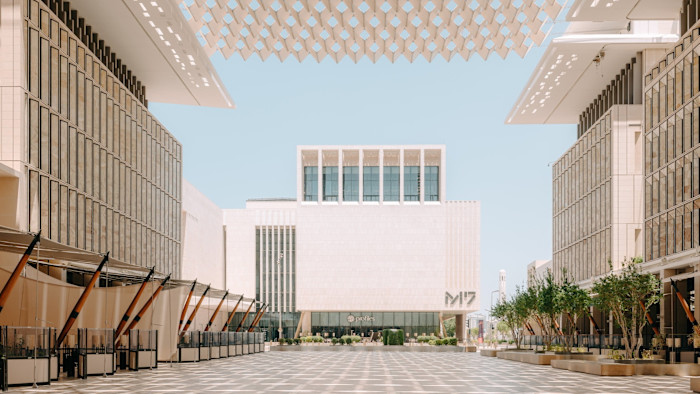
For the art market, there’s a lot riding on the small but rich nation of Qatar. Despite significant instability in the wider Middle East, the latest drive from an otherwise depressed sector intensifies next week with the launch of the venerable Art Basel fair in Doha (February 5-7).
With 87 exhibitors, spread across three buildings in the revamped city hub of Msheireb Downtown Doha, the fair comes on the back of accelerated activity in the Gulf. This includes Sotheby’s debut auctions in Saudi Arabia, after a sizeable investment from the Abu Dhabi-based sovereign wealth fund ADQ. Meanwhile, the Frieze fair franchise, Art Basel’s main competitor, joins the fray and will host its first art event in the Middle East later this year, through a partnership with the existing Abu Dhabi fair. The moves follow a raft of high-spec museum projects, driven by the ruling families, and expected to be crowned this year with the long-awaited opening of the futuristic, Frank Gehry-designed Guggenheim Abu Dhabi.
The promise of a burgeoning and affluent audience is enough of an appeal to a beleaguered commercial sector. The latest sentiment check by the analysis firm ArtTactic found the greatest confidence for the Middle East and North Africa (MENA) region, for which 76 per cent of art market participants expect improved sales, against an average globally of 51 per cent.
“I’m naturally drawn to the parts of the art world that are still forming. Other places and ideas are becoming a bit ossified,” finds the gallerist Niru Ratnam, who compares the Gulf region’s high energy levels around culture to London’s in the early 2000s.
For his first Art Basel showing, Ratnam brings to Qatar a 22-screen video work by the Turkey-born artist Kutluğ Ataman (“Mesopotamian Dramaturgies / The Stream”, 2022, £180,000), and expects “a core of Middle East curators and collectors. Plus, because it is Art Basel, some more international people, certainly more than in my small Soho gallery.”
The avant-garde work, which charts Ataman’s 10-year career break to run his family’s livestock farm in Anatolia, will sit alongside solo booths of safer, more traditional works, including heavy hitters Pablo Picasso (Van de Weghe gallery), Jean-Michel Basquiat (Acquavella) and Philip Guston, including his late, cigarette-filled self-portrait, “Conversation” (1978), priced at $14mn (Hauser & Wirth).
Not everyone is on board. For a start, the fair is very small — chief executive Noah Horowitz describes it as a “curated snapshot” (the flagship Basel fair had 289 exhibitors in June). Others chose not to apply, facing an already busy 2026 by the time the Qatar launch was announced. “Our projects and timings didn’t quite align for the inaugural edition,” says the London gallerist Pilar Corrias, though adds that “the moment feels right for the fair and I can certainly see us participating in future editions.”
Some gallerists have privately voiced concerns over the regime’s rules against same-sex activity, illegal in Qatar, and its workers’ rights record, for which it was criticised during its 2022 hosting of the football World Cup. Issues of self-censorship, at least, seem inevitable, though exhibitors say that Art Basel has not issued any advice on what they should or shouldn’t bring. Their gallery selection process is, however, based on project proposals received in advance.
Ratnam says that “in recent times, I’ve thought more about [censorship] when entering the US [he showed at New York’s Independent and Armory fairs] and that I might get stopped at immigration” — he was born in Sri Lanka and has Tamil heritage. “I had my lawyer’s number on my phone,” he says. Wael Shawky, the artist who is director of the first Art Basel Qatar, recently told Cultured magazine that “There is a culture, and it’s normal that we respect the culture . . . What I see here in Qatar, now, is much more generous than what I see in many places in the world today.”
There are separate concerns that chasing wealth is not always a successful strategy when it comes to creating a healthy art ecosystem. “There appears to be a tendency among the more influential segments of the art trade, particularly major fairs and auction houses, to cluster in tax havens,” says James Goodwin, author of The International Art Markets (2009). Qatar, as well as the UAE and Saudi Arabia, has no income tax for residents and attractive corporation tax regimes. Goodwin finds that “historically, international art markets have tended to develop through stages: countries first trading in their own art, then foreign art, and ultimately engaging with the international avant-garde.”
Galleries in the region reject the flash cash narrative, characterising instead a well-timed step change. “I’ve run a gallery for 18 years and we’ve seen the region developing,” says Mohammed Hafiz, co-founder of Saudi Arabia’s ATHR gallery. “When we started, there was [the] Sharjah [biennial], and Art Dubai was the only fair. Now we see three biennials in the region, a lot of activity around new museums, all these fairs — many promises made around a decade ago are now materialising,” he says. To Qatar, he brings photographs by the acclaimed Saudi-born artist Ahmed Mater that offer bird’s-eye views of the forces shaping the holy city of Mecca, priced mostly between $35,000 and $55,000.
The Tunis-based gallerist Selma Feriani, who brings thickly painted images of North Africa’s bold flora by the Tunisian-American Nadia Ayari ($30,000-$45,000), says that not only is there more collecting within the region’s existing communities, but that “we have clients who have moved from Europe to the Middle East, from London to Dubai or Abu Dhabi. Once they are in the MENA region, they visit private collections and institutions and broaden their collecting vision accordingly.”
Hafiz acknowledges that “the infrastructure is still being built,” particularly when it comes to commercial galleries, who mostly cluster in Dubai, whose art fair marks its 20th anniversary this year. “When you develop an ecosystem, it needs columns to stand on. You can’t build each column at the exact same speed as the one next to it. In some countries, maybe the market moves faster than the institutions. In this part of the world, the institutions move faster than the market.” Art Basel’s Horowitz notes that, on the back of the football World Cup, “a hospitality and logistics infrastructure has been built to accommodate huge crowds,” including Doha’s expanded Hamad International Airport.
Hafiz says that the region “doesn’t require more effort, but a different set of efforts”. His call to the fairs, galleries and auction houses coming in is that “you have to be in it for the long haul, because we are building this together.”
February 5-7, artbasel.com
Read the full article here