

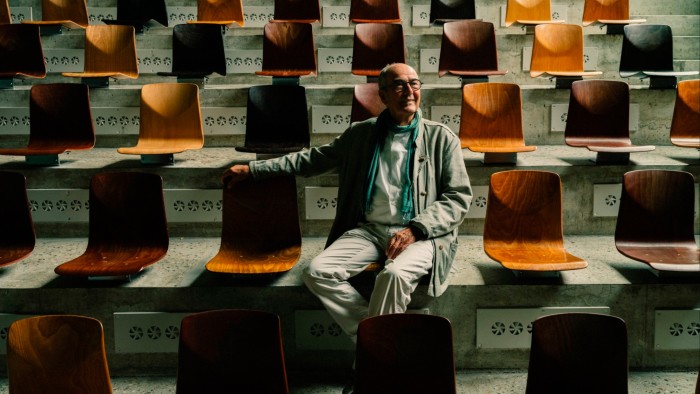
It was growing distaste with the state of the art world that made Hans Schöpflin take matters into his own hands.
“I really believe in aesthetics. I believe in beauty,” says the 84-year-old German investor and philanthropist, who is both an art collector and a crusader against the excesses of capitalism. “But . . . contemporary art has turned into a market, into consumption.”
Along with his friend Osvaldo Sánchez, a Cuban-born curator, he found himself asking: “What’s the purpose of art? Really, what is it?”
Their answer was the Spore Initiative, a “socio-ecological space” that eschews big names in favour of the work of local artists, craftspeople and even children, often from countries outside the global north.
It opened two years ago in the diverse Berlin district of Neukölln and has become a magnet for the local community, filled at weekends with young families and hosting weekly sessions for Latin American singing groups or Arab dabke dancers.
It has also emerged as a refuge for those reeling from Israel’s war in Gaza, becoming a rare space in Berlin’s cultural scene where the conflict can be openly discussed, critiqued and explored.
Schöpflin, a wiry man who pairs his white collarless shirt and beige trousers with striped socks and walking shoes, is proud of the result. “This is not about consumption,” he says. “This is about really engaging with communities and creating the opportunity for dialogue.”
Spore is the most ambitious project yet in a 30-year voyage in philanthropy for Schöpflin that began when his son died of a heroin overdose at the age of 19.
Originally from a small town on the German-Swiss border, Schöpflin had spent the previous two decades pursuing a career in venture capital on the west coast of the US.
He made millions through early bets on companies such as the technology company Qualcomm and the pharmaceuticals group Actelion.
Though he was, he says, never really interested in having “the biggest car, the biggest house”, he says he did want to create wealth. He also, he suspects, wanted to prove to his grandfather that he was better than his father, who had run the family mail-order business into the ground.
The death in 1995 of his middle child Axel — a smart, intellectual boy who “knew every philosopher” — changed everything. “It was a fork in my road,” he says from his wooden armchair in Spore’s oak-panelled library, leaning forward and locking his fingers together as he struggles to find the words to revisit the pain.
Schöpflin says he had to face accusations, from others and from himself, that his son would still have been alive if he had devoted more time and attention to his family.
He took a two-year break from business, found Buddhism and emerged with a clear conclusion: “There’s more than just making money; you have to give meaning to the money.”
It marked the beginning of a new philanthropic path and also ignited an underlying politicisation. The venture capitalist became an unlikely supporter of campaigns against corporate giants such as Nestlé, which appalled him by bottling and selling precious Californian water for profit. He even got tear-gassed as he joined the “Battle of Seattle” anti-globalisation protests of 1999.
Back home in Germany, he joined forces with his two siblings to set up a family foundation, launching a respected drug and alcohol prevention programme. Later, they also began funding projects aimed at promoting independent journalism free from corporate influence.
Spore marked his entry on to the stage of the German capital. When a plot of land in front of a Protestant cemetery in Neukölln came up for sale, he leapt at the chance. “We instantaneously said: this is fantastic here.”
Today, the €23mn centre’s rust-red brick facade sits on a busy street across the road from a Turkish grill, an Arab jewellers’ shop and a hipster coffee roastery — a microcosm of the local demographic.
Those environs felt very raw in 2023, just six months after Spore opened, when the October 7 attacks by Hamas killed some 1,200 people in Israel and the shockwaves reverberated throughout Germany, including in the arts.
The war in Gaza that followed has become a deeply fraught subject in a country where atonement for the Holocaust, the defence of Israel and the protection of Jewish life in Europe is a central pillar of the nation’s postwar identity — taught to every child in school.
The art world was rocked by the cancellation of a string of events by artists, filmmakers and authors whose views on the conflict have been deemed unacceptable, including by supporting the Boycott, Divestment and Sanctions movement.
The leftwing cultural centre Oyoun, not far from Spore, lost its annual €1mn in city funding after refusing to cancel an event by a Jewish group that was highly critical of Israel. It moved out of its premises at the end of last year.
Defenders of such steps say that they are an essential response to what Germany’s antisemitism commissioner has called a “tsunami” of hostility towards Jews since October 7. But critics — Schöpflin among them — say that Berlin got “caught in this German storyboard” of equating criticism of the Israeli government with antisemitism.
Spore’s response was to declare an open invitation to voices that were being “silenced” in Berlin, with a promise of “listening, facilitating, and encouraging spaces for dialogue, with honesty, solidarity, empathy and care”.
Since then, it has hosted events questioning Germany’s response to the Gaza conflict, with guests including the Swedish climate activist Greta Thunberg and the Indian essayist Pankaj Mishra, as well as Jewish and Palestinian voices from Germany and beyond.
“We have the advantage that we have no public funding, so we don’t have to be afraid,” says Schöpflin.
Two of Spore’s exposed concrete and oak wood exhibition halls are currently hosting exhibitions by Palestinian artists and grassroots collectives, bringing together the centre’s focus on land and ecology with the current conflict. They freely use contentious language such as “genocidal violence” and “erasure” to describe what is happening to Palestinians — terms that are fiercely rejected by Israel and its supporters.
Schöpflin himself has no role in planning the events or exhibitions. That falls to artistic director Antonia Alampi and her team.
Alampi says the war in Gaza has changed the debate in the arts over public funding, which until very recently was widely seen as “problematic”. Now, she notes, it has become clear how an over-reliance on public money can also be damaging.
She is also struck by how Spore’s founder and benefactor has been shaped by his four decades living in the US before returning to Germany in 2013. He and others who have spent long periods abroad have a “very different relationship to the German political present and past”.
Schöpflin believes that, overall, Germany has done “an exemplary job” in accepting its responsibility for the second world war and learning from the past — especially compared with former colonial nations such as Britain and France.
But, when it comes to Israel, he feels that “for a long time, Germany seemed to be caught by its guilt over its terrible history” during the Nazi era.
He has been encouraged by conservative chancellor Friedrich Merz’s decision this month to impose a partial arms embargo on Israel — even as it has been met with a huge backlash within the German leader’s own party.
Schöpflin says: “I think it’s important that Germany is no longer afraid to say that we support Israel’s right to defend itself — while at the same time speaking out about the devastating situation of ordinary people in Gaza.”
spore-initiative.org
Read the full article here