

Unlock the Editor’s Digest for free
Roula Khalaf, Editor of the FT, selects her favourite stories in this weekly newsletter.
It’s a ride
Eight years after Bose’s first SoundLink Micro speaker, here’s an upgraded version. It’s very slightly bigger, with USB-C charging, upgraded Bluetooth (5.4) and a Velcro strap to attach it to handlebars, tree branches, bags, etc. For its dinky size, the sound is surprisingly loud, and ideal for transforming tinny smartphone audio into something punchy and expansive (there are, of course, inherent limitations to a 10cm by 10cm mono speaker). There’s an app, but unless you find the EQ unpleasant (unlikely) or you’d like to pair it with other Bose products to deliver multi-speaker audio, you’re unlikely to need it. It no longer has a mic, so you can’t take calls on it – but that’s hardly a deal-breaker. Maybe even a bonus.
Ear me now
It’s astounding that these are Loewe’s first over-ear headphones, after more than a century of making audiovisual products, but they are worth the wait. I don’t know whether Kylian Mbappé’s endorsement necessarily signifies high audio quality, but they do indeed sound exceptional, while their slim form and cushioned leather earpads make them supremely comfortable to wear. I love the ergonomic controls (rotatable wheels on each earcup for volume adjustment and track selection), and the Loewe app offers extensive customisation options, including noise-cancellation levels, spatial audio settings, a hearing test to fine-tune EQ, and Loewe’s own AI assistant. A test product that I was very sorry to send back.
Shake the room
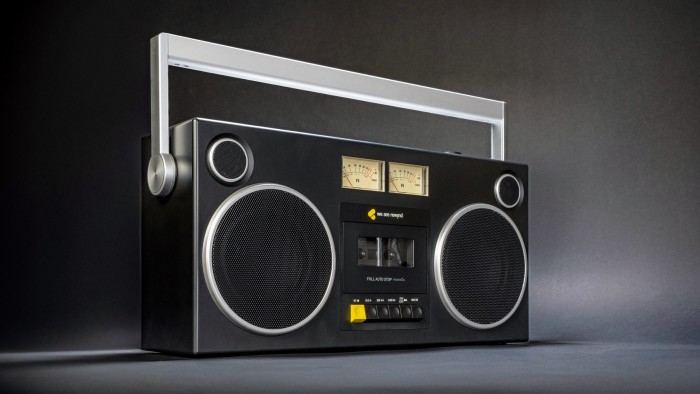
Vinyl and cassette were the dominant musical formats of the 1970s and ’80s. But while vinyl has experienced an almost fetishistic resurgence, cassettes not so much. Their compact size and affordability meant that they occupied a different cultural space; not individually treasured, perhaps, but still central to music consumption – mainly because you could buy blanks and fill them with tunes. The industry didn’t like it (“Home Taping Is Killing Music” ran the slogan of the day) but technology allowed it, so people did it anyway. I’ve got around 500 cassettes dating from my teens and 20s, each one connected with a time and a place. Rarely listened to, beloved nonetheless. I can now become better acquainted with the tapes thanks to a retro-styled boombox by French firm We Are Rewind. A few years ago the founder, Romain Boudruche, observed that the only cassette players on the market were either poor-quality throwaways or studio-grade professional units. He went midway, launching a range of high-quality Walkman-style devices with musically evocative names (Amy, Serge, Edith) and orange headphones to match. This 104W player is the next step on that journey.
The hi-fi class woofers and tweeters make for a substantial unit – around 7kg – with a sturdy aluminium handle to port it about. It has Bluetooth, so you’re able to use it as an external speaker, but that’s pretty much where its modern functionality ends; everything else is faithful to the boomboxes of the 1980s – big VU meters, mic/aux/headphone ports, a switch for type I and II cassettes and bass/treble/balance knobs.
The only obvious difference is the absence of a radio, but as Boudruche explains, “We were restrained by the fact that AM and FM aren’t allowed in some countries.” That’s easily circumvented via Bluetooth shenanigans – and, rather splendidly, you can tape directly from any Bluetooth source. We Are Rewind also sells high-quality blanks. Anyone questioning the wisdom of recording in real time from Spotify onto a cassette evidently doesn’t understand the key to a good mixtape: a painstaking process of loving curation.
Plug and plant
If your streaming playlists are feeling a little one-dimensional, delve into the unusual world of “biosonification”. Plug headphones into the Pocket Scíon, attach its sensors (two crocodile clips) to a plant (or fungi, or indeed human skin) and it will transform tiny electrical signals into musical soundscapes. Choose from four built-in instruments (from the cascading “Secret Garden” to the thunderous “Soil Circuits”) that are effectively played by the plant – you just adjust the device’s sensitivity. While it’s a plug-and-play device, it doubles as a powerful creative tool; you start by listening to organisms but end up making music with them. Some may be scornful of the idea of going to listen to a plant in the local park. Not me.
Pocket digital rocket
Some audiophiles celebrate the warmth of analogue, others insist that musical perfection can only be delivered digitally. I’d rather stay out of that argument, but Astell&Kern caters very much to the latter group. This flagship device provides huge storage capacity (256Gb plus up to 1.5Tb on a Micro SD card) for libraries of lossless audio; no shonky MP3s here, please – although it does incorporate “remastering” tech that gives low bit-rate audio a noticeable sheen. It weighs a substantial 615g, has a balanced 4.4mm headphone port alongside a standard one and runs a fuller version of Android than its predecessors, so you can install multiple apps. (Even YouTube! Just don’t tell the audiophile police.)
@rhodri
Read the full article here