

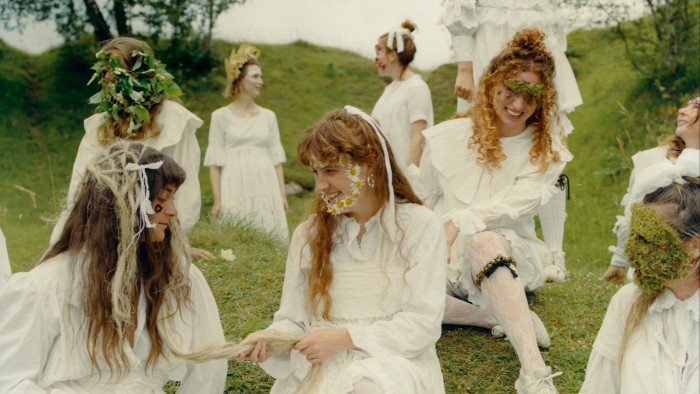
What does British springtime smell like? Sweet violets, jonquil, Rose de Mai and orris, according to the noses at Ffern, the Somerset-based natural fragrance maker that released Spring 2025, its new fairytale-like scent, in March, on the eve of the new season. Since late 2018, Ffern has brought out four perfumes a year on each solstice and equinox, shaking up the scent market not only in the way customers buy – you have to apply for membership before you can purchase – but also with its embrace of Britain’s rural landscape and ancient folklore. It says the current waitlist for membership stands at 500,000.
“When we started Ffern, we really wanted to build in nature’s rhythms and allow people to follow the seasons through a bottle of organic perfume,” says Emily Cameron, who co-founded Ffern with her brother, Owen Mears. “But we also wanted to create a world around that.” That world includes seasonal organic teas, candles (introduced for the first time this year) and specially commissioned films and artworks. There’s also a monthly podcast, As the Season Turns, a sonic almanac of the British countryside. “So you know what’s happening up in the skies and stars, in the hedgerows, rivers and seas each month. The kind of things ancient man would have known almost instinctively,” says Cameron. It has an average monthly streaming figure of up to 70,000.
With its natural ingredients and compostable packaging, Ffern is one of a number of independent, eco-minded beauty brands digging into Britain’s land and coastline to make a deeper connection with customers. When Kate Moss launched her beauty and wellness brand Cosmoss in 2022, its first campaign showed the supermodel not sauntering along a white beach in the West Indies or some other far-flung paradise but wading naked into a pond that was unmistakably English in its murkiness. Today you can enjoy the selkie-ish sensation of bathing in the marine tang of bladderwrack algae via body washes and lotions made in Margate by the brand Formerly Known As Haeckels. Or spritz the aromatic woody fragrance of the Scottish Highlands, courtesy of Perfumer H’s new scent Rain Wood.
Ffern’s perfume is blended and aged in Somerset, where Cameron and Mears grew up taking part in local folk traditions: wassailing (an Anglo-Saxon custom to bless orchards), May Day celebrations and harvest festivals. Through its just-launched Folk Foundation, Ffern offers yearly endowments to people keeping these customs and crafts alive. Its first recipient is Boss Morris, a Gloucestershire-based, all-female Morris dancing troupe who perform at festivals (and appeared with Wet Leg at the 2023 Brits), wearing vibrant costumes that bring a prog-rock edge to English traditionalism. “Groups like Boss link people and the land,” says Cameron, who has also used the Ffern platform to spotlight cook, farmer and gardener Julius Roberts and Yorkshire’s historic Rhubarb Triangle. “And in the way they celebrate these rituals, they’re fostering activism to protect the land too.”
Two counties over in Hampshire, Wildsmith Skin, the brand from luxury bolthole Heckfield Place, is inspired by the trees and botanicals first planted on the estate 160 years ago by horticulturist William Walker Wildsmith. Its signature hand and body wash is fragranced with linden, Roman chamomile and cedarwood. Nearby, at Daylesford, the organic Cotswolds-based lifestyle brand Bamford is celebrating 20 years of its signature geranium fragrance with four candles that evoke “the verdant scent of a glasshouse in spring”.
Imelda Burke, founder of natural and organic beauty retailer Content, has been highlighting British-made brands since 2008. “Over the past 18 months, it has become one of the main search-traffic terms for us,” she says. She points to two brands targeting perimenopausal and menopausal skin that exemplify the standard: Made of More, which uses hemp seed oil grown on its fourth-generation farm in Lincolnshire; and Scotland’s AS Apothecary, whose formulas use organically grown or wild-harvested botanicals and seaweeds from its regenerative farm on the Isle of Harris. “They even distil seawater to use in the products,” says Burke. “A lot of the plant and ingredient combinations are taken from wisdom passed down through generations. That really epitomises the idea of landscape and rituals for me.”
A recent report by trends-forecasting consultancy The Future Laboratory and Together Group, a collective of luxury agencies, said that to remain competitive in the future, beauty brands “must go beyond aesthetics and embrace a 360-degree approach that balances measurable performance with personal, emotional and cultural significance”. Christening the trend “transformational luxury”, it found that consumers are turning to beauty and wellbeing brands not merely to look better but to feel better too. “These two aspects are becoming increasingly intertwined,” says Alex Hawkins, director of strategic foresight at The Future Laboratory.
For Natalie Guselli, head of beauty and commercial at Liberty, the trend is an extension of the farm-to-table movement. “That focus on locality, reducing air miles in sourcing, going organic and being more mindful with every part of the process and product is now translating into beauty,” she says. Earlier this month, the store opened a new bath and body department on its top floor, where 47 per cent of stocked names are British – Cosmoss, Bamford and Wildsmith among them. (Liberty provides Wildsmith’s only spa therapy outside of Heckfield Place; field recordings of the estate’s birds play during treatments.)
Guselli says customers from outside the UK are attracted to the way British brands are harnessing native botanicals. “This balance of nature, science and heritage is driving strong demand in the US and Middle East, where customers seek effective, ingredient-led formulas with a sense of provenance,” she says. “But it’s also about legacy. British brands are getting back to their roots, understanding the need for quality in craft, responsible sourcing and the efficacy of their products.
Commune is a beauty and home fragrance brand from Somerset, founded by Rémi Paringaux and Kate Neal, a husband and wife team who previously worked in the luxury sector and moved to Bruton from Canada in 2020. Commune uses the changing seasons as inspiration for naturally fragranced products that come in striking aluminum bottles. (Aluminium is one of the few materials that can be recycled repeatedly without any loss of quality.)
Its first scent, Seymour, was designed to capture “the smell of the wet earthy ground, the essence of spring in Somerset”, says Neal. But it also aims to evoke a more esoteric essence of the locale. Says Paringaux: “We live near Bath, near Glastonbury. Every time we drive to London, we pass Stonehenge. It’s an area so rich in culture and mysticism that it feeds your imagination and connects you to the area. We really wanted to weave that story into the brand.”
At Ffern, the desire for a stronger relationship with nature is only growing. A recent survey of its podcast listeners revealed they would like to hear more folk stories. “I think there’s an ancient desire in many of us to return to that connection,” concludes Ffern’s Emily Cameron. “Maybe there’s a drumbeat within us that marks the rhythms of the year – and for most of us that noise has got so quiet. We just want to make it beat a little louder once again.”
Read the full article here