

As you enter the suitably frightening half-light of the British Museum’s new Samurai exhibition, you are confronted by exactly the sort of image you might expect. There, in splendid isolation, is a suit of armour in all its mesmerising menace. But if the display matches every expectation of a war-ready samurai, it immediately subverts the visitor’s probable preconceptions.
First, what you are looking at is not a single piece of armour, but rather a collection of parts cobbled together over centuries. The dragon-topped helmet is from 1519, the cuirass breast plate from 1696, the body covering, more perishable and more recent, a combination of lacquered rawhide and iron laced together for maximum battlefield flexibility. But there is a second surprise: the armour was never worn.
For much of their existence, the samurai — despite the fearsome reputation they acquired in the medieval period — did not fight. They were not even called samurai, a word derived from the Japanese for “those who serve”. A more common name was musha or bushi.
Even during periods of war, the samurai were artists and patrons of the arts. Later, in peace time, they were administrators, bureaucrats and even firemen and women. Their field of action was the tatami mat, the court pavilion and the tea house. They were more brush than sword.
During the Tokugawa shogunate, a period of dictatorial peace that lasted from 1603 to the opening up of Japan in 1868, the one thing they did not do was wage war. In 1871, when the Japanese postal service was established in emulation of its British equivalent, many of the branches were entrusted to former samurai who by this time had become a bureaucratic class.
The strength of the splendid new exhibition, curated for the British Museum by Rosina Buckland and Joe Nickols, is the delight it takes in myth-busting. Far from avoiding the complexity of the samurai, whose image has been warped and co-opted by successive generations of Japanese and foreigners alike, the curators delight in playing with our misconceptions and subtly straightening them out. The samurai, right back to their misty origins in the eighth-century Heian period, created their own half-truths and origin stories.
The displays are beautiful. That includes the swords, forged and pounded into silvery lethality, the lacquerware boxes, the silk scrolls, the decorated helmets — one shaped as, of all things, an aubergine — and the stunning woodblock prints.
The exhibition, large enough to be all-engrossing but contained enough to be intellectually manageable, is divided into three parts. The first deals with the period when the samurai did actually fight, albeit not quite in the way normally envisioned. The second covers the period when the shogun, the generalissimo, held absolute sway and the samurai were more likely to be practising calligraphy than beheading their opponents.
The third section encompasses the era when the image of the samurai arguably became strongest, paradoxically the period after they were abolished around 1869, when they were obliged to shelve their swords and join Japan’s modernisation drive. During this period of ghostly afterlife, the samurai have variously been portrayed as medieval knights with impeccable manners, symbols of the Japanese fighting spirit, and Star Wars prototypes.
Each phase is brought to life with soundscapes or, in one case, a Studio Ghibli-like animation projected across an entire wall. In misty purple, it portrays a battle among cavalry-mounted warriors that ends with the blood-splattered suggestion — if thankfully not explicit depiction — of a severed head. Another shows a room-length mock-up of Edo, the seat of the shogunate power that became Tokyo, with 1mn people the biggest city in the world from 1720.
One myth dispelled is that the samurai deployed swords as their principal method of killing. Swords, an imperial symbol, were used, but sparingly. Instead, fighters, usually mounted on horseback, carried bows and arrows, polearms fixed with blades and, later, after the arrival of the Portuguese in the 16th century, guns.
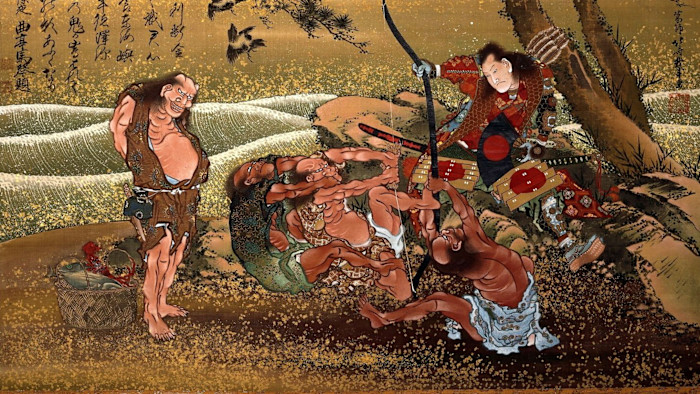
Gorgeously decorated scrolls depict famous battles, doubtless romanticised, including one in which a victor becomes a Buddhist priest in repentance for killing a beautiful young man. In the early days, battles were probably more like skirmishes than set-piece confrontations. But they could be lethal. Some of the emerging class of samurai were farmers or employees of yeomen who fought to the death for spoils, mainly land.
To claim their bounty, they had to prove whom they had killed. In a gruesome bit of medieval stocktaking, the samurai accounted for their victories by presenting the heads of defeated foes. Heads, severed at safe distance with long, bladed poles, were washed, logged and labelled by samurai women, one of many references in the exhibition to the fact that half the samurai were female.
Many samurai women became educated ladies-in-waiting and accomplished artists. Displays feature thickly embroidered kimonos, lacquered make-up sets and teeth-blackening paraphernalia, needed to denote social status.
The second phase of samurai history, from 1603, represented something of an identity crisis. What were warriors to do when they could not fight? Tokugawa Ieyasu, after winning the Battle of Sekigahara in 1600, enforced a peace that was to last more than 260 years. The feudal lords, known as daimyo, retained status in their own domains, but they were obliged to leave their families as hostages in Edo.
Stripped of their land, confined to the cities and banned from battle, the samurai turned wholesale to culture, though as Buckland points out, they had been patrons and practitioners of the arts for many centuries. Even in the early days, as they were establishing themselves as a hereditary caste, it was important to demonstrate refinement. “They cultured up because they were parvenus,” she says.
This section is filled with exquisite high art and its popular counterpart. One shunga erotic print depicts, in all too graphic detail, a samurai penetrating a courtesan — and not with his sword.
Turn a corner to see an almost shocking sign: “1869 The Samurai Class is Abolished.” What happened? After centuries of military atrophy, the Japanese were ill-prepared to repel imperial aggression. In 1853, American gunboats appeared in Edo Bay. In the ensuing Shogunate prevarication, a coalition of lower-ranking samurai took action.
They led a revolution, awkwardly known as the Meiji Restoration because it co-opted the imperial family as a symbol of legitimacy. In fact, it was the world’s swiftest modernisation in which the samurai, in Buckland’s words, “reformed themselves out of existence”.
Ironically, it was in the period after their abolition that they became most symbolically potent. After a hiatus, when their iconography was entirely usurped by western imagery, Japan rummaged for its identity in a mythologised past. The samurai were front and centre.
In one showcase is a copy of Inazo Nitobe’s 1899 classic, Bushido: The Soul of Japan. It was a half-fabricated version of the samurai code written in English for foreigners. Later, translated into Japanese, it became a propaganda tool for a new army being taught to die for imperial glory. Kamikaze pilots were depicted holding samurai swords, though in practice these were too cumbersome to fit into the tiny cockpits.
Japan’s fascist allies, too, seized on the samurai imagery. One print shows a Godzilla-like colossus bestriding the ocean, smashing allied warships. Author Yukio Mishima depicts the samurai as symbols of a lost, more honourable past. In 1970, he participated in an act of seppuku, ritual disembowelment. From the 1960s, the legendary salarymen, too, trudged to work in a spirit of samurai self-sacrifice.
In short, samurai mythology lives on, bent and twisted to serve the cause du jour. The final display features a video screen with a samurai crest fractured into a thousand moving images. The samurai have gone viral.
To May 4, britishmuseum.org
David Pilling is a former FT Tokyo bureau chief and author of ‘Bending Adversity: Japan and the Art of Survival’ (Allen Lane, 2014)
Find out about our latest stories first — follow FT Weekend on Instagram, Bluesky and X, and sign up to receive the FT Weekend newsletter every Saturday morning
Read the full article here