

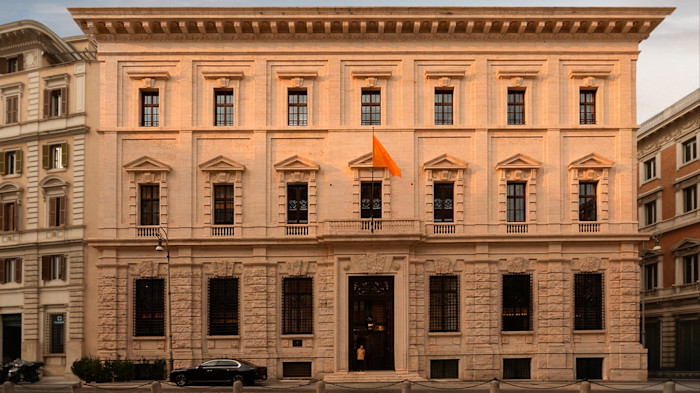
What’s the buzz? Malta-based Corinthia Hotels is in the midst of an ambitious bid to reposition itself alongside the likes of Rosewood, Mandarin Oriental and Four Seasons in the rarefied air of five-star hotel chains. The group’s property in London’s Whitehall has been the jewel in its crown for 15 years and the only one that really toes the high-luxury line. After three years of impressive salvos, in Brussels, Budapest and New York — all of them in historic buildings — Corinthia debuted in Rome on the first of this month.
Location, location, location This is half the Rome game, and the Corinthia’s is solid: more or less equidistant from the Piazza Navona, the Mausoleum of Augustus and the Spanish Steps. Palazzo Montecitorio, the 17th-century headquarters of the Chamber of Deputies — the lower house of Italy’s parliament — is directly across the street. A block away is the Piazza San Lorenzo in Lucina, where an aperitivo at Ciampini is a rite of dolce vita passage (and the pistachio gelato is world-beating).
But perhaps most alluring is its proximity to Campo Marzio (its name, Italian for “Field of Mars”, refers to its use during Imperial Roman times as a site for military training exercises). The neighbourhood, Rome’s fourth-oldest rione, is home to some of the city’s most interesting one-off boutiques, tailors and cafés.
Checking in Constructed between 1913 and 1921, the building was commissioned by the Bank of Italy to give it a grand presence much closer to Rome’s political heart than its headquarters at Palazzo Koch, a kilometre to the south-east. The facade is imposing rather than pretty; there’s a street-level lobby but it’s only after you ascend the half-dozen stairs to the first level that you get a sense of the hotel’s small and very appealing scale. The public spaces — a sitting room and small library (for hotel guests only), a fine-dining restaurant (on which more later) and a bar — surround a central courtyard, called Piazzetta, that’s home to the all-day, indoor-outdoor dining venue. Wrought-iron chairs and sofas with plush white cushions surround marble tables; potted citrus and gardenia trees stand between them, softening the space.
The hotel’s bar, commanding its own corner of the building, gets points for décor — opulent, skewing masculine, with a ceiling clad in hexagonal gilt tiles and backlighting that flatters spirits bottles and visages alike. The drinks alternate adventurous homages to Rome with the standards; the negroni (always a good litmus) was impeccable, as were the mini suppli (rice and tomato croquettes) that came with it. There’s a martini trolley that makes the rounds. Corinthia worked with London-based corporate art advisers Visto to amass a collection that’s largely by Italian artists or artists who live in Italy; some of it is very good, and all of it brings welcome character to spaces that in their intimate aggregate feel almost more like a private club than they do a hotel.
The 60 rooms and suites are less engaging design-wise — safe bordering on anodyne, as is sadly the way of so many top-tier hotels in 2026. With the exceptions of a couple of hero suites (the Theodoli Heritage Suite, formerly the bank’s boardroom, retains its frescoed walls and extraordinary mosaic-tile floor), things tend towards the nondescript, with seas of cream-biscuit-beige and dark-wood furniture. I longed for more colour and texture.
On comforts and indulgences, however, they’ve excelled: the minibar cabinet gleams with cut crystal and ornate biscuit tins from Marabissi in Tuscany (as posh and artisanal as they come). I arrived to a rose brioche baked by the hotel’s pâtissier and a plate of flawless yellow solarelli plums from Lazio. Plus the requisite Frette sheets, towels and robes, huge marble bathroom, and — welcome, this — double glazing on the windows (crucial when your neighbours across the way are partial to a police escort).
What to do In six years of living part-time in Italy (and 17 of editing HTSI’s travel pages) I’ve had a lot of privileged private “experiences”, including more than one after-hours visit to Palazzo Colonna and its galleries. But until last week I’d never walked through them with Don Prospero Colonna himself, as he parsed highlights of his family’s gob-smackingly vast art collection. It’s impressive that Corinthia, a company with zero presence in Italy until now, managed that level of access.
They also arranged for an immersion into the art and science of perfumery with Laura Busatti Tonatto, one of Italy’s most respected “noses” (she created scent for the late Queen Elizabeth II), at her beautiful apothecary on the Via di Campo Marzio. The point: make use of the concierge desk — they seem to know what they’re doing.
What about the food? Fine-dining restaurant Viride — awash, as per its name, in shades of green — is mega-chef Carlo Cracco’s first (and, says Corinthia, will be his only) foray in Rome. All the flourishes and flavours that have garnered him multiple hats and stars, first in Florence at Enoteca Pinchiorri then at his eponymous restaurant in Milan’s Galleria Vittorio Emmanuele II, have been revisited alla romana. His famous Russian salad is here encased in crisp guanciale (pig’s cheek); the signature hosomaki stew is prepared with oxtail, that most Roman of offals.
The wine list is daunting — both as an object in your hands and a collection — but includes unorthodox gems by the glass, such as Santa Maria La Nave’s cult Millesulmare white blend and three of Cracco’s own wines (Fiammarossa, the old-growth Trebbiano IGT he makes in Emilia-Romagna, is excellent, chalky and mineral).
Piazzetta is more fun and casual, with an à la carte menu that features burgers, the requisite club sandwich and plenty of classic Roman and Italian standards. There’s a commendable aubergine alla parmigiana and an outstanding vignarola (a quintessentially Roman spring vegetable stew), and every one of the antipasti with which my companion loaded our table was a winner.
Other guests? Hard to call, so early in the game, as I checked in on opening day. I’d say to expect a lot of the high-net-worth-individual Anglosphere among the hotel guests (that slight samey-ness of high design is what wealthy Americans in particular seem to gravitate towards) and a cross-section of politicos and Rome’s great-and-the-good making use of the restaurant, courtyard and bar.
And the staff? Lovely and competent to a person — probably a testament to managing director Danilo Zucchetti, who ran Villa d’Este on Lake Como for 15 years and has managed to lure some real talent over from his competitors. I had to remind myself a few times that they hadn’t been doing their jobs for a month or two already.
The damage From €1,153 for a double room, with breakfast (crafted by Cracco; think cacio e pepe scrambled eggs) included.
Elevator pitch Rooms for the (unimaginatively) well-heeled, food for the well-travelled, service that meets (if not beats) most of the competition.
Maria Shollenbarger was a guest of the Corinthia, Rome (corinthia.com)
Find out about our latest stories first — follow FT Weekend on Instagram, Bluesky and X, and sign up to receive the FT Weekend newsletter every Saturday morning
Read the full article here