

Stay informed with free updates
Simply sign up to the House & Home myFT Digest — delivered directly to your inbox.
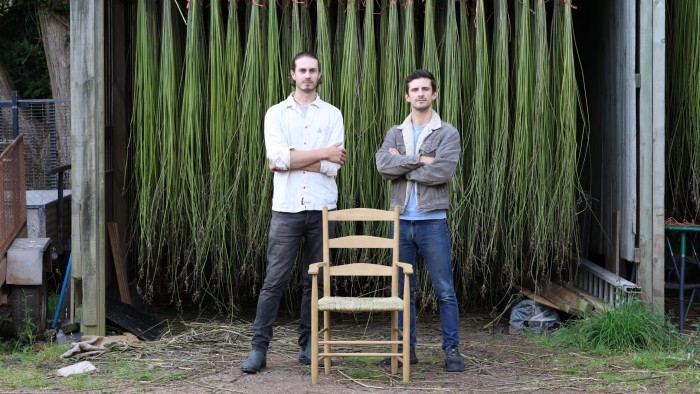
Every summer, Sam Cooper and Richard Platt head down to the River Arrow near Stratford, and the River Wansbeck, in Northumberland, to cut rushes. Over four days, they cut enough to last the year. “It’s not high tech — we go in waders, wielding hedge-slashers,” says Cooper.
Back at their workshop on the Marchmont Estate in the Scottish Borders, the pair set to work making their handcrafted rush-seated chairs. The harvest is hung to dry in bundles for three weeks, then stored. As and when it is needed, a bundle is soaked overnight to make it pliable enough for weaving. Working at maximum speed, one person can weave two seats a day.
But just eight years ago, the ancient craft of rush-seated chairmaking, practised in Britain since Anglo-Saxon times, faced an existential threat. Lawrence Neal, the last full-time artisan in the country, was nearing retirement — with no successor in sight. Hugo Burge, owner of the Palladian mansion on the Marchmont Estate, stepped in. He had become fascinated by the craft as a student at Bedales School, whose library had been designed by Arts and Crafts designer-maker Ernest Gimson and was filled with what became known as the Bedales chair, still produced by Cooper and Platt today.
In 2017 Burge, advised by the Heritage Crafts Association, offered to fund two apprenticeships, promising studio space on his estate once training was completed. The candidates were whittled down to Cooper and Platt, whose skill and aplomb stood out.
The business they founded in 2020, The Marchmont Workshop, has made its name with deft recreations of Arts and Crafts-era chairs by Gimson and Philip Clissett. Its largest commission to date is a classic spindle-backed four-seater for architect Ben Pentreath: “We worked out there’s just over a mile’s-worth of rushes in that seat, laid end-to-end.”
The studio aims to push the historic craft beyond its established parameters. “Bold colour is one way to have traditional pieces look more at home in contemporary settings,” says Cooper — indeed, it took six minutes from debuting a vivid red chair on Instagram to receiving the first order.
The business follows sustainable principles, with the frames for the chairs being handmade from native timber sourced within a 40-mile radius of the studio. “The oak logs we’ve got now, we can point to the spot in the hedgerow where the tree came down,” says Cooper.
They work with unseasoned “green” wood, which is pliable and responsive and can be moulded into arresting forms as it dries. Milled timber is turned, steamed, then placed in a bending frame for a week. Once dry, chair frames are assembled and sanded by hand.
Burge passed away in 2023, but his foundation continues to fund apprenticeships to further secure the future of this endangered craft. One of The Marchmont Workshop’s original designs, the Canopy, is a tribute to him. It has rear legs that flow up into branching forms, inspired by a clump of 400-year-old trees on the estate. “It was one of Hugo’s favourite places,” says Cooper. The chair is sold through the craft gallery and shop Bard in Edinburgh, as well as directly from the studio.
At London Craft Week, Cooper and Platt will launch their first lounge chair — a lower, wider version of the Canopy — at Future Icons Selects (May 15-18). “We wanted an option that felt more modern, slightly less ‘country house,’” says Cooper. The Marchmont Workshop is proving that the rush-seated chair can sit comfortably in both worlds.
Prices start from £484; lead time 12-16 weeks; themarchmontworkshop.com
Find out about our latest stories first — follow @ft_houseandhome on Instagram
Read the full article here