

Unlock the Editor’s Digest for free
Roula Khalaf, Editor of the FT, selects her favourite stories in this weekly newsletter.
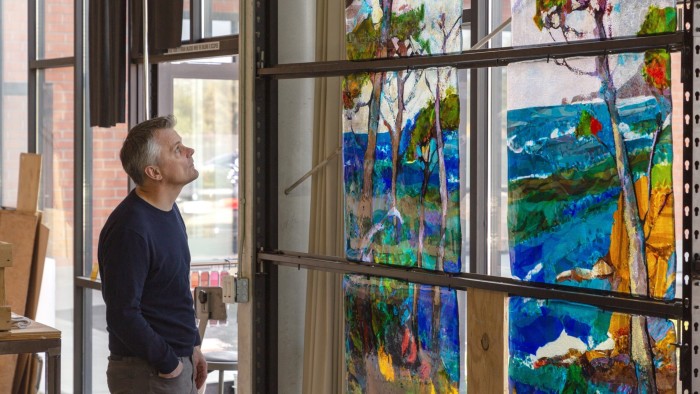
Artist James Jean’s “Pagoda” is an epic vision of fused glass panels that, when complete, should be like entering a multi-faceted, almost psychedelic gemstone. The intricate craft is the work of LA-based Judson Studios. More than a century old, the workshop is run by fifth-generation scion David Judson. “Each generation has to contribute something and own it,” Judson says of the studio’s evolution. “Otherwise it can become stale.”
William Lees Judson, an impressionist painter and member of the Pasadena Arts & Crafts movement, founded the “art glass company” in 1897. His luminous stained glass works were statements of taste and wealth for the homes, houses of worship and elaborate theatres that were burgeoning across the city, on the back of the oil, farming and entertainment industries.
His descendants, including David, have taken his legacy business around the world. Today, a labyrinthine building serves as the production line for the painstaking process, with each room housing artists working on various stages — from design to cutting, painting, applying the lead came that holds stained glass together, cementing the piece to waterproof it, and reinforcing the malleable lead with steel bars.
“Clients are more interested than ever in handmade things that are unique,” says Judson, who has been immersed in the craft for more than 30 years. “Everyone’s looking for something that’s a little different. And the thing about glass is that there’s nothing like [how] it adds colour.”
Large lightbox tables illuminate commissions in progress: 35ft windows for a Wyoming monastery, filled with saintly portraits and lines of prayers in gothic script; botanical windows for a private home, a modern twist on Edwardian leaf and flower patterns. The intricate pieces take on detail through each step of the painting process, which, depending on a design’s complexity, can require multiple rounds of application and kiln firing to fuse each layer of tracing, shading, stippling, colour, enamel or silver stain to the glass.
The smell of clove permeates the rooms — traditionally, clove oil has been used to bind powdered paint pigments. “It makes for a good, inky line,” one artist explains — and other agents tend to dry out too fast on the heat of the lightbox.
Glass seems to lend itself to being a family business; Judson points to other multigenerational artists among the 26 full-time staff, including Oniver Cuevas, who followed his father Luis Enrique into the studio. It also means there is a through line on historic projects. In 2009, Judson was asked to restore the 20ft stained-glass skylight of the dome in the Natural History Museum of Los Angeles County, which was made by his grandfather in 1913. In phases in 2002 and 2007, the studio refreshed the geometric windows it had designed for Frank Lloyd Wright’s Mayan-inspired Ennis House in 1924.
But while continuing the family tradition, Judson has modernised the studio by expanding into fused glass and partnering with contemporary artists, such as Jean.
Perhaps that ethos explains why the studio has a greater bulk of new commissions than restoration work. Judson estimates that his competitors do “90-95 per cent restoration”, but that makes up just a third of Judson’s business. Today, the studio is more likely to create glass for hotels, bars and homes. A recent commission was a window for the reading nook in actor Jennifer Garner’s house, featuring three owls in a tree and the family’s golden retriever, rendered in the style of a favourite children’s book.
“The light coming through the colour fills your soul in a way,” says Judson of stained glass’s continued appeal. “The colour changes with the light, so you have a subconscious connection with the day through a piece of art that’s in your home.”
Projects can take 12-16 weeks, and cost $600-$1,200 per foot; judsonstudios.com.
Find out about our latest stories first — follow @ft_houseandhome on Instagram
Read the full article here