

Unlock the Editor’s Digest for free
Roula Khalaf, Editor of the FT, selects her favourite stories in this weekly newsletter.
As an Italian amateur cook who often fantasises about opening his own osteria, I spend a lot of time ogling chefs on Instagram. However, nothing could have prepared me for the surprise of seeing one of my favourite chefs, Mitchell Damota, showcasing a bowl of tortelli piacentini as part of his latest menu for Dalla restaurant in London.
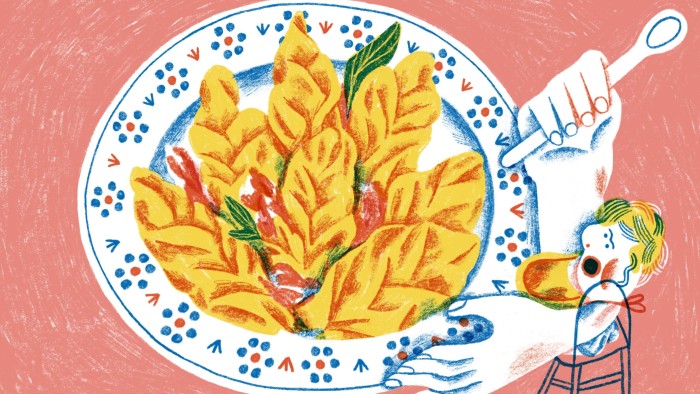
Tortelli piacentini are a handmade pasta that can only be found in Piacenza and thereabouts. No different from your standard ravioli in butter and sage, except for the way they are made, pinched and folded together not unlike a Chinese dumpling, which renders them devilishly difficult to execute. It’s what your grandmother feeds you, if she (like mine) happens to come from a very specific corner of Emilia-Romagna. You can imagine my shock seeing it executed to the letter at a hip Hackney restaurant.
Handmade pasta per se is not cutting-edge. What’s new is the appearance on menus of hyperlocal offerings even most Italians will scarcely know about. I have spotted culurgiones ogliastrini and testaroli al pesto on London menus — both of which are really the stuff of the chef turned anthropologist. They come from lesser-known frontier areas — Lunigiana in the Apennines and Ogliastra in Sardinia, and are extraordinary expressions of hyperlocal culinary traditions. Although the end result is similar to spongy crêpe, testaroli are made in special cast-iron pots made scorching by the open fire, a technique that might hark back to the Etruscans. Culurgiones are dumpling-like ravioli which originated in a handful of mountain villages.
Where does this obsessive push for regionalism actually come from? To an extent, it has to do with the current attention economy, where the narrative one tells is just as important as the wares one sells. But it also tells us something about Italian food more generally. In less than a century, it has gone from exotic curiosity to go-to, popular food, something valued above all for its no-fuss practicality. Now, in the UK, it has been either appropriated to an extent that it has stopped being Italian altogether (as in the case of pizza) or superseded by other excellent cheaper options such as Turkish, Chinese and Indian cuisine.
The frantic quest to resurface abstruse pasta shapes and forgotten regional delicacies signals Italian food’s further repositioning from easy option to object of cultural discernment, something only a certain kind of middle-class person “gets”. The best chefs are busy collecting regional cookbooks and taking trips to Italy that look a lot like fieldwork. As someone perhaps a little too sentimentally attached to this convivial, democratic aspect of Italian food, it is a little strange to see a greasy brick of parmigiana di melanzane turned into a totem of quiet luxury. But if a little snobbery is what it takes to bring new appreciation for this vast history and gastronomic heritage, who are we to protest?
Bartolomeo Sala is an Italian writer based in London
Find out about our latest stories first — follow FT Weekend Magazine on X and FT Weekend on Instagram
Read the full article here