
The Flying Dutchman, Opera Holland Park review — dramatic designs and a chorus on lusty form

Unlock the Editor’s Digest for free
Roula Khalaf, Editor of the FT, selects her favourite stories in this weekly newsletter.
Somebody at Opera Holland Park must have had a word with the Nordic gods. Wagner’s Der fliegende Holländer (“The Flying Dutchman”) opens with a violent North Sea storm that drives the Dutchman’s ship into port for shelter and right on cue the canvas sides of Opera Holland Park’s semi-open-air theatre started to flap ferociously in timely gusts of wind.
This year a serious case of Wagner-itis has struck the UK’s summer opera festivals. No sooner had Glyndebourne opened with its first ever production of Parsifal than Opera Holland Park followed up with Der fliegende Holländer, its first Wagner of any kind. Not to be outdone, Grange Park Opera is going one better and has announced its first Ring cycle, due to start with Das Rheingold in 2026.
The Wagner operas constitute a big challenge for these privately funded festivals, not least because of their length, plus in some cases the need for an enlarged chorus. Der fliegende Holländer is the shortest of the mature operas, but it is chorus heavy, at least for the men.
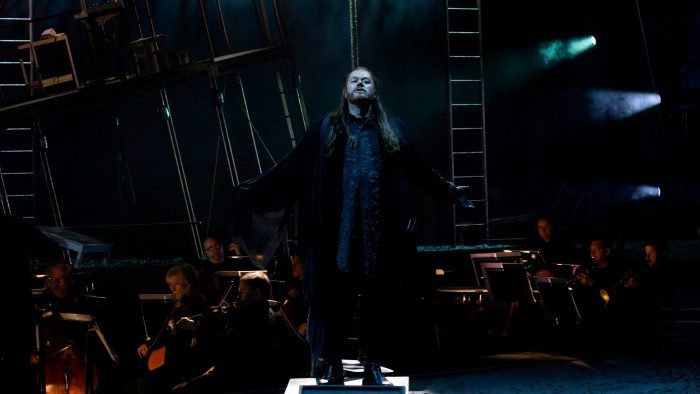
At Opera Holland Park, director Julia Burbach has put on a jolly good show. The opening storm envelops the auditorium, as lighting flashes in the roof and the men of the chorus pull ropes down the aisles in the struggle to moor their ships.
This temporary theatre, with the orchestra sunken in the middle of the stage, is a tricky venue to use effectively, but Burbach and her designer, Naomi Dawson, have brought everything into play — height, depth and atmospheric lighting. The main feature is a dramatically sloping set with Senta’s bedroom perched at a sharp angle, but it was mean to tease us with the expectation that she was going to follow Wagner’s stage directions at the end by running up the slope and throwing herself off.
Although illness had prevented Welsh bass-baritone Paul Carey Jones from singing the dress rehearsal, he sounded in good fettle, strong and resonant, and the vocal range of the Dutchman’s role lies well for him. Eleanor Dennis is a lighter Senta than usual, but lyrical and shining bright, and she is fearless in the opera’s last minutes. Robert Winslade Anderson makes a benign Daland, rather woolly of voice. Neal Cooper has the volume for Erik, but the sound was forced and uningratiating. As Mary and the Steersman, Angharad Lyddon and Colin Judson do not let the side down.
The chorus, men almost doubled in strength as sailors and off-stage ghosts, were on lusty form. Although the limited room in the pit makes for a rather thin string sound, conductor Peter Selwyn gets a plausible Wagnerian performance out of the City of London Sinfonia (but whatever was that bizarre and abrupt ending to Act 1?). The next opera in this year’s festival is Jonathan Dove’s highly inventive Itch (June 3-13), given its premiere here in 2023 and fully deserving of a return visit.
★★★★☆
To June 14, operahollandpark.com
Read the full article here