

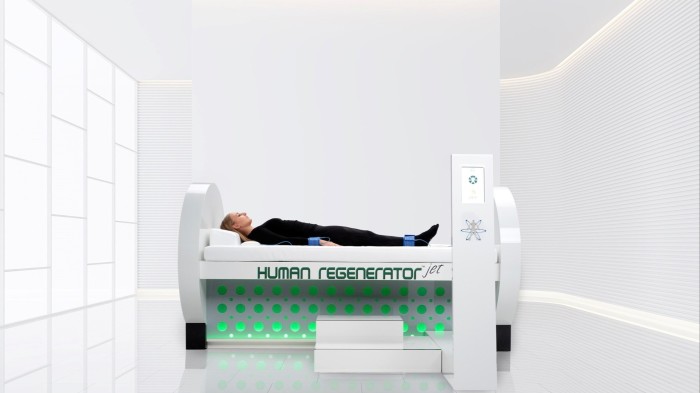
Every other day or so for the past 16 months, when Gary Shepherd has woken up in his Surrey home, he has padded slowly, half-asleep, up to the top floor. The 65-year-old property developer isn’t heading to the gym — that’s on the ground floor, next to the swimming pool — or the spare room his wife has repurposed as a Reformer Pilates studio. Rather, Shepherd is about to prep for the day with a 30-minute stint in his “longevity room”.
Filled with gadgets promising to improve his health, his favourite resembles a futuristic hospital bed: he’ll clamber inside, strap himself to the electrode panels and lie there, half asleep, as it works on his body. Dubbed the Human Regenerator, its creators claim that its cold atmospheric plasma helps optimise cellular function and speeds healing. Shepherd is more matter of fact. “I have no idea how this thing works, and no idea if it works,” he shrugs. “But I just know that when I use it, I feel better than when I don’t; and when I haven’t used it for a while, I really want to again.”
This €142,000 machine is just one of the many now available for those wanting to take the straightforward at-home spa or gym to the next level. As wellness provisions are now standard in high-end developments — few are without a sizeable footprint earmarked for fitness — there’s a new, emerging differentiator: longevity or, more specifically, healthspan.
In developed nations, there’s an expectation of longer life; the Centers for Disease Control and Prevention says Americans can now expect to live around two decades longer than a century ago, and the UN says the crop of centenarians worldwide by 2050 will be 3.7mn, an eightfold increase. The quest, though, isn’t just for length of life but quality of living; ensuring that your health holds up as long as your heart is beating — or healthspan — is the ultimate quest, and one that’s increasingly having an impact on the built environment.
“People joke about wearables — ‘Don’t you know when you have a good night’s sleep?’ — but we don’t know what’s in our own goddamn bodies,” says Brad Inman, who founded the namesake real estate media company before pivoting to the healthspan space via his Livelong Summits. “But we’re at the infancy of all this, and none of it’s perfected. I think the bottom line is: this is [like] the personal computer in 1977.” However, he adds: “There is a lot of bullshit. The fancy pants crazy stuff has never been my cup of tea.”
“In the last five to 10 years, ‘healthspan’ has almost become a catchphrase,” says Peter Bowes, the BBC journalist who also hosts the Live Long and Master Aging podcast, “It’s a new word for quality of life.”
The Estate, a global development company created by hotelier Sam Nazarian and motivational speaker Tony Robbins, recently hired a “chief longevity officer” to turn the fitness areas in its future residences and hotels — planned for Miami, St Kitts and Switzerland, among others — into biohacking hubs. The Atelier building, under construction in Miami, has just hired a functional health expert to help future residents navigate facilities including red-light therapy chambers and NAD+ IV treatments.
Kate Donneky, managing director of UK-based property management company Rhodium (which includes The Broadway and 60 Curzon Street in London) says interest in high-end healthspan enhancement has doubled in just five years among her clients. “It wasn’t even a talking point back then,” she says, “Now, in a post-Covid world, it’s dominant in the super-prime market. Initially, it was seen as a gimmick. Now it’s a selling point.”
Thomas Heyne would agree. The German founder of Mykonos nightclub Scorpios completed his three-level, nine-bedroom home, En Kyano, on the Greek island last year. A longevity enthusiast, he has configured it to appeal to like-minded individuals as a rental when he’s not there. He spent about €400,000 on the longevity facility, which takes up about 20 per cent of the home’s 1,000 sq m.
It includes a custom hyperbaric oxygen chamber by HPO Tech. There’s a doctor and nurse on call, should guests need assistance with the lymphatic drainage body suits, for example, or want a blood panel conducted in situ. Heyne says the longevity facilities are often clinchers for bookings — one former German national football player is coming this summer with a few other players, their families and physiotherapists for some rest and rejuvenation.
Shepherd has opted against a hyperbaric oxygen chamber despite being a keen diver. “There’s too much risk associated with [at home] misuse,” he says. The US Food and Drug Administration recommends seeking hyperbaric therapy in a facility inspected and accredited by a non-profit body known as the Undersea and Hyperbaric Medical Society. Installing it at home, of course, bypasses these recommendations. Shepherd does, however, have a red-light therapy bed and an oxygenation machine (though he rarely uses the latter as the mask fits poorly over his beard).
Shepherd’s first encounter with the Human Regenerator came after breaking his hand during a Muay Thai training session; his wife suggested a session using a machine might aid recovery. “The bone healed incredibly quickly. Within three weeks, I could swing a golf club,” he says.
The couple decided to invest in their own; upkeep is easy, he says — technicians recently came to replace the contact pads — and operation straightforward. A 30-second starting delay allows him to clamber inside before the treatment starts. “If I play golf, my back is murder, so normally I come back from playing and go straight up to lie on the machine,” Shepherd says. “It’s not a panacea, but it helps.”
Jovita Martinkenaite has been distributing the machine for the past four years, and says around 30 per cent of her business now is individuals like Shepherd, rather than clinics. “At the beginning, I wasn’t expecting private customers to be that interested, because it’s a large piece of equipment and you need a separate room,” she says. Buyers can customise the unit to better match their decor — she’s even produced a bespoke, extra-long bed for a retired NBA basketball player.
In Los Angeles, William Mungall, of Landry Design Group, is working on a Beverly Park property where almost 25 per cent of its 60,000 sq ft is earmarked for a private longevity space. The client had a hyperbaric chamber in a previous house, artfully curtained off from the gym, but now this equipment will be in the foreground. There’s also space to allow the owners — a couple with young children — to add new technologies as they become available. “There’s a whole room with extra ventilation and power. If there are more machines that come out in the future, they want to plan for that.”
Another of Mungall’s clients, in Pebble Beach, northern California, had concerns about nanoplastics in the water supply: Landry Design Group proposed an Ophora system to treat all water before it reached the taps, whether for drinking or bathing. “It’s not a small system — it’s the size of a small truck, but we fortunately had a very large mechanical room in the basement.”
Like Donneky, Mungall says longevity features more and more in client briefs in the last five years. He has worked with German sauna and spa producer Klafs as a consultant on at-home longevity rooms, including adding ice machines, both for treating muscle injuries and a bracing facial every morning.
Sabine Donnai, founder of London-based longevity clinic Viavi, offers year-round longevity coaching but is frequently asked by clients to consult on the designs of their homes as well. While hyperbaric chambers are a fixture — Viavi recommends the Oxyhealth brand — many clients also have infrared saunas. “People tend to go for very large ones, because they look good, but you want it to be small, with hardly any glass, so you can get as many waves on to you as possible,” she says.
Her preferred manufacturers are Sunlighten and Weka. She doesn’t endorse the Human Regenerator, saying the trials she’s seen have been limited to on skin problems, so she does not understand its full capabilities but she has recommendations for everything from vacuum cleaners (HEPA filter-equipped to better suck up nanoplastics) to bed linen (cooler night-time temperatures better aid the brain’s nightly clean-up, so she suggests investing in an Eight Sleep mattress cooler).
Donnai and her team have consulted on the homes of many clients, including a hedge fund manager who built a pool on the ground floor of his duplex apartment. “The diving board is on the first floor, so you can get a sense of how deep it is,” she says. “The rest of the first floor is all about health.” As well as an infrared sauna and oxygen chamber, he has a rehab-style water treadmill to help prevent knee injuries and weight machines that automatically, and gently, increase resistance with each workout. “He had just bought that apartment,” she says, “But he wanted to mimic all of that in his other houses.”
While longevity facilities in standalone private homes demand a hefty initial outlay, when they are communal amenities in scaled up residential developments, the monthly fees can be onerous. This can pose a challenge for developers.
Rising fees are have become a sore point in the UK over the past six years, says Rhodium’s Donneky: “Service charges have gone up something like 40 per cent.” But she notes that it’s much easier for residents to accommodate increases in high-end developments in Dubai, for example, as they’re cheaper to run to begin with. “Our Middle Eastern clients cannot believe the budgets we run in London. They fall off their chairs. It’s five times the amount that Middle Eastern budgets have been, historically.”
No wonder, then, that many longevity-focused developments like this are in that region, from the soon-to-open island outpost of SHA Wellness between Dubai and Abu Dhabi, with 86 villas and 51 apartments, starting at Dh4.5mn ($1.22mn) for a one-bed apartment (sold through Knight Frank), or Amaala in Saudi Arabia, which has a “Longevity Plaza” at the heart of its 13-residence property, operated by Clinique La Prairie.
Shepherd used to live in Dubai. His son and his family still do, and Shepherd’s daughter-in-law recently bought her own Human Regenerator in the hope that it will help her with the symptoms of Lyme disease (the FDA says it is not proven). Still, Shepherd also admits that it’s a handy gizmo for anyone living — and living it up — in Dubai for other reasons. “If you’ve gone out and got a hangover? Get on the machine first thing in the morning and it will be gone.” Rather more expensive than Alka-Seltzer, however.
Find out about our latest stories first — follow House & Home on Instagram, and sign up to receive our House & Home Unlocked newsletter every Friday
Read the full article here