

Unlock the Editor’s Digest for free
Roula Khalaf, Editor of the FT, selects her favourite stories in this weekly newsletter.
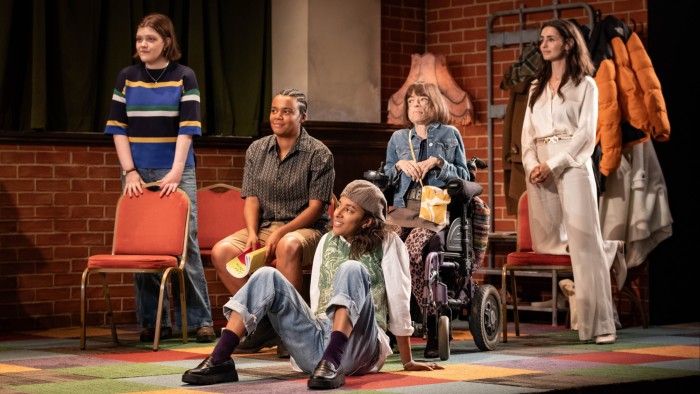
The Ministry of Lesbian Affairs might sound like a government department guaranteed to send Doge devotees into a flat spin, but in fact it’s the name of the lesbian choir at the heart of Iman Qureshi’s rich and hugely enjoyable musical comedy. This eclectic ensemble meets once a week in a leaky church hall (you can see the damp on the walls in Anna Reid’s delightfully evocative set) to work through conductor Connie’s curious repertoire of songs, but also to gather in a welcoming space — leaks or no leaks.
Among the assembled altos and sopranos are Bridget (Mariah Louca), the group peacemaker, who nurses a quiet devotion to the acerbic Fi (Liz Carr), plus newbies Ana (Georgie Henley), an anxious academic, and her shy partner Lori (Leah Harvey), who still isn’t out to her Black churchgoing family. Then there is exuberant womaniser Ellie (Fanta Barrie), who — despite instructions to leave newcomers alone — makes a beeline for sweet ingénue Dina (Serena Manteghi), married to a controlling husband but keen to explore her sexuality.
Presiding over affairs is Connie, a self-styled OWL (older wiser lesbian), who brings infectious enthusiasm and a wildly eccentric conducting style to the task, and is played with terrific physical comedy by Shuna Snow. There’s something very touching about her delight as she leaps about, leprechaun-like, coaxing the choir through a cappella versions of “Puttin’ on the Ritz”, “Downtown” and “O Fortuna”, oblivious to the fact that they might favour a few additions from the 21st century. That, and the struggle to get a ramp installed for wheelchair user Fi, are among the rumbling concerns in the opening scenes.
Qureshi’s script is packed with mischievous humour and deliberately toe-curling puns — “this is a nut-free zone” — and neatly bats away any objections about stereotypes. “If you’d been doing this as long as me, you’d know all stereotypes come from somewhere,” says Connie, firmly, at one point. Besides, these characters are vivid, flawed and complex. And soon serious issues emerge; among them, cultural heritage, racism and transphobia. This last becomes bitterly personal for Bridget after the choir’s joy at being selected to perform at Pride is cut short by one clumsy blunder.
Qureshi says that she wrote the piece partly because there are so many great queer plays focused on men — The Inheritance, Angels in America, The Pride, The Normal Heart — but few about women. Her play suffers a bit from trying to cram so much in: the sharp turn into the trans debate feels rather awkwardly engineered and Dina’s back-story is undernourished (as a Qatari immigrant, she daren’t leave her husband).
But it’s still wise, frank and funny, the more uplifting for its honest ending, and it is joyously delivered by a wonderful cast in Hannah Hauer-King’s production. There are particularly lovely performances from Louca as the gentle Bridget and Harvey as the guarded Lori, who reveals a glorious voice as she begins to open up. In the end, Qureshi’s play poignantly foregrounds the importance of found family and the difficulties of achieving harmony — in life, as in song.
★★★★☆
To July 12, kilntheatre.com
Read the full article here