

Unlock the Editor’s Digest for free
Roula Khalaf, Editor of the FT, selects her favourite stories in this weekly newsletter.
Emma Prempeh’s panoramic painting Come see has an arresting, cinematic presence. It is made in oil, acrylic and Schlag metal – an imitation gold leaf that changes as it oxidises. But it’s the central female figure in the scene who commands the attention: seen slightly from below, she is caught
mid-conversation, finger wagging in the direction of an unseen person – a gesture that underscores her authority. The woman is Prempeh’s mother, Carmen, in one of several paintings made by the artist on a trip to St Vincent in the Caribbean in 2024. It was the first time her mother had returned to her birthplace since leaving for the UK aged 16. “It was a spiritual homecoming for both of us,” the artist says.
Prempeh took the trip because she “wanted to look at my family to understand my existence and where I came from. It has been challenging, but also a blessing.” She has been estranged from her father, who lives in Ghana, since she was 11. Art has become a way of communicating and addressing absence. During a residency in Accra this spring she plans to confront him – in painting. “I thought, I need to tackle this through my art – it enables me to speak to him, because in conversation he’s hard to reach emotionally.” A show at London’s Tiwani Contemporary gallery this autumn will bring together some of her works.
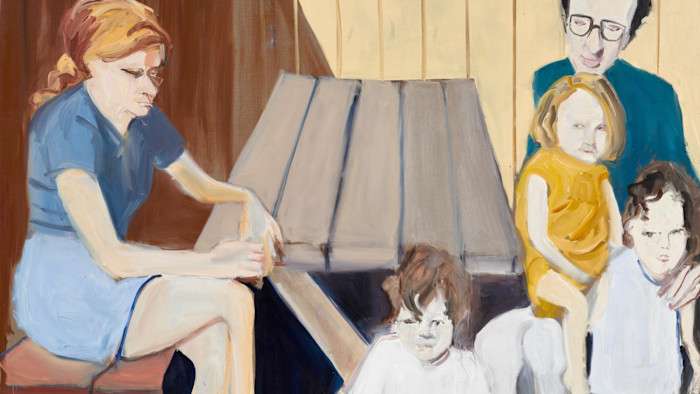
Prempeh is one of many contemporary artists making work about family. British artist Chantal Joffe has long turned to family photographs for her paintings, using them to reflect on ageing, loss and how we are shaped by memory (see the larger-than-life odes to her late mother and father that appeared in her most recent solo exhibition at Victoria Miro). Photographs by Nan Goldin and Zanele Muholi have chronicled friends and lovers and challenged the image of the traditional nuclear family model. Njideka Akunyili Crosby, meanwhile, blurs the line between private and public in her large-scale works.
They all belong to a well-established canon. The family portrait surged in popularity in the 18th century thanks to masters such as Thomas Gainsborough, Sir Joshua Reynolds and George Romney. The works were used by aristocratic households to assert wealth, status and moral standing. But many contemporary makers are drawn to conveying a different set of ideals. New Delhi-based artist Sohrab Hura’s depictions of familial scenes, for instance, are small-scale portraits: pictures that could be carried around. He began photographing his mother as a way to cope after she was diagnosed with schizophrenia. “Photography gave me a lifeline at a time when my world had seemed to crumble, and from then on making photographs became a way for me to deal with the world,” he says. In 2022, Hura brought drawing and painting into his practice, allowing him to look at his family in a more elastic and expressive way. In the artist’s recent exhibition, Mother, at MoMA PS1, his portraits show a deep affection while also capturing something of a parent’s distant, unknowable world.
When a family has experienced trauma, exile or displacement, the portrait becomes particularly charged. At London gallery Autograph’s group exhibition, I Still Dream of Lost Vocabularies (on until 21 March), a series of family portraits reminds me of my own family albums featuring my grandparents in Sri Lanka – smartly dressed, handsome figures arranged by age and posing against tropical backgrounds. Yet in Sabrina Tirvengadum’s images, the closer you get, the more confused the details: stairs lead to nowhere, tables float, faces are warped and bodies have odd proportions. They are glitches produced by the AI tool she uses to create the works.
Tirvengadum grew up in the UK with Mauritian-born parents, and had few photographs of her relatives. “With my family mainly in Mauritius, I had images from my family archive but little context around stories like the Indian indenture system,” she says of the colonial labour regime that saw more than 1.6 million Indian workers taken to the British colonies. “That distance and those historical gaps made me feel disconnected. Exploring them through art became a way to reconnect with my roots.”
For people who had to leave their homes without photos, AI can reimagine “moments where no images exist”, says Tirvengadum. “It’s an opportunity to restore what has been lost and to retell stories. It becomes a way of saying, ‘We exist here too.’”
While researching her surname, Tirvengadum discovered a link, confirmed by DNA, to a French aristocratic family, the Marrier d’Unienvilles, for whom her great-grandmother had worked as a maid. It changed completely the notion she had of her family history. “The work has opened up conversations we hadn’t really had before and has brought people closer,” she says. “There have been questions about why I’m doing it, but there’s also an understanding that this wider history of indentureship needs to be spoken about.”
Somerset-based painter Antonia Showering became particularly interested in painting her family while she was a student because they were reliably available. It’s another tradition: James Abbott McNeill Whistler’s dour portrait of his mother from 1871 only exists because his original model didn’t show up. Showering painted her younger brother most frequently while at the Slade School of Fine Art in London. “I assumed he was delighted to feature, but when I asked him about it, he seemed indifferent, and on reflection, that’s probably why it was him I chose to paint most at that time,” she says. “He didn’t sit in interesting positions, or get upset if it was distorted or unflattering. He also became a father young, so seeing our roles within the family move along life’s conveyor belt made me want to paint that.”
Showering’s latest paintings are still informed by family relationships. In the artist’s 2025 solo exhibition at Timothy Taylor’s gallery in New York, several paintings featured her late grandmother, whom she lived with for many years. “During my grandmother’s illness, I struggled to paint anyone else. I wanted to hold on to her, to remember her hands, her hair.” In the painting 5L, from 2024, several figures swirl together in a loving, hazy embrace. “As the work was developing, I realised I had painted our final moment with my grandmother, with family surrounding her,” she recalls.
But for Showering, it’s important that once the work leaves the studio, she doesn’t “put too much onus on who the figures are”. She hopes the viewer will “recognise relationships from their own worlds and histories”.
Read the full article here