

Unlock the Editor’s Digest for free
Roula Khalaf, Editor of the FT, selects her favourite stories in this weekly newsletter.
In 1941, an Australian unit stationed in Syria rescues a small boy from a blazing building. The next day, a soldier goes for a wander with the child while his comrades share cigarettes and trade jokes. Suddenly the air fills with smoke and screams. The men race to the site of the explosion to find their comrade mortally wounded and the boy who was saved just hours earlier now dead.
This punishing sequence sets the tone for The Narrow Road to the Deep North: an outstanding new second world war drama arriving now on the BBC. Adapted from Richard Flanagan’s Booker Prize-winning novel, the five-part series dispenses with heroism and sentimentality, instead offering a visceral, unsparing confrontation with “the immense suffering, the constant sorrow, the pointlessness of it all”.
The words belong to the show’s protagonist Dorrigo Evans, who appears in dovetailing timelines as both reflective veteran played by Ciarán Hinds and as a harrowed military surgeon played by Jacob Elordi.
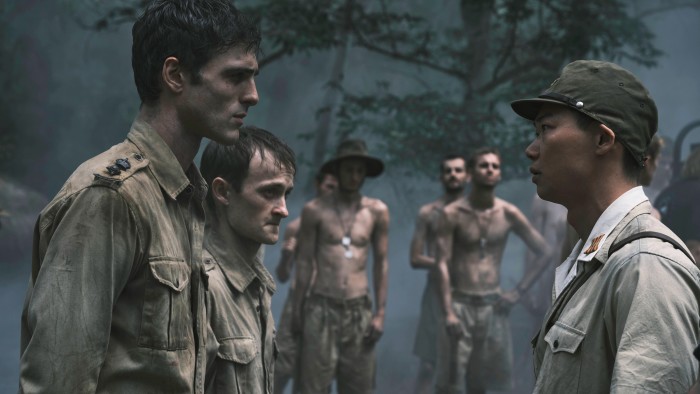
For much of the runtime, the series serves as a gruelling chronicle of the ordeals endured by Dorrigo and his comrades — first in Syria, and later as prisoners of war condemned to labour on the infamous “death railway” in Burma by their Japanese captors. But a framing narrative set in 1989 also thoughtfully captures how war is remembered and the impossibility of conveying the horrors to those who weren’t there. Asked to share his experiences at a book launch event, the older Dorrigo finds himself unsure what to say, and what to leave out.
“They don’t want to hear what happened,” he observes dolefully at one point. While he’s thinking of his audience — artsy types who want to be stirred but not put off their champagne and canapés — it can also feel like he’s tacitly addressing us viewers, accustomed to tales of action and camaraderie; bands of brothers and rogue heroes.
But series co-creators Shaun Grant (who writes) and Justin Kurzel (who directs) don’t spare us the grim realities of the POW camp. Here we see soldiers reduced to skeletons by disease and exhaustion, graphic shots of injuries and amputations, and moments of utterly inhuman brutality. Whenever you think Kurzel is going to cut, he asks us to keep bearing witness.
If there’s plenty to turn stomachs here, there’s also much to get hearts fluttering in the show’s poignant third timeline. Set in the months before Dorrigo’s deployment, it follows his short, intense affair with his uncle’s vivacious (and much younger) wife Amy (Odessa Young). But all the tenderness and simmering sensuality of these scenes is belied by a gnawing sense of fatalism. After all, we already know from the 1989 segments that Dorrigo married the fiancée he had been planning on leaving.
While Elordi’s quietly communicative, assured performance serves well in both scenes of love and war, Narrow Road is perhaps most compelling in its flash-forwards, in which the ever-reliable Hinds and Heather Mitchell as his wife Ella capture the aching, understated sadness of a relationship defined by trauma, regret and disappointment. “I waited for you,” Ella says to her husband, who didn’t return as the same man who left in 1941. He survived hell, but she remained in limbo.
★★★★★
On BBC1 on July 20 at 9pm. New episodes weekly and streaming on iPlayer. Streaming on Prime Video in the US
Read the full article here