

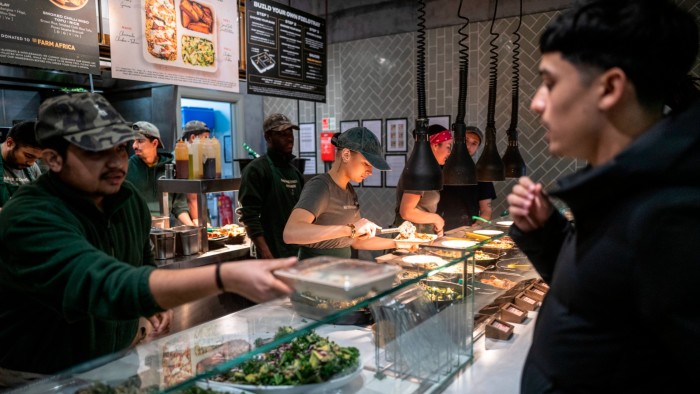
At lunch time in London’s Canary Wharf, office workers are queueing round the block for salads.
“It’s nice to have a treat,” says civil servant Rachel, one of a dozen people waiting in line for Farmer J’s build-your-own “field trays” of grains, greens and toppings such as chermoula chicken and miso tofu. “Not something unhealthy — just spending a bit more money . . . Not many people are happy to settle for the same sandwich these days.”
As business districts refill with workers, the office lunch is back — and has evolved beyond the dry baguettes and wilted, barely dressed leaves that used to be commonly eaten at desks. In London, healthy — and often pricey — new takeaway outlets are expanding fast, fuelled by City workers with high expectations of nutrition and a desire to make the most of their days in the office.
“We sell a lot more salads than we did pre-Covid,” says Sam Cole, co-founder of The Salad Kitchen. It opened its first premises in 2014 and has doubled revenue — last year to £5mn — and turned a profit each year since 2021. “There’s a buzz in the office districts . . . People keep coming back every day because they don’t feel guilty about it.” The business aims to open a further seven stores by the end of 2026.
The Salad Kitchen says all its ingredients are fermented, roasted or marinated in-house. It is a subtle USP when most of its competitors also broadcast unprocessed, seasonal and nutritious credentials. Many offer design-it-yourself bowls assembled in front of customers or picked up from stores reminiscent of biotech labs. The new office take-out marries the virtues of self-care, business-like optimisation and a tasty treat. Who says you can’t have it all at lunch time?
“Ten years ago, something was defined as a healthy option if it had a bit of green in it,” says Stuart Fyfe, managing director of retail leasing at Canary Wharf Group. “Now customers are much more literate about things like gut health and processed foods.”
The rapid expansion aligns lunch offerings in central London more closely with those of US cities such as New York, where customisable, freshly made salads have been a staple for a decade or more. Sweetgreen, a leading US salad chain specialising in “fresh, plant-forward, earth friendly” salads such as Super Green Goddess, lists 45 locations in the New York area alone.
The catch, perhaps, is the price. Menu items at outlets such as The Salad Project can exceed £12, depending on customisation. At The Salad Kitchen, a basic bowl with a protein topper costs around £7-£8.
Providers say prices are a reflection of quality — and they have no shortage of demand. “People do want to take a break away from their desks,” says Eleanor Warder, co-founder of Atis, which as of this month has 10 London locations.
This might be an upshot of inflation. When lunch at chains such as Asian-inspired Itsu and sandwich specialist Pret A Manger creeps closer to £10, a little more for a salad that contains one third of your recommended 30 plants a week may seem less unreasonable. In 2020, the price of a hot meal at Itsu was not supposed to exceed £7; the threshold is now £10, an increase chief executive Julian Metcalfe blames on staff costs and rent rises. “Office lunches [have] probably become very expensive,” he says.
Metcalfe believes “salad is not the answer” to demand for healthier choices, instead recommending easier-to-assemble options such as noodles, broth, brown rice and cooked vegetables (all of which appear on Itsu’s menu).
Warder disputes the idea that the premium options offered by Atis are too complicated. “The ticket pricing gap is closing . . . People are starting to recognise they can go somewhere else,” she says. When Atis opened in 2019, she hoped to generate “buzz” around the idea of “reclaim your lunch break”.
Industry analyst Simon Stenning compares these brands to one-time disrupter Pret. When he worked for the now ubiquitous lunch outlet in the 1990s, it was the “new kid on the block that everyone wanted to emulate”. It still makes its sandwiches and salads on-site and now has more than 690 shops internationally, including more than 480 in the UK. But Stenning argues it is “less premium, more mainstream”. “Once you get to become the market leader you’ve got everyone snapping at your heels.”
That means opportunities for disrupters, which are often basing themselves in smaller, cheaper, takeaway outlets. The Salad Project has grown to seven branches since 2021 and hopes to nearly double its roughly £13mn 2024 revenue to £22mn this year. It is a tiny proportion of the overall market but Stenning says the growth potential is strong. The UK food-to-go market is expected to grow by 3.3 per cent to £24bn in 2025, driven by lunch purchases and outpacing total eating out market growth, according to food and drink research firm Lumina Intelligence. “They’re up against a huge market, but there’s fantastic scope to build on that if they get the formula right,” he says. “I think some of them are really well placed to grow exponentially.”
Despite return-to-office mandates, lunch providers are still contending with a limited customer base compared with five years ago. Transport for London data analysed by property consultancy Cushman & Wakefield showed an approximately 22 per cent decrease in footfall compared with pre-pandemic levels across a sample of 14 stations with key food and beverage hubs.
That does come with an upside, however. C&W analysis of 10 central London locations showed food and beverage rents remained about 20 per cent below pre-pandemic levels. Trading revenues for the grab-and-go sector have remained broadly positive, increasing about 25 per cent during the 2023-24 year.
At The Salad Project, which serves about 6,000 salads daily, co-founder James Dare says appetite for premium lunches has not been hurt by lower footfall. When workers only commute on two or three days, “a perk of going in is to get your favourite lunch”, he says.
Cheaper post-lockdown rents gave the business “the opportunity to get a site that would’ve been previously out of budget”.
Matt Ashman of C&W says demand also increased in cheaper suburban neighbourhoods where people were working from home. “Cool, independent and growing [food and beverage] groups realised they could go out to London neighbourhoods.” Pret has also taken this strategy, expanding rapidly outside of the capital. The sector also benefited from a countercyclical element to economic doldrums. “You might not go on holiday but you might treat yourself to a lunch date.”
Dare of The Salad Project says the company will double its store numbers this year, including in more residential locations. “We’re being proven that we were very right with our prediction that the quick service restaurant category in the UK is still in its infancy compared with the US.”
Read the full article here