
‘The play we need now’ — how images of Auschwitz staff at leisure became Here There Are Blueberries

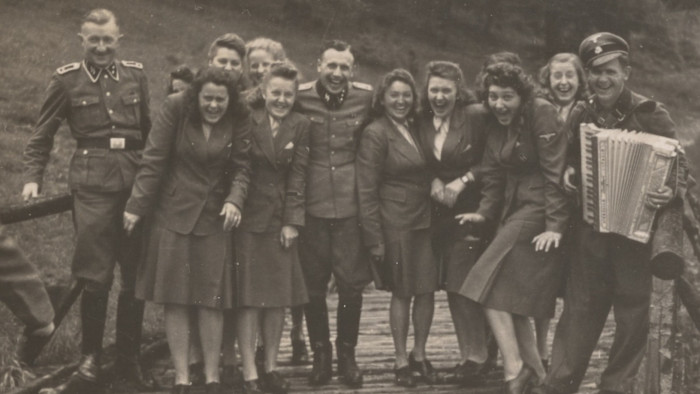
A man pets his dog affectionately. A group of men cluster around a table, drinking beer. A row of young women perch on a fence, laughing and joking as they share freshly picked blueberries.
These could be any holiday snaps: cheery images of workers kicking back and relaxing after days of hard graft. But this is Auschwitz, 1944. The men are SS officers, the women are communications staff; the pictures belong to a remarkable photo album documenting life inside the death camp as lived by the officers in charge.
Looking at them, your blood runs cold. We all know what horror was going on just outside the frame: 1.1mn people were killed at Auschwitz-Birkenau. And yet here are these smiling faces, these people lounging in deckchairs — images of apparent normality, all assiduously documented by Karl-Friedrich Höcker, adjutant to the camp commandant.
It was precisely that chilling dichotomy that struck theatre writer and director Moisés Kaufman when he first saw the photos in a 2007 newspaper report.
“My father is a Holocaust survivor, from Romania,” says Kaufman, when we meet in a rehearsal room in London. “And I always knew I wanted to write a play about the Holocaust. But it is the event in history that has been most written about. What is there left to say? Certainly by me. Then I saw these photographs and I got chills up my spine. I thought, ‘How do you eat blueberries next to a concentration camp? I think there is a play here’.”
Kaufman co-founded Tectonic Theater Project, a New York-based company that champions new theatrical forms aimed at engaging audiences in vivid dialogue. (Previous works include The Laramie Project (2000), which investigated the murder of college student Matthew Shepard). His instinct was to bring the photo album to the stage in a way that would drill into the deeply disturbing issues it raises.
So he sought out Dr Rebecca Erbelding, the archivist who first received the album from a US counter-intelligence officer, at the US Holocaust Memorial Museum in Washington. Their meeting was supposed to last an hour, but ran to three days. From this sprang Here There Are Blueberries, a Pulitzer Prize-nominated docudrama, written by Kaufman with Amanda Gronich, first seen in California in 2022 and now making its UK debut at London’s Theatre Royal, Stratford East.
The play spools out like a detective story, tracking the painstaking work of Erbelding and her colleagues to verify the photos and identify their subjects. Meanwhile, the photographs themselves loom large over the stage. For Kaufman, that’s important: the pictures play an integral part.
“I wanted the audience to have that undiluted experience of them,” he says. “To discover what is in the images, to interrogate them. We make the audience co-detectives: they are scanning the photographs for information. And what happens in performance is that there is an incredible silence.”
There’s a ghastly fascination in studying the faces of these individuals, scrutinising them for what was going through their minds. But pulsing beneath the play is the question: should we? Should we give the perpetrators any attention? That concern has gripped everyone involved in the project.
“When I first looked at the pictures, I thought ‘I’m not sure it’s possible to make a play about a Nazi photo album’,” says Gronich, on a Zoom call from New York. “It was an incredibly daunting idea. You’re inviting the audience to step into the selfies of an SS officer. That’s really what these pictures are. These people were caught up in a horrific regime, they carried out the most terrible atrocities against fellow human beings. Why should we spend time with them?”
The answer, she suggests, lies in that very facade of normality. Seeing mundane images of the Nazis makes it harder to dismiss them as simply devils: “They were real people like us. It behoves us not to turn them into aberrant monsters. If we make [Nazi physician Josef] Mengele into a freak, then we learn nothing.”
Take away that buffer, she adds, and the bigger question is exposed: how did ordinary people succumb to such a poisonous ideology? At a time of rising xenophobia and division, that feels like an important question to address.
“I’m a Jewish artist,” she says. “We lost a whole branch of our family in the Holocaust. So this was deeply personal to me. I kept thinking, ‘Do we dare to do this play?’ But every survivor who has looked at the Höcker album has said, ‘You must tell this story, let people see it for themselves.’ So it was incredibly important to feel that we are honouring the victims as well. We owe it to the survivors to say, ‘We must understand how human beings did this.’ What do you learn about the human capacity to destroy one another? Where does that come from?”
Several of the photos were taken at the Solahütte, a lakeside guesthouse used by the SS for rest and recreation. The unseen awful context for these cheery snaps demonstrates how people can literally screen out what they don’t want to see. As in Jonathan Glazer’s 2023 film The Zone of Interest, about the family life of Auschwitz commandant Rudolf Höss next door to the camp, it’s the detailed and determined pursuit of normality cheek by jowl with atrocity that is so sickening, and so disturbingly revealing of psychology. Murder people by day; pet your dog by night. (Images of the charming Höss home, just yards from a gas chamber, appear in the play, together with testimony from his grandson.)
“You have to remember that they thought they were going to win the war,” says Gronich. “And what you see in these pictures is how they envisaged their lives were going to be when they eliminated all of the so-called ‘undesirables’. So of course there are no pictures of the atrocities [in the album]; of course there are no prisoners. That’s not what Höcker wanted to remember.”
Erbelding, who still works at the museum, points out that Höcker would have had to frame many photos carefully to avoid including any of the many thousands of prisoners at the camp. “He’s deliberate in the photos that he chose, and where those cameras were aimed. There’s a picture of him that is just marked ‘summer 1944’. He’s by a tree and there’s an air raid shelter behind him. That is right inside the famous ‘Arbeit Macht Frei’ gate in Auschwitz, so there are prisoners all around him, but he’s made sure they are not in the shot . . . His album is both true but also a lie: it’s a deliberately created reality.”
The play purposely undercuts that partial narrative, setting Höcker’s photos alongside those from another famous album from Auschwitz (the Lili Jacob album) depicting the arrival of thousands of exhausted prisoners. But the drama’s import extends far beyond historical context. Coming at a time when history is fiercely contested, when facts are elbowed out by conspiracies and deepfakes, and when demagogues and division are on the rise, it sends a stern warning from the past. Demonisation of the “other” can enable horrors. As one character says, “Every genocide starts with words.”
Those apparently banal images force uncomfortable reflection, says Kaufman. “We have so many defence mechanisms. We say, ‘the Nazis were monsters, so they could do horrible things. That exonerates me because I’m not a monster.’ But if we say ‘the Nazis were human beings who did monstrous things’, then we have to look at ourselves in the mirror. We want people to look at the pictures and say, ‘I like blueberries. I have a dog. I play with my dog exactly the way that guy is playing with his dog.’ And then you have to say, ‘What would I have done in that situation?’”
The play, he says, explores “the continuum between culpability, complicity and complacency”.
“I think that if I was writing the first play ever written about the Holocaust, I would have a different responsibility. But I feel very strongly that the focus the play takes is something we desperately need right now. To me, the biggest defence of it is: look at where we are now. This is the play we need now, especially in America.”
‘Here There Are Blueberries’, Theatre Royal, Stratford East, London, January 31-February 28, stratfordeast.com
Also at Seattle Rep, January 21-February 15, heretherareblueberries.com
Find out about our latest stories first — follow FT Weekend on Instagram, Bluesky and X, and sign up to receive the FT Weekend newsletter every Saturday morning
Read the full article here