

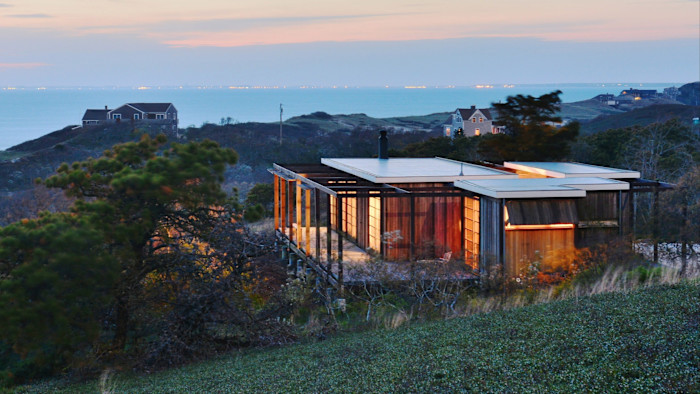
To reach the former home of the Hungarian-born architect and designer Marcel Breuer in Wellfleet, Massachusetts, you’ll need to drive slowly. Rutted dirt tracks twist through pine forests here on the outer edge of Cape Cod, where GPS is useless. Around a bend and up a steep incline, the house suddenly reveals itself: an austere, L-shaped masterpiece of mid-century modernism overlooking a tranquil pond. Built in 1949 and twice extended in the 1960s, this cabin in the woods was an unlikely meeting place for artists and architects and the launch pad for a revolution in design.
As of this year, Breuer’s house welcomes visitors on occasional open house days. True fans of the Bauhaus alumnus and leading proponent of brutalism can book to stay. Artists can take inspiration during residencies. All of this is possible due to the work of a small group of architecture enthusiasts and Wellfleet locals who make up the Cape Cod Modern House Trust (CCMHT).
Peter McMahon is the founding director of the CCMHT, overseeing the care of five mid-century properties of historic significance in Wellfleet. He’s also the co-author of the book Cape Cod Modern, which documents the history of local modern architecture beginning in the 1940s, when émigré artists and writers such as Max Ernst, George Grosz and Arshile Gorky were first attracted to the area for its remote beauty. The artists were soon followed by architects including Serge Chermayeff, with whom Breuer stayed in 1945, when he decided to buy his own lot across the road. Together they created a nexus for modern art and design that would go on to draw into its orbit the likes of Walter Gropius, Peggy Guggenheim and Alexander Calder.
The homes Breuer and his cohort built offer a survey of modernist tendencies — some light and airy, others sculptural and heavy — each putting forward their own version of how to live close to nature, which was ultimately the reason they came to Cape Cod. Many of these homes weren’t showpieces, but experimental prototypes the architects used to work out new ideas with the hopes of replicating them on an industrial scale, including Breuer’s design for his own house.
“It was that kind of experimentation with materials, including new materials and how a modern form . . . could be simple, but also rigorous,” says K Michael Hays, professor of architectural theory and co-director of the Master in Design Studies at Harvard’s Graduate School of Design. “The Breuer house singularly stands out for that.”
The form of the house is an elevated, wooden rectangle with large picture windows, an early example of Breuer’s “longhouse” buildings which now dot the east coast of the US. The interior of the original building feels modest by today’s standards: plywood walls, two bedrooms and a single bathroom, with a small kitchen in Breuer’s signature deep blue.
“I think a lot of people assume that it’s a very grandiose house, and it’s honestly pretty basic,” says Francesca Breuer, the architect’s youngest child and namesake of his tubular Cesca chair. “I don’t think he had ever anticipated that it would still be there after this many years because it’s a pretty simple build.”
Its furniture — most of it original — will be familiar to any Breuer aficionado, but there are a few surprises. Benches designed by him for the Whitney Museum in New York stand by the living room entrance, here made of heavy lumber and plain canvas with added back cushions. In a bedroom towards the back, Breuer’s leather and chrome Wassily chair and Laccio side table sit across from a Transylvanian folk chest brought over from his native Hungary. And throughout the house, artworks by Paul Klee and Josef Albers hang from the walls by thumbtacks, just as they had in Breuer’s time (though these days, they’re reproductions). The true luxury, however, is the view of Williams Pond, best enjoyed from a hanging screened-in porch.
Surrounded by the woods of Wellfleet, the Breuers took their meals around a massive slate and concrete table that anchored the space. But over the course of 65 years, the weight of the table began to pull down the porch, and then the whole house with it. When McMahon’s team started renovations, the walls were 5 inches out of plumb. Supporting the porch and bringing the house back into alignment were some of the many jobs that lay in store when the trust bought the property in 2024. But the origins of McMahon’s quest to save the Breuer house can be traced decades earlier.
A Wellfleet summer resident since childhood who trained at Boston Architectural College, McMahon had always been fascinated by the unusual concentration of modernist homes in the area. In 2005, he began photographing some of these structures, many of which were crumbling among the dunes of the National Seashore. Their ruin was a byproduct of local environmental conservation; when the Cape Cod National Seashore was created by the Kennedy administration in 1961, the houses within its borders became property of the National Parks Department. These homes were purchased and leased back to their owners for 20 years and then were intended to be torn down. A half-century later, many were forgotten and slowly falling into the sea.
With the help of National Park historian Bill Burke, McMahon began to map out which houses were still standing. “I started just going around on all the dirt roads and just trying to find all the modern houses,” McMahon recalls. “There was no map and no records in the town, no building permits. You’d have to go look for them.”
The first house the pair looked at was the Kugel/Gips house, a low, sprawling, flat-roofed home built into the side of a hill that evokes both the work of Frank Lloyd Wright and a concrete bunker.
“Oh, this is a Charlie Zehnder house,” McMahon exclaimed when they visited. “I know, I grew up in one.”
“Well, you know, if there was a non-profit we could deal with,” Burke replied, “we could lease them the house, and they could figure out what to do with it.”
McMahon filed to create a 501 C3 (to make the trust a non-profit) within a few weeks and took out a lease on the Zehnder house. It had been empty for 11 years and the damage was significant. Six inches of water sloshed in the basement, raccoons and bats had moved in upstairs, and the roof had failed. With small donations and funds from the Wellfleet Community Preservation Act, McMahon renovated the house and turned it into the first rental property. Its income allowed him to invest in the next property, and on it went. In the years that followed, the trust added homes designed by Jack Hall, Paul Weidlinger and Luther Crowell. But for McMahon, the Breuer house, which was still owned by the family, was always “the crown jewel”.
After the deaths of Marcel and Connie Breuer, the house was inherited by their son Tamas, a photographer who had neither the means nor the inclination to keep the place up. Over the years, McMahon got to know Tamas, listening to his stories over Klondike bars and doing simple repairs. His first concern was the condition of Breuer’s artworks and rare books, which were being slowly eaten by silverfish. To keep them safe, he was allowed to start removing things to off-site storage — in what he called “a trust-building exercise”.
Over the years, Tamas had discussed selling the house, whose oversized parcel and grandfathered status in the National Seashore would make it particularly attractive to developers. When he dropped his price to $2mn in 2023, McMahon knew he had to act quickly. “That’s when I went to the board and I said, ‘$2mn is the appraised value of the land. Someone’s gonna buy this and tear the house down.’”
The group had never purchased a home outright before, and had never raised this kind of money, but with the help of local grants and a wide network of design lovers who recognised the significance of the home and wanted to prevent its loss, CCMHT was able to secure the house. Then construction began, and with it, new problems. A simple wall repair necessitated a complete replacement, tariffs delayed the mahogany deck, and a bitter winter closed the site for months.
When the construction finally wrapped last July, Francesca and her husband visited the property and were amazed. “Except for a few minor details, it definitely looked like the house I grew up in,” she says. The furniture is in its rightful place and the books have returned to their shelves; stepping inside, one feels as if the family has just gone out for a swim.
While Breuer travelled the world for projects, lectures and exhibitions, this house remained his centre of gravity, the place where he found peace. Outside, a boulder marking the architect’s grave stands guard, ready to watch over the house for many decades to come.
ccmht.org
Find out about our latest stories first — follow @ft_houseandhome on Instagram
Read the full article here