

Unlock the Editor’s Digest for free
Roula Khalaf, Editor of the FT, selects her favourite stories in this weekly newsletter.
“What tremendous rejoicing and applause! A delirium unparalleled in the annals of furore”, wrote the German poet Heinrich Heine. “He is here, the mad, handsome, ugly, enigmatic, terrible, and often very childish, child of his time . . . whose genius enchants us.”
The occasion was a legendary piano recital in Berlin in 1844 by the Hungarian pianist Franz Liszt. So great was the frenzy that a special term was coined: Lisztomania. Hans Christian Andersen said that “flowers rained down upon him”. The philosopher Friedrich Engels reported that there was a fight over a glove he had dropped. A countess kept the dregs from Liszt’s teacup as a permanent memento on her writing desk. Women are said to have thrown their underwear at him.
All art forms have their icons — and classical music is no exception. Now a new wind is blowing. It originated in east Asia, but a remarkable generation of young pianists from the west are also being caught in its wake.
The advent of Chinese pianist Lang Lang around the turn of the millennium heralded a new dawn. Since then, he has achieved worldwide fame, playing the opening ceremony of the 2008 Beijing Olympics, Queen Elizabeth II’s Diamond Jubilee concert and the Coronation Concert of King Charles III. And he reached a new audience with his role as mentor in the hit TV series The Piano, from which he recently stepped down.
Lang Lang has been followed by a string of exceptional young pianists from Asia: Yuja Wang, Seong-Jin Cho and Mao Fujita, to name but three.
“We are in a golden age for pianists,” says Clive Gillinson, executive and artistic director of Carnegie Hall. “Lang Lang was certainly part of what helped to build this. When a person becomes a figurehead, they are an inspiration to a generation and a lot of extraordinary people have gravitated towards the piano. It is like when you get one great tennis player in a country. I have never understood why classical music has such an extraordinary resonance in east Asia, but it is not only pianists from that part of the world that have come forward. Think of Víkingur Ólafsson, Igor Levit, Daniil Trifonov.”
What is remarkable is that each is so different. Wang’s eye-catching outfits could hardly contrast more with the sober Ólafsson. The poetry of Seong-Jin Cho and precision of Alice Sara Ott are poles apart from the power-playing Trifonov or the intellectual Levit.
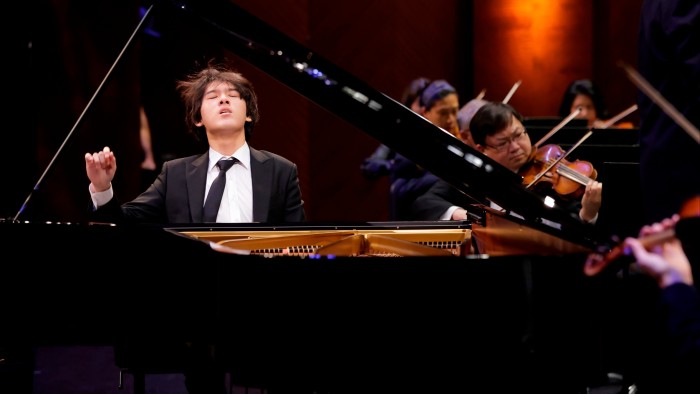
Now another young star has rocketed into orbit. When Yunchan Lim won the Van Cliburn International Piano Competition in 2022 at the age of 18, he might have been just another teenage prodigy. After all, the competition had discovered precious few big winners since the 1970s. But the scintillatingly brilliant Lim is something else.
“I think he has an ability to pour his soul into every performance,” says Jenny Murphy, head of Decca Classics, Lim’s record company. “We’re bombarded all the time now with personalities and it feels as if audiences recognise when someone really authentic comes across their screen. He is quite reluctant about promoting himself, such as using social media, and has said in the past that he would be happy if he could retreat to the mountains with a piano on his own. The celebrity side of a career is far away from what he’s about, but the fans respect him for that.”
The impact that this new generation of pianists has made on the classical music business can be seen everywhere. Last year, Cho played a concert in London in which the main item was Tippett’s knotty Symphony No 2, guaranteed to empty a hall in other circumstances. But the Royal Festival Hall was packed. “There are very few violinists who could sell out Carnegie Hall,” says Gillinson, “but now we have 10 or 12 pianists who can, which was unheard of 20 years ago.”
Sales reports from record companies put a figure on their success. Ólafsson’s recording of a Bach Prelude in G major, not an obvious hot seller, has more than 44mn streams on Spotify. Alice Sara Ott almost topped the Apple classical chart with her recording of John Field’s Nocturnes, also something of a rarity. A couple of weeks later, Wang had a hit with Shostakovich’s piano concertos.
Clemens Trautmann, president of Deutsche Grammophon, which records many of these pianists, says, “The best-performing classical pianists on Spotify are Lang Lang with 3.7mn monthly listeners, Ólafsson with 2.1mn and Sara Ott at 2mn. Ten years ago, the classical charts conveyed a broader picture, still dominated by the golden generation of Daniel Barenboim, Martha Argerich, Maurizio Pollini and Murray Perahia, but now a few generations have almost been skipped, and it is the 20- and 30-year-olds that have that pulling power.”
The advent of streaming has changed both the way people listen and the age profile of listeners. As Murphy says, individual piano pieces are ideally suited to short-span listening, unlike symphonies or operas, and some of the younger pianists have tapped into this, notably Ólafsson with his dreamy pieces that seduce the ear. “Streaming has created a noticeable repertoire shift,” says Trautmann. “There is a new willingness to make discoveries”.
The clear winner in all this is classical music. At a time when there is a dearth of opera singers and conductors who have broken out beyond the traditional classical audience, music lovers have found a new class of icons to follow.
In a 21st-century way, the most popular of them are reaching many millions of times the number of people who ever saw Liszt play. There are no reports of gloves being fought over or underwear being thrown, but who knows? Those delights may still be to come.
Find out about our latest stories first — follow FT Weekend on Instagram, Bluesky and X, and sign up to receive the FT Weekend newsletter every Saturday morning
Read the full article here