

Unlock the Editor’s Digest for free
Roula Khalaf, Editor of the FT, selects her favourite stories in this weekly newsletter.
Benjamin Britten has become an unlikely speciality in Rome. In the past seven years, the Teatro dell’Opera has presented Billy Budd and Peter Grimes, two of the composer’s large-scale operas, in stagings by British director Deborah Warner. Now she is back in the Italian capital for The Turn of the Screw, Britten’s spare and unsettling chamber work set in an English country house haunted by ghosts.
The production is one of the many highlights of the theatre’s outstanding season. Francesco Giambrone, superintendent since 2021, has continued his predecessor’s good work in transforming a house once known for financial precarity and strikes into a hub for some of Europe’s most interesting directors. That has made Rome a refreshing alternative to Milan’s La Scala, where casts are unmatched but stagings are often staid.
The opera was commissioned by the Venice Biennale in 1954. Myfanwy Piper’s libretto, adapted from Henry James’s gothic horror novella, traces the Governess’s dawning suspicion that the children she safeguards are taunted by ghosts. Britten tells the story with unsparing economy in a score for 13 musicians, its tightly structured scenes built atop harmonies that shift like sand.
Unanswered questions — are the ghosts real?; is the Governess mad?; were the children sexually abused? — drive the work’s unsettling intrigue. Warner does not provide answers, instead enhancing ambiguity in a starkly lit staging as artfully suggestive as it is bare. Floodlights cast long shadows on a back wall; phantoms Jessel and Quint lounge on Miles’s bed as the boy plays the piano. If the ghosts feel all too real when singing in plain sight downstage, they are like chilling voices from the subconscious when emerging from a forest hidden behind sliding doors.
Warner cleverly conveys the Governess’s state of mind, too, the stage set in motion as her grip on reality loosens. Pipes suspended horizontally are gradually pulled upright; Miles’s piano is lowered from above.
Meticulously prepared performances are the core of this production. Anna Prohaska’s Governess, though her voice sounds small in this theatre, charts a credible journey from stoicism to self-doubt and possible psychosis. Emma Bell’s billowing mezzo renders Mrs Grose especially obtuse, while Christine Rice gives Jessel a steely edge. Ian Bostridge, a veteran Quint, sounds remarkably fresh at 60, his otherworldly melismas flowing with ease.
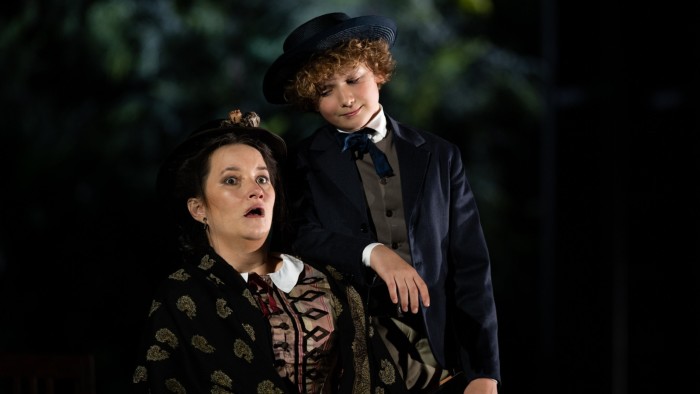
The two children provide some of the best performances, capturing boundless energy and mischief with disarming naturalness as they tear across the stage. As Miles, 12-year-old treble Zandy Hull’s strident voice masks vulnerability and maternal longing behind a boisterous exterior; two years his junior, Cecily Balmforth’s Flora sends a chill down the spine with venomous professions of hatred.
Stepping in for an indisposed Henrik Nánási to make his house debut, British conductor Ben Glassberg conjured oneiric trances in weaving winds, serpentine lower strings and eerie tubular bells. However, while the playing was taut and Glassberg tirelessly mined colour, some of the big climaxes — which can astonish — lacked impact. An evening of finely wrought terror nonetheless.
★★★★☆
To September 28, operaroma.it
Read the full article here