
The Unlikely Pilgrimage of Harold Fry theatre review — hit novel becomes a schmaltzy musical

Unlock the Editor’s Digest for free
Roula Khalaf, Editor of the FT, selects her favourite stories in this weekly newsletter.
When a book sells millions of copies, makes the name of a debut author, is translated into multiple languages and becomes a quirky film with Jim Broadbent, there’s really only one destination left: make it a musical.
Step forward The Unlikely Pilgrimage of Harold Fry, Rachel Joyce’s hit novel, adapted by Joyce herself with music by Passenger (Mike Rosenberg), whose hit song Let Her Go has seemingly been played on a loop in every branch of Starbucks since 2012.
With its sense of niceness and optimism, this premiere at Chichester’s Minerva Theatre, often a promising seedbed for new musicals, finds its feet only towards the end when the poignancy of the story breaks through the sugary glaze.
Middle-aged middle Englander Harold Fry receives a letter from an old colleague saying she’s dying of cancer. He wants to post a reply, but feeling it inadequate instead he embarks on a walk from South Devon to Berwick-upon-Tweed to see her, leaving behind his world of jam and net curtains.
Very quickly Passenger’s lyrics reach for worn metaphors in a succession of folk-adjacent songs about how you can do anything if you believe: flying high, rising from ashes, rainbows and stars and every other hallmark of Hallmark cards.
Only as the lights go down on the act one closer does a hint of anything other than teacakes and inoffensive eccentricity creep in. Mark Addy, gruff but kind-hearted as Harold, does better in the soul-searching second half, pained by his feet and anguished by his past. Jenna Russell is in her element as wife Maureen, who snaps and gripes, and goes on a journey of her own through a series of similar-sounding ballads.
Jack Wolfe, meanwhile, reinforces his rising star status after a brilliant turn in musical Next to Normal in which he played a troubled young man. Here he plays, yes, a troubled young man but also a haunting woodland sprite, Pan-like and Puckish, laurels in his hair, with a wonderful voice.
The quaintness worked in Joyce’s book because there was room for detail and a touch of irony. Here it feels too face-value, especially when set to the mushy music. The only irony is that Joyce’s adaptation lacks forward motion. Harold sets off, then walks for a long time. Not much else happens. He meets a few kindly characters who offer wisdom and, of course, break into song, but these — a wistful farmer’s wife, a closeted gay man with a shoe fetish — miss their target of charming us with their humanity and instead end up as unhelpful stereotypes.
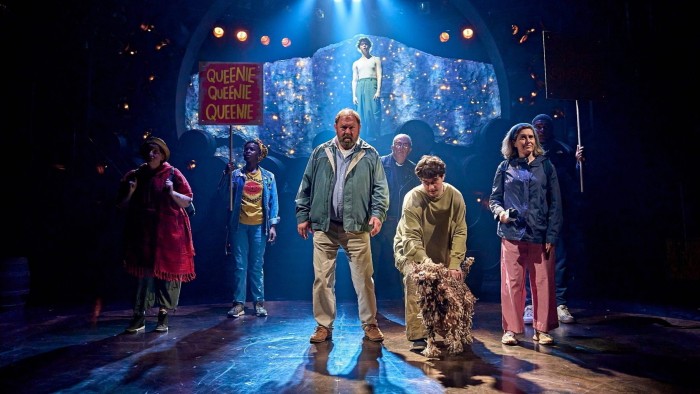
Director Katy Rudd — whose recent hits The Ocean at the End of the Lane and Ballet Shoes were multi-layered feats of playful storytelling — tries to combat that sense of inertia, summoning fun and fantasy where she can. Washing lines, sheep, fairy lights and charming tea rooms materialise with a minimum of fuss and prop-shunting. A puppet dog comes close to stealing the show.
And as the story reveals its secrets, it does build to a moving ending where grief and guilt take their place amid the schmaltz and whimsy. But it’s an awfully long journey to reach that poignant point.
★★★☆☆
To June 14, cft.org.uk
Read the full article here