

Stay informed with free updates
Simply sign up to the Climate change myFT Digest — delivered directly to your inbox.
Temperatures are on track to exceed the 1.5C threshold of average global warming for the longest period yet, as the latest data shows the past three years have been the hottest on record since the industrial era.
The EU’s Earth observation service Copernicus said 2023 to 2025 was set to be the first period when the temperature rise taken as an average would surpass the level at which scientists believe irreversible changes to the planet will begin if sustained.
“A warming of 1.5 degrees may sound small, but we are taking ourselves outside of the climate our entire agriculturally-based civilisation has grown up in,” said John Marsham, professor of atmospheric science at the University of Leeds.
The 2015 Paris accord goal of limiting global warming to well under 2C and ideally to 1.5C since the pre-industrial era refers to a long term average over two decades, taking the measure for the period now to 2043.
But even a temporary “overshoot” of the 1.5C level, for less than two decades, would lead to more severe and widespread effects, scientists say, some of which would be irreversible. These would impact food, water and nature, and displace populations, with long-lasting consequences even if temperatures later drop.
“These milestones are not abstract,” said Samantha Burgess, Copernicus strategic lead for climate. “They reflect the accelerating pace of climate change and the only way to mitigate future rising temperatures is to rapidly reduce greenhouse gas emissions.”
The world breached 1.5C of warming last year for the first time. While 2025 overall may not exceed 1.5C, it was “virtually certain” to be the second or third warmest on record, potentially tying with 2023, Copernicus said.
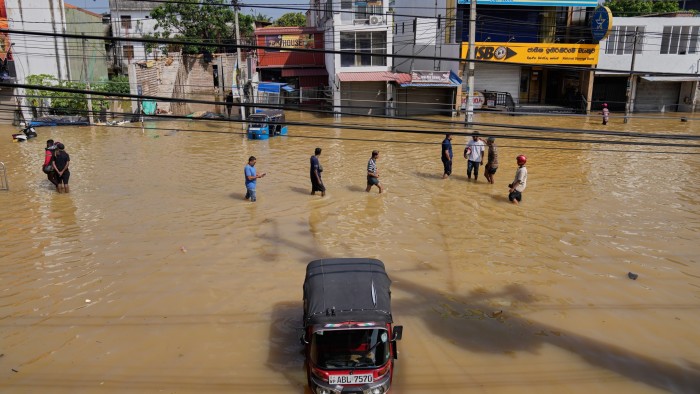
This follows the month of November ranking as the third warmest globally, with temperatures at 1.54C above preindustrial levels. It was marked by extreme weather events that included a rare cluster of tropical storms in south-east Asia leading to widespread flooding and loss of life.
Temperatures were above average in November over the polar regions, in particular over northeastern Canada, the US, the Arctic Ocean and East Antarctica, the agency said. In Europe, temperatures were the highest above average in eastern Europe, Russia, the Balkans, and Turkey.
In the Arctic, the average sea ice extent in November was 12 per cent below average, the second lowest for the month.
The average sea surface temperature for November was 20.42C, the fourth highest value on record for the month.
While much of the north Pacific Ocean was warmer than usual, temperatures were close to or below the 1991-2020 average in the central and eastern equatorial Pacific Ocean.
This reflected a transition to the La Niña phenomenon, the cyclical and naturally occurring Pacific Ocean cooling effect, following a “neutral” period, Copernicus said.
The latest World Meteorological Organisation update shows “borderline” La Niña conditions developing, after the reverse El Niño heating effect helped warm the planet in 2023 and 2024.
Professor Richard Betts, chair in climate impacts at the University of Exeter, said the milestones that were “now coming thick and fast” were a reminder of the need to cut greenhouse gas emissions and adapt “to the climate change we’ve already caused.”
“But crucially, crossing 1.5C should not mean we give up,” he said. “We can still limit further damage by rapid action — but the longer we leave it, the harder and more expensive it gets.”
Read the full article here