

Stay informed with free updates
Simply sign up to the Arts myFT Digest — delivered directly to your inbox.
You may be familiar with the story of the ocean liner that hit an iceberg on its maiden voyage in 1912 and sank, killing about 1,500 of its passengers and crew. Some historical events never get old, and the story of the Titanic, which has spawned films, documentaries, exhibitions, books and even a musical, apparently bears retelling.
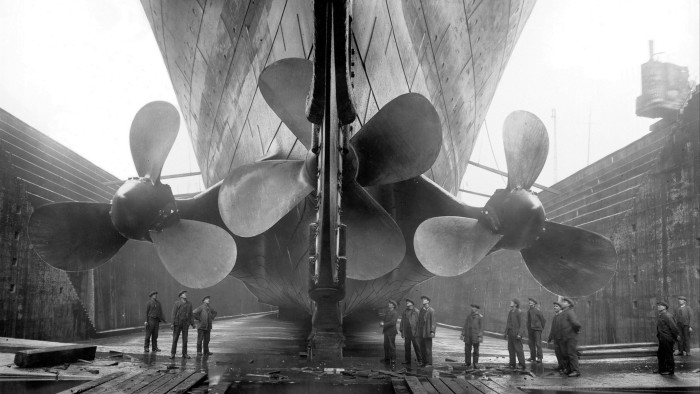
Behold, then, the glossy new BBC podcast Titanic: Ship of Dreams, which promises to take listeners through it all, from the Titanic’s early designs and years of construction to the doomed voyage and its aftermath. The series opens on May 31 1911 in Belfast Harbour, then the heart of the UK’s shipbuilding industry. There, a new liner — 883ft long and known to shipwrights as SS401 — is about to be launched in front of a crowd of spectators, including financier JP Morgan, one of the Titanic’s biggest investors. As the ship is freed from its moorings and moves towards the water, a wooden support topples on the slipway, landing on shipwright James Dobbin, who later dies in hospital. Not an auspicious start for this so-called “ship of dreams”.
We are currently two episodes into this 12-part series, which is narrated by the actor Paul McGann, of Withnail and I fame, and fashionably delivered in the past-present. With his stern tone and exaggerated diction, McGann overdoes the portent, much of the time sounding as if he’s reading from the Book of Revelation. It turns out the actor has a personal connection to the story through his great-uncle. Jimmy McGann served on the Titanic as a trimmer, which meant he ensured that coal for the ship’s boilers was evenly distributed. When the vessel hit the iceberg, he was able to get on an upturned boat and was rescued.
Smart sound design brings to life the industrious sounds of the shipyard, with horns parping in the distance. The narrative is of course familiar, although — thanks to the testimony of assorted experts, historians and Julian Fellowes (writer of the 2012 TV series Titanic) — there is enough detail that listeners may discover something new. I didn’t know, for instance, that more time was spent debating the design of the ship’s carpets than its lifeboats, or that the binoculars put aside for the ship’s lookout were mislaid and never replaced (couldn’t the commanding officers have spared a pair?). Whether this contributed directly to the Titanic’s fatal collision isn’t clear.
One difficulty here is the absence of suspense. How do you build tension when everyone knows how the story ends? The creators of Titanic: Ship of Dreams get around this by focusing less on what happened than why. What went wrong with a vessel that had been hailed as unsinkable? What could have been done differently with its design and construction to avoid such a tragedy? Such are the mysteries that continue to perplex historians — and are why this story is still being told today.
bbc.co.uk/programmes
Read the full article here