
Unsuk Chin’s new opera Die dunkle Seite des Mondes was meant to be a must-see — so what went wrong?

Unlock the Editor’s Digest for free
Roula Khalaf, Editor of the FT, selects her favourite stories in this weekly newsletter.
There can be no doubt that Unsuk Chin is one of the great composers of our time. Her orchestral scores are fastidiously wrought and exquisitely beautiful. They take time to create, which is the main reason why she had, until now, written only one opera. Eighteen years have elapsed since the premiere of her Alice in Wonderland in Munich. So the hype around her new opera, Die dunkle Seite des Mondes (The dark side of the Moon), has been immense.
Sunday’s world premiere at the Hamburg State Opera was departing chief conductor Kent Nagano’s swan song; he had conducted Alice in Munich, making the two works prestigious bookends for his most important posts. This was unquestionably a high-carat event, lavishly presented by a house with considerable resources at its disposal. So why did nobody intervene?
Unsuk Chin decided to write her own libretto, and Hamburg supplied dramaturge Kerstin Schüssler-Bach to help with the German-language text. What went wrong?
To be clear, Chin’s music, as always delicate, complex and intriguingly descriptive, is not the issue. The problem with Die dunkle Seite des Mondes is everything else. Beginning with the subject.
Ostensibly, this is a fictional story of Chin’s own contrivance about the relationship between Austrian physicist Wolfgang Pauli — who worked for a time in Hamburg — and Carl Jung.
Pauli was famous for his role in defining quantum physics back in the 1920s; he told Jung about his dreams, and the two developed a profound and mutually beneficial relationship. In Chin’s telling, Pauli becomes Dr Kieron, a rude and abrasive social misfit; Jung is Master Astaroth, an opportunistic cult leader. Kieron becomes emotionally dependent on Astaroth, only to be first manipulated, then betrayed; along the way, he declines the invitation to work on the atomic bomb. The story is unwieldy and incoherent. Women appear only as lovers or fantasy projections; coming from a female composer, this is particularly disappointing.
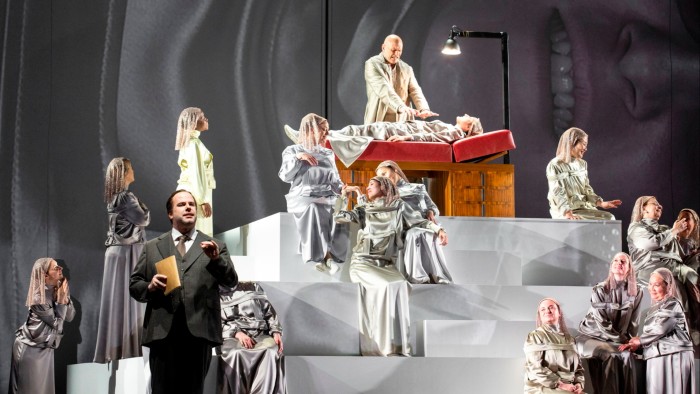
Ben Kidd and Bush Moukarzel from Dead Centre have provided a staging which is heavy on video projections and static imagery; they illustrate the story, rather than directing a drama, leaving the singers to sing and gesticulate on the spot, or to clamber awkwardly up and down steep stairs. At no point do we have the chance to feel sympathy for any of the characters.
Die dunkle Seite des Mondes weighs in at a tedious three and a half hours. Most of the burden of the wordy text, as much of it spoken as sung, falls to outstanding American baritone Thomas Lehman as Kieron. His part becomes in effect a duet with the voice of the prompt, who declaims his sung and spoken lines audibly just ahead of him throughout; but how could it be otherwise? Nobody could remember that many rambling lines. The fact that he gets through the evening at all is almost miraculous. As the evil Astaroth, Bo Skovhus has much less to sing and thus has an easier time of it; he rides the evening on his own stagecraft and charisma. Siobhan Stagg makes the most of the flimsy role of opium addict cabaret dancer Miriel, a role with gorgeous lines but no agency, while Kangmin Justin Kim rocks a glittering drag outfit and floats his high notes effortlessly as dream figure Anima.
Kent Nagano’s thoughtful and nuanced conducting cannot be faulted. Musically, this is an outstanding evening. But to what end? The piece is a good two hours too long, and by the end, we still have no idea what it’s about.
★★☆☆☆
To June 5, staatsoper-hamburg.de/en
Read the full article here