

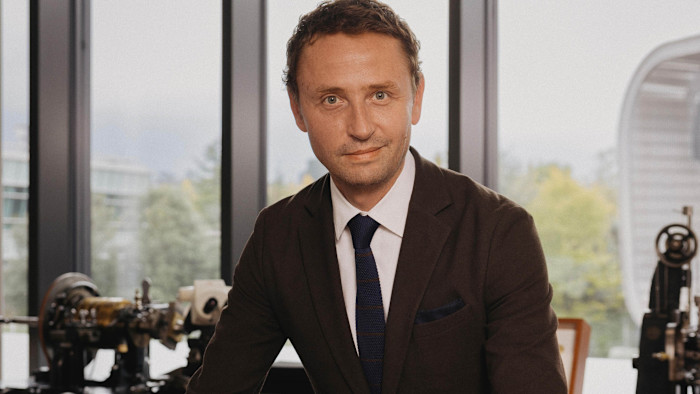
In an industry that often equates growth with volume, Laurent Perves is attempting something more delicate: to expand the oldest continuously operating watchmaker without diluting its own scarcity.
Fifteen months into his tenure as Vacheron Constantin chief executive, Perves runs a brand that, according to industry analysts, generated more than SFr1bn (£950mn) in revenues in 2023. Annual production is estimated at over 25,000 watches — up from roughly 3,000 in the 1980s, before the watchmaker was acquired in the 1990s by what is now the Richemont luxury conglomerate. Although revenues have since dipped slightly, the numbers place Vacheron firmly among the upper ranks of Swiss watchmaking. Yet Perves, in his first interview since taking the reins, is clear that acceleration is not the goal. “We must evolve with the market,” he says, but without chasing volume for its own sake.
The timing is delicate as Perves sees “a very volatile context outside and inside the watch industry”. Secondary prices have softened, hype has receded and growth across the sector has become less predictable.
Perves describes the brand’s positioning almost as a balance sheet of capabilities: classic watches, jewellery watches, sport integrated bracelet watches, very high complications, métiers d’art and the revived Historiques line — the last, as its name suggests, a family of retro and shaped watches.
The objective is to “occupy the whole field of high watchmaking,” ensuring that when one segment slows another can carry momentum. He half-accepts the analogy when pressed: Vacheron is a kind of horological hedge fund, diversifying risk not across asset classes but across métiers, aesthetics and price tiers.
The slowing has been most visible in the steel sports watch category. Perves concedes the “phenomenon of speculation and hype” has abated, even if the integrated bracelet segment itself “is not going to go away”. But while others worry about the fading of an asset class, he simply says that over the past years he has seen “a bit more demand for classic watches, for high complications, for shaped watches . . . for smaller diameters,” prompting, among other things, a 36.5mm Traditionnelle perpetual calendar.
Since taking the top job, Perves has moved decisively towards culture, leveraging the contents of two of the world’s largest and most prestigious museums: The Met and the Louvre. The Tribute to Great Civilisations collection saw the creation of a quartet of five-piece limited edition watches, each featuring a miniature enamelled version of a Louvre masterpiece, such as the “Winged Victory of Samothrace”.
Beyond this series lies an even more bespoke partnership with the museums, where a collector can choose any masterpiece — painting, sculpture or ornamental item — for Vacheron to reproduce on the dial. Each project is unique so there is no fixed scale of charges but Perves cites the minimum being €150,000 pre-tax. Techniques range from miniature enamel painting, which Perves says is the most popular, to engraving and champlevé (powder packed into engravings).
Numerically, production is almost risible. “We don’t do more than 10 or 12 pieces a year,” he says, constrained not by demand but by the time required to create both the watch and the experience that comes with it. The commission includes a visit to the museum, meetings with the curatorial teams and the slow, analogue pleasure of seeing one’s chosen work translated from stone or canvas to enamel and gold.
Perves rules out any meaningful expansion of production. As new collectors arrive, the brand must instead “evolve with the market”. With volumes in effect capped, the only sustainable lever is value: higher pricing, richer specifications and a stronger perception of intrinsic worth.
There are practical limits to expansion. Training a watchmaker takes years, not months. With much of its movement production kept in-house, Vacheron’s focus is on refining its core calibres — extending power reserves, improving precision and robustness, and meeting the finishing standards required for the Geneva Seal quality hallmark, which many of its watches carry.
For Métiers d’Art bespoke watches, 10 or 12 pieces per year can be sufficient. For more commercial models, 700 is the sweet spot. Overall growth, he suggests, should be a shade slower than the broader market, as Vacheron’s positioning demands.
The same measured approach governs distribution. Among its 122 boutiques, roughly one in three is run as a joint venture or franchise — a structure that balances brand control with local expertise.
Layered over some boutiques is a private geography of hospitality: Suite 1755 in Dubai, Maison 1755 in Shanghai, Club 1755 in London — each a space where collectors can meet, handle watches and attend cultural events. It is a network designed less for traffic than for tenure, a way of making a relatively small global community feel both recognised and at home.
This is the community Perves has in mind when he considers the secondary market. “We are manufacturing watches. We are here to create emotion. I’m not selling ETFs.” In other words, if Vacheron makes exceptional watches, residual values should follow.
That does not mean ignoring the resale boom. The brand operates a tightly controlled certified pre-owned (CPO) programme, but its deeper engagement is aimed at serious collectors. Above the standard CPO offer sits Les Collectionneurs, a travelling selection of museum-quality, fully certificated vintage pieces. The approach is deliberate: participate in the secondary market, but on terms that strengthen the brand’s authority and its relationship with collectors rather than fuel speculation.
In this light, the Concours d’Élégance Horlogère event announced earlier this year is significant. Conceived to “give back some voice to the collectors”, it invites owners to bring historically significant Vacheron pieces for a day of quietly competitive pleasure.
The emphasis is on the stories behind the watches and on the social aspect of gathering with like-minded collectors rather than on market value.
Read the full article here