

Unlock the Editor’s Digest for free
Roula Khalaf, Editor of the FT, selects her favourite stories in this weekly newsletter.
If you’re wondering why there are so many Japanese novels in the bookshops — in 2022 they represented 25 per cent of all translated fiction sold in the UK — you can blame Sayaka Murata. Well, up to a point.
Murata’s novel Convenience Store Woman, published in English in 2018, tells the story of Keiko, a young woman who doesn’t feel she fits into society until she gets a dead-end job in a strip-lit mini mart. It spoke particularly to younger readers seeking their place in the world, and Murata’s three books in English have now sold half a million copies in the UK alone.
Cue a stampede of copycat publishing; and so books about alienated young women join cat novels and coffee-shop stories on the shelves as a narrow anglophone representation of the breadth of contemporary Japanese fiction.
Convenience Store Woman had a sharpness beneath its calm, charming exterior that came out more clearly in Murata’s next novel to be translated, Earthlings — it featured cannibalism and necrophilia — and her latest, Vanishing World, is firmly in the latter camp. It makes the ordinary world as we see it look strange again.
We’re in an alternative or near-future Japan, where most babies are conceived through artificial insemination. It’s reliable, it’s “clean” (a favourite word in this world) and it doesn’t involve the complicated mind-body transactions of sexual intercourse, which nobody really understands. Families are simplified utilitarian arrangements for raising children. “Things are getting more and more convenient, aren’t they?” asks one character, in a perfect deadpan tone.
Our narrator, Amane, is an outsider who tries to fit in. Like many others, she has parasocial relationships with “nonreal” people — such as characters on TV shows — and satisfies herself sexually by masturbating. But Amane has a secret shame: her parents conceived her by having sex, not by artificial insemination, and she too develops an appetite for what her society calls “copulation”.
In this upside-down world, everything is reversed. A friend worries that when she masturbates to her favourite fictional character, she is “defiling the person I love most”. Sex between couples is taboo: when Amane marries and her husband initiates sex, she is “horrified. I’d never imagined that a member of my own family would have an erection because of me.” Yet other taboos — for us — go unremarked: one of her first sexual relationships is with a teacher, but she mentions it only in passing.
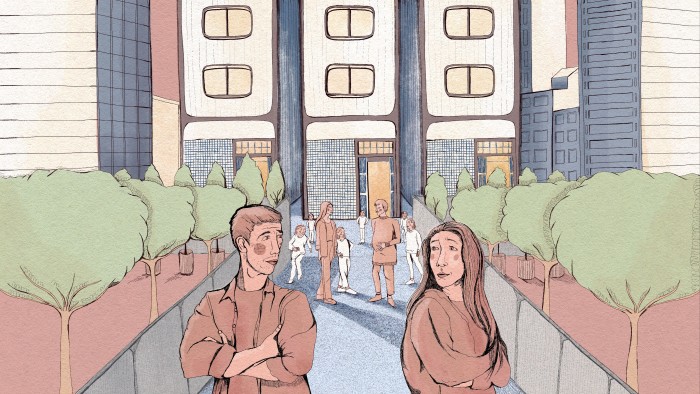
In this society, the potential hurt that relationships can cause is too great to take a chance on the benefits. And its desire to streamline things that are by definition messy finds its perfect expression in the “Experiment City”, an initiative that takes these ideals to an extreme. There, all babies are brought up collectively, and every adult is referred to as Mother — including the men, who are fitted with artificial wombs (externally, so that they have to be covered by a long “male pregnancy sweater” as the baby grows). Furthermore, trials are under way to eradicate sexual arousal, treating it as a parasite on the clean human soul.
Yet these attempts to control what makes us human are doomed. We are “monsters”, in the words of Amane, who is still torn between social compliance — reconstituting herself to adopt “the shape of this world” — and her natural instincts. Nonetheless, she and her second husband move to Experiment City (this is a welcome dramatic push after the narrative treads water for a while by iterating and reiterating the set-up).
It’s in Experiment City where the book achieves its greatest heights, full of rapidly switching feelings — creepiness, alarm, delight — but where the lasting response is laughter. Vanishing World is a comedy, its darkness almost indistinguishable from horror under Murata’s restrained style, which is translated expertly by Ginny Tapley Takemori, her regular collaborator.
This comedy is wide-ranging. When Amane and a male friend are attempting sex for the first time, their commentary is hilarious in its flat appraisal of the mysteries of sexual love. “We started searching for the vaginal opening together,” she tells us. “Seems like my body has finished the ritual,” he solemnly declares after ejaculating.
Meanwhile, the government’s information on Experiment City recalls the bureaucracy-speak satire of George Saunders: “Please be present to shower affection on children and thus continue the life of humankind.” There’s a satirical bent to the topsy-turvy sexual taboos: when Amane’s husband attempts to have sex with her, a friend offers reassurance. “Don’t worry, perverts wanting to commit incest with their wife are very rare.”
But comedy, as well as an end in itself, is a means of lowering the reader’s defences to let other things in. “I only want to hear blissful stories headed for a happy ending,” one character tells Amane. He may not be satisfied by the ending of Vanishing World, which is in one sense happy but also sad, shocking, queasy and a perfect culmination of everything that has gone before. It brings out an emotional intensity that until then Amane has done her best to keep hidden.
Murata’s skill is to accumulate the strange, the sad and the comic so expertly in the preceding chapters that the indelible final scene can make us experience many different feelings at once. “This was all insane, yet it was so right,” Amane says, and we can only agree. Publishers will continue to seek out imitations of her vision — but why bother, when the real thing is so good?
Vanishing World by Sayaka Murata, translated by Ginny Tapley Takemori Granta £16.99/Grove Press $23, 240 pages
Join our online book group on Facebook at FT Books Café and follow FT Weekend on Instagram and X
Read the full article here