

Unlock the Editor’s Digest for free
Roula Khalaf, Editor of the FT, selects her favourite stories in this weekly newsletter.
Over six intense years spanning the 1920s and 1930s, the playwright Bertolt Brecht and composer Kurt Weill distilled the sounds and vices of Weimar Germany into half-a-dozen stage works examining the evils of capitalism, consumerism and moral decay. Now La Scala in Milan is presenting three of those works in a single production, seen through today’s climate crisis.
The project grew out of an ambitious experiment. In 2021, during the Covid lockdowns, director Irina Brook staged Weill and Brecht’s chamber opera Mahagonny Songspiel (1927) alongside the ballet chanté — sung ballet — Die Sieben Todsünden (The Seven Deadly Sins) (1933) in an empty theatre so that the performance could be recorded by the national broadcaster Rai. Constrained by social distancing and budgetary limits, Brook opted for the sparest of sets, salvaging scenography from La Scala’s storerooms and sourcing costumes from second-hand shops. Her original vision has now been expanded into a triptych with the addition of songs from the musical comedy Happy End (1929).
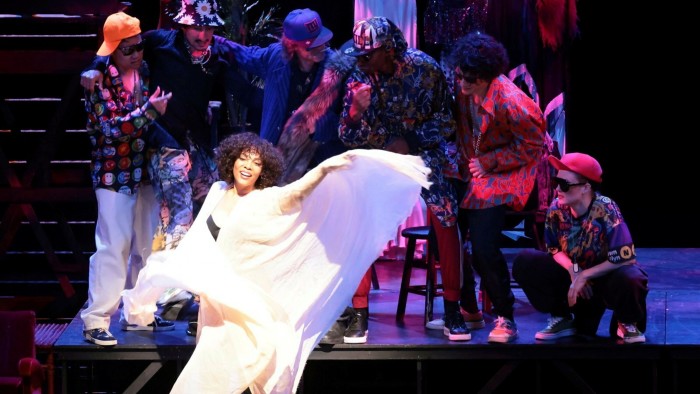
The updated staging is largely faithful to the original, with clothes rails, a bar counter and an installation of recycled plastic bottles hanging above. Brook weaves the three works into a loose narrative arc progressing from the Anna sisters’ nomadic pursuit of fortune in Die Sieben Todsünden to attempts at survival in the collapsed pleasure city of Mahagonny, culminating in an ode to American capitalism in Happy End. A sultry arrangement of Weill’s tango-habanera Youkali — a bittersweet evocation of an imagined island paradise sung by candlelight — closes the evening.
Modern dress, Brechtian alienation with onstage costume changes, and video projections of environmental catastrophes — including floods and melting polar ice fields — force recognition of contemporary relevance. At its best, unfussy staging and expressionistic vocal performances mean the excoriating satire packs a punch. Yet the most powerful moments, such as a crowd of lurid men throwing banknotes at a scared and exhausted cabaret dancer in Mahagonny, are interspersed with periods of dramatic inertia. References to impending ecological Armageddon feel underexplored and never fully integrated.
The biggest rewards came from the music. Riccardo Chailly, the 72-year-old music director, conducted the opening night two days after the theatre announced he would be succeeded by fellow septuagenarian, South Korean conductor Myung-Whun Chung, from next year. A small ensemble drawn from La Scala’s orchestra played wonderfully for him, harnessing the music’s dancing energy, jazz inflections and cabaret swagger. Youkali was an aching coda, a crooning trumpet’s sinuous phrases entwining beautifully with soprano Natascha Petrinsky’s smoky, seductive tone.
There was fine singing throughout. Alma Sadé’s gritty and vividly expressive Anna I was the perfect counterpoint to Lauren Michelle’s voluptuously dejected Anna II in Mahagonny. Tricky a cappella numbers were finely balanced. Matthäus Schmidlechner’s whiny tenor and the rich-voiced Elliott Carlton Hines, riotous as a leg kicking dancer in a dress and wig, brought similar coarse theatricality to Happy End. In the same work, Markus Werba stole the show as the charismatic gangster, Bill Cracker, blending menace with wit.
★★★★☆
To May 30, teatroallascala.org
Read the full article here