

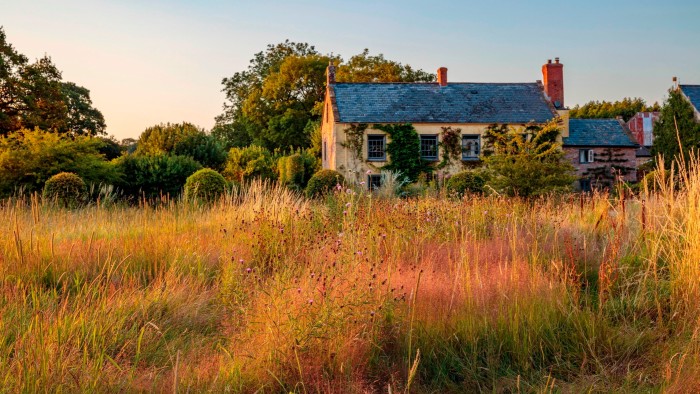
“One of the most special moments was finding a hedgehog on the lawn eating worms,” says Alasdair Cameron of the Devon garden he has spent 13 years nurturing with his wife Tor. When the couple and their young family had first taken on the Georgian dairy, Silver Street Farm, the garden was “tiny wee”, surrounded by cow paddocks with bright green grass that had been sprayed with chemical fertiliser and fenced in.
As garden and landscape designers, they set their sights on opening up the garden boundaries; it took about two seasons without chemicals for the soil to replenish and biodiversity to flourish, says Cameron. Today, the house is approached along a drive through two wild-flower meadows and its striking, yellow-limewashed facade is covered in climbers. Structure comes from gardens behind the house and between an ancient threshing barn, stables and cottage; the rectangular lawn is softened by deep herbaceous borders and loose planting that weaves through the railings. Topiary footballs bounce from the flower beds out on to the lawn. All this thrums with the sounds of wildlife.
The house is on the market and it’s the garden that’s as much of a draw as the eight-bedroom house itself, says Sarah Brown of Knight Frank, who is handling the sale. “A ‘special’ garden might add [as much as] 20 per cent to the value of a home,” estimates buying agent Mark Lawson of The Buying Solution, “even more when it’s designed by a renowned name.” It’s difficult to quantify just how much a recognised designer adds, but “in our experience, it’s perhaps a further 10 per cent”, Lawson says, “and a willingness to stretch on price”.
Many new owners are after instant gratification — they want a grand garden but they don’t want to wait years for it to develop, he continues: “We’re increasingly seeing buyers importing mature trees, towering yew hedging and even fully formed parterre gardens.” The obvious alternative route is to buy a property where the garden is “ready” at the point of sale. The premium is not only the time, care and thought poured into the garden, often over decades — but also the plant value and seed banks that have taken years to establish. The Camerons estimate the value of plants in their Silver Street garden to be roughly £50,000.
Tom Stuart-Smith has designed more than 10 award-winning gardens at Chelsea; Moor Hatches in Wiltshire, currently on the market at £3.95mn with Blue Book Agency, offers buyers the opportunity to access a country house with gardens that he has entirely overseen. “In a competitive market, a garden with identity — particularly one by a Chelsea award-winner — gives the home an edge before a buyer’s even stepped inside,” says agency co-founder Lindsay Cuthill.
At Moor Hatches, Stuart-Smith brings his naturalistic style to the space. The walled garden wraps around a 21-metre heated swimming pool; the kitchen garden includes no-dig vegetable and cutting beds, 15 varieties of dahlia, raspberry canes and an orchard that produces 300–400 litres of apple juice a year. Tulip-filled courtyards were in full flower just as the house hit the market.
“Timing matters,” says Cuthill. “The country house market slows right down over winter because gardens are hibernating. Bare beds, no scent, no theatre. It’s no coincidence that the busiest sales window coincides with peak bloom.”
This is hardly a new phenomenon. One has only to think of Capability Brown and the landscapers of old who created a sense of drama with sweeping driveways leading up to historic houses. The first sight of a house is coloured by the front garden; a pretty aspect can be enough to set us in the right mood to buy. But the value of such an attribute is held particularly highly right now.
The emotional and mental health narratives coming to the fore — from forest bathing to the Princess of Wales’s emphasis on nature and healing — are helping more people to understand the power of a garden and spaces that allow for quality time spent outdoors, away from screens.
For Michael Balston, co-founder of Balston Agius landscape architects, the feeling a garden evokes is paramount. “You want to find a garden where you connect to the style,” he says. This isn’t simply down to someone having employed designers, but is achieved “by anyone, just by being there for 20 years and making adjustments all the way through,” he says. It’s about the symbiosis between the house, the garden and the person: it takes time as they “all grow up together”.
Balston’s own house and half-acre garden at Maslens Farm, Wiltshire is currently on the market with Savills for £1.85mn. Ready to downsize, he describes pouring love and energy into the garden — from the hazels that flower in January, to the mahonia that flowers into November, “a sign of hope if ever there was one”. The value lies in the emotions it stirs above anything else, he says. “The garden is very often the clincher”.
But it’s not all about plants. Today’s buyers are also looking for private gardens that provide living space — whether turning sheds into offices and gyms or providing space for outdoor dining and relaxing, says Jonathan Brandling-Harris, co-founder of London-based estate agents House Collective. Post-pandemic, “Gardens have gone from nice-to-have to must-have.”
According to research by Savills, buyers can pay up to 39 per cent more for homes with larger gardens. Perhaps unsurprisingly, their analysis shows that the largest gardens in the UK are on the Scottish islands — Eilean Siar and Orkney — as well as East Sussex and Suffolk. In London, the outer boroughs — Bromley, Barnet and Harrow — come out top, with Kensington & Chelsea and Westminster at the other end.
But for some, a small garden appeals. “It’s very hard to definitively value a garden because for some people a smaller garden may hold more value that a larger garden, believe it or not,” says Lee Greenfield, broker for UK Sotheby’s International Realty. Many want outdoor space, but are deterred by the considerable upkeep costs of a larger garden. A full-time gardener starts at £25,000 per annum and would be a necessity at a house like Silver Street Farm, unless the owners were exceptionally green-fingered. As well as the expense, it’s a responsibility — one the Camerons are ready to relinquish. Easy maintenance can be a distinct plus.
Broadly speaking, it’s an international truism too. “Many buyers are focused on the cost of maintaining a garden when viewing major estate properties,” says US agent Tim Davis, who operates in the Hamptons. “Creating a more natural landscape that doesn’t require a team of gardeners is becoming a conscious choice for some.” In the Hamptons it’s also about age — established plants are particularly highly regarded. Listowel, an estate sold by Tim Davis in Mecox Bay, included a vast rose garden and an orchard of 60-year-old apple trees. Such assets are precious; “in some cases millions of dollars can be justified in value,” he says.
In Mallorca, biodiversity and ecological balance were the driving factors for the Lindners, who spent years creating a beautiful garden at their finca in Felanitx, currently on the market with Savills. The couple deliberately chose native plants — rosemary, thyme and drought-resistant shrubs — adapted to suit the region’s arid climate and needing little to no irrigation. This, they hope, will appeal to buyers concerned about the increasing scarcity of water, as well as the costs of upkeep.
Conversely, some buyers are looking for a garden space with “potential” that they can make their own — in much the same way as a house renovation. For one Australian buyer in Dulwich, a leafy situation was top of the wishlist; a new garden could be incorporated into a wider reimagining. Architecture and interior design studio De Rosee Sa and Chelsea Flower Show’s 2024 Best in Show landscape architect Ula Maria worked together on a garden for the client who wanted “to recreate something of back home”. The resulting garden — costing around 10 per cent of the total construction costs — offers a private oasis that feels cool and contemporary, linking the house, garden and Dulwich Park beyond.
For designer Lucy Bathurst, owning a collie dog was the impetus for searching for the biggest garden she could find close to central London. Having homed in on Hackney, she looked for the streets with the longest gardens. In her particular stretch of Albion Drive, the back gardens are 100ft long. As the founder of Nest Design, “interiors were my thing — not gardens”. Soon, that changed. She planted birch trees, a magnolia and a plum, and kept two hillocks created from the discarded soil when the far end of the garden was redeveloped into an outdoor kitchen. “It’s the garden, rather than the house that would now make me reluctant to move,” she says. “The house I could repeat.”
Dog ownership is a hot topic, says Robin Chatwin at Savills. “Traditionally people upsized to bigger gardens because of a growing family, but now it can be as much about wanting space for a new puppy as it is a new baby.” Think of Monty Don, who will be creating his first ever garden at Chelsea Flower Show this year — a dog-friendly space with a lawn abundant in daisies, dandelions and clover. The lucky hounds now have the power to transform gardens and even, perhaps, the housing market.
Find out about our latest stories first — follow @ft_houseandhome on Instagram
Read the full article here