

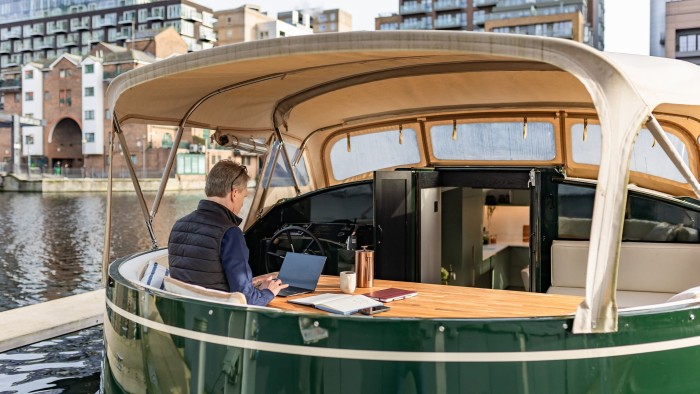
When clients visit interior designer Mark Howorth’s new London office, he often takes them out for lunch — with a twist. They’ll clamber on board his 160ft barge, moored at Limehouse Marina, near Canary Wharf, for a morning of meetings. Then a skipper unmoors them and takes off down the Thames until they reach the Houses of Parliament. On deck, lunch is served. “There’s something about boats that makes you feel full of wonder,” he says.
Howorth’s floating office is now the headquarters for his company Callender-Howorth. His inspiration came after jettisoning larger offices in east London post-pandemic; walking past canals in Islington, where he once lived, he wondered if a boat might be a viable replacement. “But [I had] a misconception about tiny little narrowboats, with no security and rats running past the size of dogs, all very kumbaya and dungarees, which is not really me,” he says. Then he came across Waterspace Living, a barge maker at Collingwood Boat Builders in Liverpool, and adapted one of its wider barges to create an office and two cabins for his eight-strong team.
Howorth is among a growing cohort who are evolving the concept of the “home office” — taking it out of their actual home, but maintaining the idea of live-work space — whether on land, river or sea. Often it’s mobile. Helped by advances in technology, architects, boat designers and vehicle companies are designing solutions for clients who want to take the integration of home, work and lifestyle in a new direction.
Howorth’s barge isn’t a full-time live-work space — his home is in the south of France — but he can sleep on board while in London. “It’s calm,” he says, reassuringly. “We’re in a marina, so it isn’t tidal, going up and down.” The marina community has been a boon, too, as it’s filled with other creatives — a jazz musician and an actor, among others — and maintenance is surprisingly straightforward, he says. There’s state of the art WiFi (“It looks like Cape Canaveral on top”) and all mod cons. Howorth’s barge cost £320,000 to buy outright, plus mooring charges of around £800 per month; he was paying around £70,000 per year for office space before the pandemic.
Chris Hill, Waterspace’s director, is seeing more clients like Howorth who use barges as live-work spaces. He recently kitted out a barge for a client who wanted a work area in the second cabin; Hill is also planning to move his own office on to a boat soon. “I can’t stand the ‘working from your spare bedroom’ culture,” he says, adding that marinas are upgrading their technology in response to the increase in working from the water.
This year, Waterspace will launch Bramley Falls, a new marina in London’s Docklands, expressly aimed at this niche. “You’ll have the ability to plug your boat into the main broadband network and all facility services on site, with 10 boats looking out on to open water.”
There’s no more open water than the high seas, and yacht builder Heesen reports a similar surge of requests for on-board offices. In yachts, of course, every inch is crucial, yet clients are increasingly moving away from a desk in a corner towards dedicated workspaces, says executive commercial officer Mark Cavendish. For a 57-metre full custom all-aluminium motor yacht codenamed Project Setteesettanta, a new-build for a long-term client, Heesen is quadrupling the space allocated to an office compared with his previous vessel.
“He’s a successful businessman, with kids in their late teens and early twenties. They use the yacht to explore, and they’re incredibly sporty. But he works like a demon, and I suspect he’ll be spending a lot of time on the boat working.” He isn’t alone. “Technology has allowed people to spend more time on board. Every 50m boat now will have a dedicated office space. Back in the 1980s, absolutely not. Communications have become so affordable and reliable — crikey, you even see 50ft Fairlines and Princesses with satcom domes on them now,” Cavendish says. The satellite system Starlink, which Heesen has installed in that new-build, is less bulky, more efficient and, crucially, more reliable than many of its predecessors.
It’s Starlink that largely allows Erin Jacobs to work wherever she wishes from her high-spec Airstream trailer. She runs a cyber-security consultancy and has a bricks-and-mortar home in Chicago, but spends nine months each year travelling around the US and working along the way; in the past three years, she’s clocked around 70,000 miles. Jacobs says her current Airstream, her third, is one of 50 or so in the country with such high-grade detailing: she spent $200,000 on the model, then added a $50,000 off-grid package, which included solar panels, a generator and batteries allowing her to be self-sufficient for up to two weeks. Starlink’s a game-changer for that, she says, though even it has limits.
“It works really well 85-90 per cent of the time, but I couldn’t use it in the Redwoods in California — there was too much tree coverage,” blocking satellite access (she has cellular service from two providers as back-up). “I have Frette bedding and my Airstream is more luxurious than the Four Seasons — that’s a downgrade,” she laughs.
When Jacobs bought this Airstream, it was too heavy for her SUV to tow, so she swapped in a pick-up truck. But there are few other drawbacks. “When you travel and stay at a hotel, even a nice one, the desk there gets the job done. But this feels more like your home is everywhere with you.”
Does she use a Zoom backdrop that suggests she’s in an office rather than on the road in meetings with C-suite level clients? “I used to hide it, but now I don’t care. Last week, I was on a hammock, writing up my reports.” She isn’t the only employee at her company to work from the road, either: another also has a trailer like hers. “He pimped it out, too, but it reminds me of a dorm room. It’s definitely a guy’s Airstream.”
Not everyone is looking to work in motion. Some simply want to carve out a standalone space closer to home that’s dedicated to office hours. Architect Tom Kundig of Olson Kundig calls them accessory buildings. “You have to make a physical move between the sacred home and the profane office, otherwise you’re working 24 hours a day, seven days a week. It’s about saying, ‘OK, I am working at home, but I don’t want to work from home’, creating a gap, whether you’re commuting 15ft or 100ft.” Five years ago, one such accessory building brief might cross his desk each year; now it’s four or five.
Such huts and cabins, Kundig adds, often unlock spaces on large estates. He has just completed a 70 sq ft office in a hut 300ft behind a main residence on Hawaii’s Big Island, featuring design details that connect to the landscape, such as a sliding, hanging louvre system that exposes a glass wall overlooking a koi pond below. “It’s a place to escape,” he says. “And there’s nothing man cave-ish about it.” A standalone building like this one costs $250,000-$350,000 from Olson Kundig. For a recent, cosy project in northern Idaho, Kundig’s client wanted their desk to be installed alongside a fireplace and a sitting nook.
Little compares to the playfulness of Howorth’s barge, however. “I was having a cup of tea on the upper deck the other day, and 4ft in front of me a huge carp jumped up out of the water. And I feed the swans right out of the kitchen window. I would never go back to a normal office.”
Find out about our latest stories first — follow @ft_houseandhome on Instagram
Read the full article here