

Strolling through this year’s Whitney Biennial, you could almost persuade yourself that the world beyond the museum walls had fallen quiet. US attacks on Venezuela, a spreading war in Iran, masked men sweeping people off the streets of US cities, the toxic seep from the Epstein files — little of all that fury and dread crops up in the work of the Biennial’s 56 artists, duos and collectives. For the most part, they turn away from the blunt force of events. Instead, we are greeted by animals: dogs and cats, moles and cows, reindeer, frogs, horses — creatures that radiate a steady, dependable comfort.
The retreat is intentional. This is an “atmospheric survey”, we are told, an exhibition that doesn’t dwell on anxiety or outrage, but “foregrounds mood and texture” — and the first is mostly light, the second soft. Curators Marcela Guerrero and Drew Sawyer have sought out artists attuned to tonal shifts and emotional grain, who find space between tenderness and tension. The show doesn’t just offer feel-good escapism, though; it lingers on complexity and inventiveness, leaving ample room for nuance.
That expansive vagueness draws attention to everything it leaves out. What does the art of today become when mood is separated from external causes and political weather systems are left unnamed? The omissions are as telling as the inclusions, especially at a time when one ubiquitous politician has stomped so heavily through the museum world, hoping to give his taste the force of law. The Whitney, at least, has the luxury of treating him as He Who Shall Be Ignored.
Emilie Louise Gossiaux, who is blind, contributes a beguiling suite of drawings of her guide dog, an English Labrador named London. Human and pooch appear as buddies of equal size, embracing, romping, and wandering through fields stippled with flowers. The lines are delicate and lightly comic, alert to the small absurdities of devotion. In “The Marriage of Hand and Paw” (2025), the interspecies soulmates have swapped bodies, becoming a pair of mythical creatures: a woman with a tail reaches out to a dog with breasts.
“When we worked together, we became one full organism or a superbeing,” she explains.
When London grew old and began to fail, Gossiaux made 100 multicoloured ceramic copies of a favourite rubber chew toy, the Kong. These bright and buoyant little sculptures scatter across a white plinth like offerings or grave goods, ready to accompany the dog into an afterlife of eternal nuzzling and gnawing.
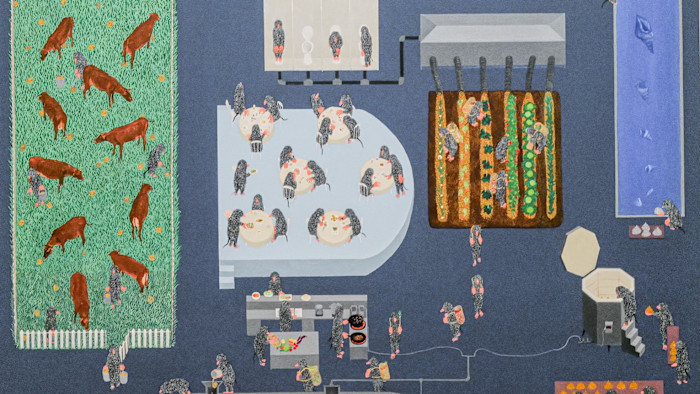
Akira Ikezoe conscripts animals into the service of an intricate ecology. In her painting “Mole Stories Around Methane Gas” (2025), brigades of industrious moles gather cow pats (along with their own droppings), using them to fertilise crops and somehow grow more cows. The result is a whimsical vision: a tidy, circular system in which endearing creatures sustain a utopia of perpetual renewal.
Taína H Cruz, a New Yorker to the core, typically draws her energy from graffiti and other urban eruptions. Yet in the painting “This Counts” (2026), she turns inward, blocking out the noise in favour of a private exchange between a girl and her dog. The girl lowers her gaze as she gathers her fluffy friend into a close embrace; the dog, unconvinced, looks out at the viewer for a reaction — or rescue. Its steady, searching eyes invite dialogue, as if the circuit of communication extends beyond the canvas to include anyone willing to meet its gaze.
Jasmin Sian scavenges New York sidewalks for discarded chip bags and candy wrappers, filigreeing them into lacelike frames. Within these fragile halos she paints minute living beings — chickens, donkeys, dogs, woodpeckers, a favoured cat — each nestled amid flowers and curling vines. The compositions recall the unicorn tapestries, miniaturised to an intimate scale. From the refuse of the city she fashions something exquisite and exacting, delicately arresting its most fugitive forms of life.
Some of the most quietly ravishing objects in the Whitney comes from the late Kimowan Metchewais, who drew on his Cree and Cold Lake First Nations heritage to transform dogwood blossoms and daisies into meditations on the natural world. Passing these modest flowers through a porous sieve of photography, ink and paint, he rendered them at once precise and tremulous, hovering between presence and disappearance. Hung together along a single wall, the works seem to murmur and sway in concert. They emit a muted pulse of life that persists in the face of its own frailty.
This year’s Biennial rises like an island of grace in a sea of coarseness. It’s hard to say whether the institution has deliberately cultivated that calm or found itself settling into a defensive crouch of neutrality. For years, the Whitney has weathered controversy and criticism, almost exclusively from the left, over racial insensitivity, its treatment of pro-Palestinian artists, the source of trustees’ fortunes, the ethics of museum funding. Now that new blasts of scorn are coming from the right, the museum appears understandably wary of fresh combustion. The temperature has dropped.
Artists, too, may feel the chill. In an atmosphere where overt political statements can ignite unwanted attention, some have waded towards safer shores. Others use art as their own refuge from the daily brutality of the news, or have learned to value subtlety after long and exhausting spasms of bluntness. Whatever the psychological source of this recalibration, it’s yielded pleasing results.
I arrived at the Whitney expecting an exhibition sharpened by satire and disgust, full of bristling commentary in the spirit of George Grosz or John Heartfield. Instead, I found something gentler: an opening on to the consolations of beauty. My surprise felt less like disappointment than relief.
To August 23, whitney.org
Read the full article here