

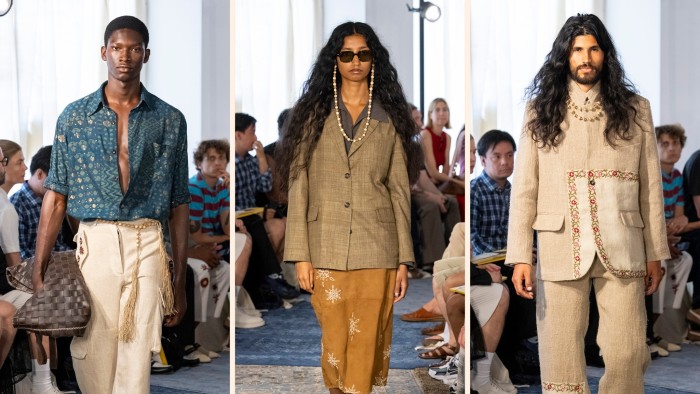
Kartik Kumra had no road map when he started his menswear brand Kartik Research during the pandemic in 2021. “There’s no manual for where to source craft in India,” he says. His early toolkit? A car, the internet and a willingness to explore.
Today Kumra, 25, spends most weekends in craft clusters (a term for localised groups of skilled artisans in a single discipline that are scattered throughout India) from Bengal in the east to Almora in the Himalayan foothills and Bhuj in western Gujarat. One that he works with previously collaborated with Yohji Yamamoto; now, Kartik Research is their most important client. The best way to keep these clusters thriving, he adds on a zoom call from New York, is to give them your business.
Worn by singer Kendrick Lamar and basketball player Stephen Curry, with a recently opened flagship store on New York’s Orchard Street and a womenswear launch at Bergdorf Goodman set for next spring, Kartik Research has cracked a code many Indian ready-to-wear brands have struggled with: how to translate indigenous textile traditions into contemporary, globally resonant fashion without leaning into the usual craft-heavy couture stereotypes. The brand is part of a larger wave of Indian designers attracting attention for use of ancient handcrafted textiles such as bandhani, a word rooted in Sanskrit for a type of tie-dye where the fabric is pinched and bound to create figurative patterns, and chikankari, a lacelike hand embroidery from Lucknow that dates back to Mughal India. The result? Everyday clothing with heritage that doesn’t feel like costume and that can blend into a global wardrobe.
Alongside Kartik Research, more established brands like 11.11 / Eleven Eleven, Péro by Aneeth Arora, Bodice by Ruchika Sachdeva, and Verandah by Anjali Patel Mehta are having a moment thanks to a thriving domestic market, a patriotic diaspora abroad and perhaps — at a time when India is being positioned as a growth market by the stuttering luxury industry — the recent appreciation for India’s fashion heritage emerging among Western brands. In June, Prada menswear models wore footwear that closely resembled Kolhapuri sandals in its latest runway show — prompting an outcry. The Louis Vuitton menswear show days later recreated the ancient Indian game of Snakes and Ladders as the show set.
But what sets Kartik Research apart is how quickly it has scaled: in under five years, it’s already stocked in over 70 global retailers, including Selfridges, Mr Porter, Liberty and Dover Street Market. In June, it became the first Indian label to show on the official calendar at Paris Men’s Fashion Week, debuting a co-ed collection called “How to Make it in India”. Layering contemporary staples such as bomber jackets, shirts and vests finished with hand-embroidered details, this was where streetwear met the modern maharaja. The collection featured Kumra’s signature layering aesthetic, drawing on kantha, an age-old craft from West Bengal and Bangladesh that involves stitching layers of old fabric together. Kumra’s kantha was crafted using only fine mulberry silk and with intricate embroidery typically seen only on bespoke pieces. This legwork, this commitment, is the “research” in Kartik Research. He collaborates with vintage dealers in the US and researches fashion history online to gather information about silhouettes.
“Just because something is made in India doesn’t mean it supports craft,” Kumra says. “Working with a factory isn’t the same as working with a handloom weaver in Bhuj or a block printer in Mumbai.”
It is a way, he adds, “to bring a sense of humanness back into clothing by collaborating directly with India’s master artisans and giving them global visibility.”
The path to Kumra’s success was paved by labels such as 11.11, which launched in 2009 and was the first Indian brand stocked by Mr Porter. Known for its use of jamdani, khadi cotton and natural dyes, 11.11 helped initiate a conversation among a new generation of Indians about their textile heritage.
“An indigo shirt — like the one recently worn by Brad Pitt in the film F1 — takes four months to make,” says co-founder Shani Himanshu. “We semi-produce them and then finish them once an order is placed.”
11.11 has leaned into a bespoke direct-to-consumer model and is now setting up its own production company to scale operations. Its founders are working to educate artisans about the fashion system — including a for-profit producer company co-owned by craftspeople in Khambra village in Gujarat. “Most indigenous practices lack the resources to build a complete product for today’s demand,” Shani says. “As a conscious fashion label, it was important to make the complete value chain sustainable.”
Resort label Verandah recently had multiple pieces worn in The White Lotus. It started in 2011 working with craft communities in Bihar. Originally working with hand-embroidered khadi cotton and silks, the process proved so challenging that it pivoted to regenerative fabrics milled in India.
“Being Indian is at our soul,” says founder Anjali Patel Mehta, who views her zero-waste approach as rooted in India’s tradition of upcycling and reuse and adds that the majority of her business is international.
For Kartik Research, Kumra cites Yohji Yamamoto’s spring/summer 1992 and 1996 collections, Comme des Garçons spring/summer 1999, and Dries Van Noten spring/summer 2002 as constant mood-board references. His love for concept-driven fashion began while at boarding school in England, where he frequently visited London. “That’s where I really started paying attention to directional design,” he says. “You had people like Craig Green and Wales Bonner making strong work that felt true to who they were. Back home, we didn’t really have that kind of language.”
Returning to India during the pandemic — then a university economics student — he took a short trip to Jaipur, known for its block printing. A few experimental pieces posted to Instagram led to friends and family placing orders. “I think delusion is your best friend when you’re starting something like this,” says Kumra.
After being spotted on Instagram in 2021 by Gregory Hewitt, founder of London-based showroom DMSR who then put him on his rails, Kartik Research quickly entered major stores before Kumra had even met a single buyer. Hewitt credits Kumra’s “sponge-like curiosity” as key to his success. “We had many conversations about what buyers are looking for — everything from tags to pricing,” he says.
Joshua Orlandini, fashion and accessories buying manager at Liberty, first encountered the label at DMSR and has been stocking it since last year.
“What stood out immediately was his deep commitment to craft and his innovative approach to fabric and embroidery. Every piece is original and tells its own story and that aligns with the Liberty customer — someone who values creativity, detail and a strong craft narrative. Our customers are increasingly interested in brands with purpose and provenance, and Indian designers are well positioned to lead that conversation,” he says.
Pricing remains one of the biggest challenges for Indian contemporary labels seeking global recognition. For Kartik Research, there’s a delicate balance between reflecting artisanal value and staying within a “sweet spot” under luxury brands. Many of Kumra’s shirts retail around $300, outerwear averages $700, and fully embroidered statement pieces can go up to $2,000.
Verandah’s pricing is similar, starting at $225 and reaching $1,750. “When people hear it’s made in India, they often ask why it’s so expensive,” Patel Mehta says. “What they don’t realise is that our country has the finest fabrics, and we use mostly hand-finished details.”
Kumra launched the label with a personal investment of $5,000. He does not reveal his bottom line figures but said that his 80 per cent revenue growth year over year was driven by the opening of the NY store. He has yet to draw a salary and runs the business with a team of 12 — including his mother — and opened a retail store in Delhi in 2024. He refuses to work on consignment — a major reason he avoids Indian multi-brand outlets. Although he enjoys a cult following in India, his market is mostly global.
“For Indian brands, it’s really hard to grow a direct-to-consumer business globally,” he says. “There’s a 70 per cent import duty on returns, so you can’t really offer international returns, and shipping alone takes about a week. Within India, it’s manageable — but outside, it’s tough.”
The New York store helps solve that. It functions as a warehouse, builds the brand’s world, and offers liquidity. With Verandah expanding in the Middle East and London, and 11.11 growing its direct-to-consumer operations, a new Indian voice in global fashion is taking shape. While at the beginning of his journey, Kartik Kumra is reshaping how the world talks about contemporary Indian fashion with a vocabulary defined by integrity, innovation, and craft that is going global.
“I’m in this for the long haul,” he says.
Follow us on Instagram and sign up for Fashion Matters, your weekly newsletter about the fashion industry
Read the full article here