

Unlock the Editor’s Digest for free
Roula Khalaf, Editor of the FT, selects her favourite stories in this weekly newsletter.
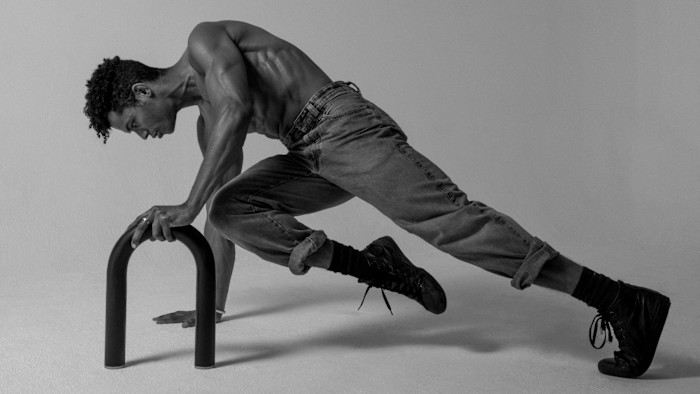
It’s a Nora Ephron-ish autumn Sunday, and everybody in New York is either running the marathon or cheering from the sidelines. I am on my knees at Movement Gowanus, a gym in an industrial stretch of Brooklyn, attempting to manoeuvre my body from something called a “crab” into a “jumping understitch” and on to an “ape”. I’d happily describe these low-to-the-ground poses in further detail, if I had a better idea of what I’m meant to be doing. The sequencing appears to elude my classmates too: everyone is writhing around and giggling.
We are united by our pursuit of “mobility”, the latest fitness buzz. While strength training (lifting weights), balance training (holding still in stork-like positions) and flexibility training (dynamic stretching) have their devotees, mobility training is billed as the pathway to peak performance and injury prevention, not to mention longevity. The ability to move with ease has long been a fixation of physical therapists and those who seek them out. But the M-word is now cropping up with increasing frequency at next-level gyms and on body-optimising podcasts. According to a meta-analysis published in 2024 in The Journal of Sports Sciences, 20 of 22 trials showed that mobility training was of some benefit to participants, helping maintain or improve performance. Jennifer Aniston credits regular sessions with a trainer from Pvolve, a mobility‑centred mashup of Pilates and physical therapy, for her eternally lithe physique.
But what exactly is it? “There’s strong and there’s flexible,” says Tom Morrison, the creator of The Simplistic Mobility Method. “And mobility is where they meet.” According to Morrison, a healthy range of motion occurs not at the muscles but the joints – the areas where our bones meet. His basic course involves executing motions that engage these areas: for example, windmilling your arms in giant circles, or lifting your leg like a dog would over a fire hydrant in order to rotate your hip.
“A lot of people make the mistake of mixing mobility up with flexibility,” says New York trainer Michael McGuire. “Flexibility requires less muscle control. Mobility requires strength, and it’s also necessary to attain strength.” McGuire suggests I start out with an Animal Flow session, a yoga-like programme that taps into our primal instincts. “Just get on the ground and listen to your body. When you’re wriggling around like a tarantula or a snake, you’ll see what feels tight and you’ll lean into these points,” he says. “That might feel funny, but our bodies are designed to squat, lunge, duck under and climb over things.” The class is designed to address the basics: we have to be able to move comfortably in order to move well.
Truth is, I don’t need to cosplay a member of the animal kingdom to know that my mobility is far from ideal. In addition to hips and hamstrings that have been tight for as long as I can remember, my body has been finding a host of new ways to remind me that it wasn’t born yesterday. Out to dinner recently, I tried to turn my head to glance at the woman who was gossiping with abandon at the table behind me, but my neck refused to co-operate. That same week, on our walk home from school, my hypermobile daughter pointed at an older gentleman shuffling laps around a playground and exclaimed: “Look, Mom, that’s going to be you soon!”
She might be part of the problem. The fact that I’ve given birth to two children could have contributed to my body’s creaky state, suggests Melissa Bentivoglio, CEO and co-founder of Frame Fitness, an at-home Pilates machine (think of it as a Peloton for Pilates lovers). “During pregnancy, the production of the hormone relaxin can make our pelvic joints relax and then resettle in new positions,” she explains. “A common result is a compressed lumbar spine.” Frame Fitness just added 15 mobility-themed workouts to its video collection, and the bundle is set to grow to 50 by next month. “The demand for it was overwhelming,” says Bentivoglio. “Intensity is out; low-impact recovery is in.”
“Don’t worry: you don’t need to become a gymnast or do anything fancy,” says Morrison, sensing my panic. He reassures me that if I spend just five minutes a day playing around with his joint-focused video tutorials, which show me how to do everything from undulating lunges to hip hikes (kick one foot in the air behind you and tilt your hip up and down while balancing on the other leg), I’ll be well on my way to joining the well-oiled ranks.
Still, I want somebody to tell me how to make my body move with a supple elegance. I book an appointment with Derek Lee, a physical therapist at the New York City-based chain Spear. Compromised mobility affects the vast majority of his clients, and was what led many of them to the injuries that brought them to his table in the first place. “If you can’t control the way you move, your muscles never fully contract and relax, and your whole world will start to shrink,” he says.
A shadow crosses his face as he watches me raise my arms, lie on my back and lift each of my legs as high as I can, then stand up and touch my toes. “Don’t get too worried, but the vertebrae aren’t really articulating.” His suggestion is that I devote 10 minutes per day to mobility and flexibility exercises such as scissor-kicking hamstring stretches.
I also stop by a Sunday morning kettlebell class with Emilio Joubert-Montanero, co-owner of 720 Strength, a grungy gym on the Lower East Side that’s a favourite with the city’s fashion editors. Joubert-Montanero incorporates mobility training into the majority of his strength-based workouts. We begin with a round of what he calls “balletic” Romanian dead lifts, which involves swinging a kettlebell in an arc from my hips to my feet. The focus is less on how heavy the weight is than getting our bodies to move rhythmically. It’s the same thing with the prying goblet squat, a hip mobility drill that involves squatting deep and holding the weight beneath our chins while twisting our torsos from left to right. Every time I sink down into a squat for a new round, I feel a dash more fluid in my joints.
I’m on a walk a few days after our session when Joubert-Montanero texts me. “Checking in on your calves,” he says. They’re feeling fine, I tell him. Half a block later, I see that a shoelace has come undone. For the first time in ages, I don’t groan at the sight of it.
Read the full article here