

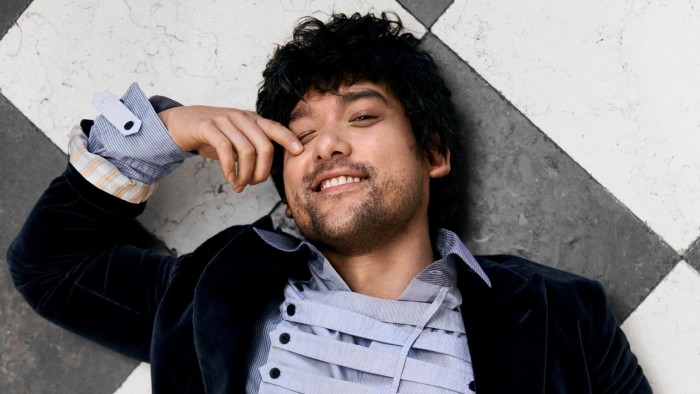
Will Sharpe is dressed in baggy all-black: jeans, hoodie and a cap embroidered in red with the words “love poems”. Love poems? That’s pure romantic catnip for fans of the 39-year-old actor, writer and director, who has emerged from the darkly comic shades of his early film and TV work to become a hot contender for most enigmatic leading man of our times.
Suggest this to Sharpe and he’d doubtless throw out a sceptical look from under that baseball cap. We are meeting in the parlour of a central London hotel, crammed with Georgian-period knick-knacks and a chirpily interruptive grandfather clock. Friendly, courteous (he hasn’t eaten lunch yet but puts his boxed delivery order on top of his rucksack for later), he is understated and modest, brushing off compliments like stray confetti. A bit of a giggler in his hipster garb, and with a conversational style full of “sort ofs” and “you knows”, he could be mistaken for being 10 years younger than he is, but this belies his wealth of experience and a sophisticated commitment to camaraderie and artistic innovation. His criteria for career choices? “It always comes down to the people. That’s the part that I really enjoy. Meeting like-minded creative people and learning from them.”
Benedict Cumberbatch, who brought Sharpe on to direct his 2021 film The Electrical Life of Louis Wain, tells me that “Will’s the kind of person who, if you met him at a party, you could spend the whole evening not talking about what it is he does because he’s so interested in other people. He’s so unassuming about what he’s achieved and the quality of it.”
Perhaps that’s why Sharpe, despite being one of the past decade’s most gifted on- and off-screen talents, is only now coming into mainstream consciousness. There’s also his cunning ability to shapeshift, which makes it tricky pinpointing him as the same person who played, say, Shun, the court jester-ish illustrator in Flowers, the 2016 black comedy Sharpe wrote and directed for Channel 4, and Rodney, the impish rent boy in the BBC’s Giri/Haji in 2019, or Ethan Spiller, the brooding tech bro of the second season of The White Lotus.
Next came a role as a northern English tour guide in Poland in last year’s critically acclaimed A Real Pain. Sharpe followed that act with Felix, the shoe-gazey boyfriend in Lena Dunham’s Netflix romcom series Too Much. “I’d seen Will in Giri/Haji and in The White Lotus, and had the repeat experience of thinking ‘who the hell is this genius?’ because he transforms so fully,” Dunham writes in an email. “But through all his performances there’s something playful and a bit old-fashioned – almost Chaplin-esque even – especially in the darker moments.”
Now, just in time for Christmas, we are being gifted Sharpe’s fizzing, visceral portrait of Wolfgang Amadeus Mozart, pitted against Paul Bettany’s villainous Antonio Salieri in Amadeus, a highly entertaining five-part series on Sky Atlantic. Based on the 1979 Peter Shaffer play, the series sees an adult Mozart enter Vienna from Salzburg, still high on his child-prodigy era. Sharpe’s Mozart is hungover, vomiting and cocksure that he’s about to wow the court of Emperor Joseph II and its ladies with his musical genius and… other talents (strawberries might want to look the other way in episode one). “He’s incorrigible,” says Sharpe. “He’s not very good at reading a room. He’s very forthright in the way he expresses himself and quite tactless, often. But that was the appealing part of his character in a way, that he’s quite dangerous and incredibly flawed.”
Filmed in Budapest, the series is written and directed by two of the talents behind Giri/Haji – an attraction for Sharpe, who loves working with a familiar team. Another draw was playing a real-life musical genius. He had to learn to conduct an orchestra in the rather static 19th-century style, not to mention taking his “chordsy, indie-band sort of piano playing” to a convincingly virtuoso standard in the six months leading up to filming.
“The scariness of that – all the stuff I hadn’t done before – was quite appealing.” How did he get up to scratch? “Sometimes it would pivot from one piece to another at quite short notice, so I’d be in the flat in Budapest suddenly cramming,” he says. “But I quite liked it. It was sort of meditative, and it was work I could do on the character that didn’t feel too academic. To listen to the music and know that’s him, the real guy, expressing himself. That felt more valuable than reading about his life.”
Amadeus is a bit of a fudge anyway, isn’t it? The premise – that the established court composer Salieri has a venomous hatred for young upstart Mozart – is based on a wild rumour. It was first dramatised by Alexander Pushkin in his 1830 play Mozart and Salieri, and, in 1984, in a film by Miloš Forman. While Sharpe is sure the adaptation will be held up against Forman’s film, which bagged eight Oscars, he thinks the new version “allows for a bit more space” to explore the myth.
“I still feel the principal mode is Salieri’s envy and his obsession with Mozart,” he says, but here we get more of Amadeus’s “perspective on his own predicament”. Predicament? “He’s painted as someone to whom music comes effortlessly. And, certainly, that’s Salieri’s view of him, that it all just falls into his lap. But I was interested in trying to figure out: what does that do to you? What’s the day-to-day of that? What Salieri covets is something that Amadeus is carrying, and it’s kind of wearing him down.”
It’s coincidence that while trotting, joyfully wigged, onto our screens as one of the world’s most brilliant prodigies, Sharpe is in the midst of post‑production on a new romantic comedy series for Apple TV called Prodigies. He’s done the triple on this one, as he did with Flowers and earlier films Black Pond and The Darkest Universe: writing, directing and acting. This time, he’s working alongside everyone’s current favourite actor, Ayo Edebiri. The two of them play former exceptionals, Ren and Didi, who met as kids and are now still together in their 30s. Genius.
Sharpe had the idea about 10 years ago and, after meeting Edebiri in London and seeing her in The Bear, he wrote the project and thought of her. “She’s extremely funny. She’d just watched Landscapers [the 2021 black comedy series Sharpe directed at the request of its star Olivia Colman] and we got on really well. As I got more into the mode of writing it, I started to see her for the character of Didi.” He is intrigued by the idea of potential. “Are you who you’re supposed to be? And are you the person that other people want you to be? Ren and Didi are quite specific, unique characters but hopefully their predicament” – that word again – “is something that everyone can feel and recognise in their own experience of life.”
I wonder if there’s any reflection on his childhood in this show? “Well, I’m not a genius,” he scoffs. “So, no. But hopefully there’s a relatable sense of something that we all feel. However successful you might be, whatever your line of work, sometimes you feel like you’re doing all right and other times you feel like you’re really falling short of the promise that you had. Is this the right job? Is this the right life even? And occasionally I feel like those big questions bubble up.”
While we’ll have to wait until next year to find out more about Prodigies, there isn’t much question about whether Sharpe is fulfilling his potential. He was born in London to a British father and a Japanese mother, but his family soon relocated to Tokyo, where he spent the first eight years of his life before returning to live in Surrey when his father, who works in finance, changed jobs. After attending Winchester College, he studied classics at Cambridge, and was president of the famed student comedy group Footlights. Afterwards he spent a year acting with the Royal Shakespeare Company and then started making films with his friend and co-director Tom Kingsley. Their first feature film, Black Pond, was nominated for a Bafta.
He said that their DIY, all-hands-on-deck approach is why he doesn’t think it’s such a big deal to write, direct and act at the same time. “I learned making films with my friends, holding your own reflector in a field, cutting it on your laptops back at home, so it doesn’t feel that unnatural to me,” he says. “And filmmaking is so collaborative. You’re never, ever doing anything on your own.”
Is the joy of his career in being able to jump in and out of these different modes? “I think so. It’s a strange privilege to be a director who acts in other people’s projects because you get exposed to other sets and other ways of working, and that expands your way of thinking. But whatever I’m doing, I often miss the other side.” Jesse Eisenberg, who cast Sharpe in A Real Pain, calls him “a chameleon of a performer”. Having not been familiar with the actor’s work, Eisenberg says he “went down a brief rabbit hole and was astounded by what he had made. He was entirely overqualified for the role. The whole time we were making the movie I was begging him to write a script with me.”
Almost from the beginning of his career, Sharpe has worked with his partner, the actor Sophia Di Martino, best-known as Sylvie in the Marvel Cinematic Universe television series Loki. They met on the set of Casualty and now live in London with their two young children. In season two of Flowers, Di Martino’s character is diagnosed with bipolar II, a mood disorder that Sharpe himself was diagnosed with in his mid-20s. It seems a touching and intimate thing to have explored together.
Sharpe is typically matter-of-fact on the subject. “It seems weird to say, but that show was so subconsciously realised. I really didn’t know how much it was going to be about the things that ended up bubbling up to the surface,” he says. “I suppose in hindsight it was quite an intimate thing to do. But we didn’t really have long into-the-early-hours conversations philosophising about it. One of the nice things is that when we’re on set together we just click into work mode.” They’ll be seen clicking again in Prodigies, in which Di Martino will appear (although Sharpe remains close-lipped on the finer details of the show). “It was really nice to work with her again. I miss it. She’s so funny.”
Having a young family has coincided with both Sharpe and Di Martino gaining worldwide recognition. Sharpe remembers taping his audition for The White Lotus with one of his children on his knee. Later, the whole family relocated to Sicily for the three months of filming. Sharpe’s portrait of the inscrutable Ethan, emotionally tortured by his sexless marriage to Harper (Audrey Plaza) and morally compromised by the influence of the laddish Cameron, earned him an Emmy nomination. “It was an exciting show to be part of. I mean, he was quite a stressful man.” The creator and director, Mike White? “No, Ethan. But there’s definitely an atmosphere of tension that White creates on the show, and you can feel it somehow. I mean, the surroundings were beautiful but there’s definitely an energy.” When the show aired there was much online enthusiasm for Sharpe’s ripped physique; I’d read that White advised him to get buff ahead of the role. When I bring this up, Sharpe sweetly says: “Well, I enjoy exercise anyway. It’s a helpful way of switching off from everything.”
Pushed, he will admit that that show opened doors to bigger, sexier roles, including in Audrey Diwan’s 2024 remake of the erotic drama Emmanuelle, in which he played the object of Noémie Merlant’s desire. How does he consider his newfound heart-throb status? He doesn’t, of course. “It’s definitely flattering, and I don’t mind being asked that, but because I’m not very online I’m quite removed from that kind of thing. Now and again there’s, like, a day of having your photo taken but actually, apart from that, I’m not really thinking about any of this.”
Having children will do that. “Necessarily you have to stay grounded. When a job finishes you’re immediately brought straight back to normality,” he says. “I can go to work and have a breakdown or die, and then I can come home and read a bedtime story.” The kind of leading man we can all get behind.
Amadeus is streaming on Sky Atlantic and Now from 21 December
Hair, Chi Wong at MA World. Make-up, Claire Urquhart at Julian Watson. Photographer’s assistants, Fabian Nordström and Jim Tobias. Digital operator, Bruno Conrad. Stylist’s assistant, Giovanna Piergallini. Production, Town Productions. Special thanks to Henry’s Townhouse, part of The Collins Collection, and JVPR International
Read the full article here