
William Boyd: Chekhov was a prolific lover, a commitment-phobe — and the perfect muse for my first opera

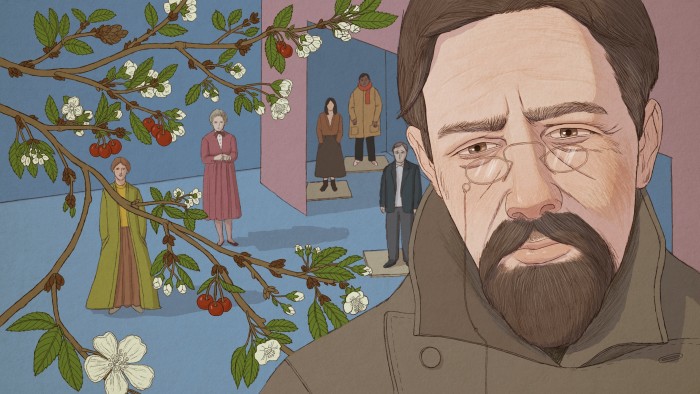
Back in October 2019, out of the blue, I received a letter — a real letter — from the eminent composer Colin Matthews. I already knew of Colin’s work and reputation because he had written a song-cycle set to the poems of Christopher Reid, one of my favourite poets, and this had led me to explore Colin’s other compositions, notably his orchestration of Debussy’s Preludes. I always responded to the richness and complexities of his music and the palpable emotion underlying his work. In his letter, Colin said he wanted to write an opera and asked if I would be interested in writing the libretto. There was no suggestion about what such an opera, such a collaboration, might consist of.
It took me about one second to realise that this was something I wanted to do. I had always loved my collaborations with actors in the theatre and an opera seemed to provide even more toothsome possibilities: singers who were also actors. Irresistible. We arranged to meet for lunch at the Chelsea Arts Club, where we instantly hit it off.
Certain aspects of this putative opera became clear. Colin posited the idea of an opera about creating an opera, and the name of Anton Chekhov was mentioned. Chekhov was fertile ground for me. I am a fervent admirer of the short stories — works of genius, in my opinion, and I rarely use that appellation. I had written a lot about Chekhov the man — the very complex man — and had also written a film based on three of his short stories (never made) and a play, that I called Longing, based on two short stories that I yoked together to form a new “Chekhovian” drama.
Longing was produced at the Hampstead Theatre and had a five-week, sellout run there, in 2013, starring Tamsin Greig and Iain Glen. More extraordinarily, it was translated into Russian and another production of the play was put on in a theatre in St Petersburg where it ran in repertory for some six years. That fact remains one of the most astonishing aspects of my writing life.
One of the two key Chekhov stories behind Longing was called “A Visit to Friends” (1898). It’s an interesting story in Chekhov’s oeuvre because it is the source of The Cherry Orchard (1904) and also, mystifyingly, Chekhov chose not to include it in his collected short stories. The narrative concerns the visit of a Moscow lawyer, Podgorin, to some old friends in the country. Their country estate is mortgaged to the hilt and is about to be sold at auction. Podgorin’s legal expertise is, they hope, going to prevent this fate occurring and save them. More to the point, two of the friends, an older and a younger woman, are in love with Podgorin. Problem. Podgorin is overwhelmed by the potent amorous emotions swirling around. Rather than confront or deal with them, he runs away, leaving both women in despair.
Chekhov had many love affairs in his short life (he died aged 44) — some 33 by one calculation — and many were intense. He was much loved by the women he had affairs with but, whenever the prospect of marriage or something more lasting loomed, Chekhov would cut and run. He was, to use the contemporary phrase, a commitment-phobe. As is Podgorin, the lawyer in the story. I personally believe Chekhov didn’t include “A Visit to Friends” in his collected works because it was unusually, untypically autobiographical. People who knew him would make the clear identification. It was too close to the bone.
This was the story that Colin and I chose to place at the centre of the opera we were going to write together. And because I had used it already in my play Longing we had licence to cherry-pick scenes from the play as well.
And then Covid-19 arrived.
In retrospect, I can now see that the evolution of the opera, A Visit to Friends, was our lockdown project. Colin and I now communicated solely by email and didn’t physically see each other again for well over a year. Our key decision arrived during this distanced process. The conceit that we came up with was that an opera score had been discovered in a Moscow archive: libretto by Chekhov, composer unknown. The centre of our opera would be four crucial scenes from this notional Russian opera — scenes taken from the short story and my play, fused together. This was the first music that Colin wrote and it’s in a musical idiom that suits Russian classical music of the period. Colin’s reference point is the turn-of-the-century composer Scriabin, particularly his fourth piano sonata (1903).
And then, in the to-and-fro of our deliberations, we elaborated the idea of a framing device. This late 19th-century Russian opera, A Visit to Friends, is being rehearsed today, in 2025, by a small group of opera singers. We cut back and forth between the rehearsal room and a staging of the 19th-century opera. Life inexorably begins to imitate art. The emotional reverberations of the Russian story begin to shape relationships in the rehearsal room to traumatic effect.
Having never written a libretto before, I had to intuit what was required and learn on the job, as it were. I read other librettos but they weren’t much help, paradoxically. Of course, I had written many films and TV series and also had three plays produced, so I was very accustomed to writing dialogue for actors to speak. But to sing?
Here my experience of writing for the theatre was useful. When you write a film you’re aware that you have the crucial tool of the extreme close-up in your armoury. Often, with close ups, there’s no need for dialogue at all. But there are no close-ups in the theatre; everything is a wide-shot. Consequently everything in dialogue, in my experience, however naturalistic, has to be ever-so-slightly heightened to make sure the point is not missed. Now, contemplating the libretto, it seemed to me that if I was writing words to be sung (another step away from naturalism) then the lyrics had to be slightly further heightened again. I was very aware that I was meant to be giving Colin words that he would set to music and I thought that I should write dialogue and arias and duets in a very slightly “musical” way.
In the end I opted for a kind of blank verse. I write my films with software known as Final Draft, formatted for the standard film script. So I wrote the libretto of A Visit to Friends on Final Draft but instead of using blocks of dialogue I broke the words into lines that resembled a kind of poetic layout. Final Draft accommodated this unforeseen formatting development very well.
Writing in “lines” was the breakthrough for me. Because it was a form of pseudo-poetry it seemed to easily admit rhymes, internal rhymes, emphases and repetitions more naturally. Nobody, so my reasoning went, actually speaks like this, but they might very well sing like this. Here’s an example:
VANESSA
In a dark wood,
still early in my life,
a strange man beckoned.
He seemed to want to lead me
on a road unreckoned.
And I followed him slowly.
We came to a point
where the road divided.
Each way seemed ideal.
We were both undecided.
I asked him:
Which path shall we choose?
I tasked him: He said I don’t know.
Virtually every word in the libretto of A Visit to Friends is sung. This method that I came up with seems to me the best way of writing a libretto — a script that will be sung, that will form part of an aria or a trio or recitative. In any event, Colin has written all the music for the singers and the orchestra. The opera is complete. A Visit to Friends will have its world premiere next month. Our lockdown project reaches its apotheosis.
‘A Visit to Friends’ receives its world premiere at the Aldeburgh Festival in Snape Maltings on June 13-14, brittenpearsarts.org
Find out about our latest stories first — follow FT Weekend on Instagram, Bluesky and X, and sign up to receive the FT Weekend newsletter every Saturday morning
Read the full article here