

Unlock the Editor’s Digest for free
Roula Khalaf, Editor of the FT, selects her favourite stories in this weekly newsletter.
An animated puppet film telling the story of Russian history in the mid-20th century is an unusual idea, to say the least. The puppet Lenin sports a cardboard costume. Stalin bobs about, revolver in hand, in pursuit of Trotsky. Shostakovich conducts with a little red flag on a podium. At the end the characters come together to dance a jig at the bottom of a disused swimming pool. What does it all mean?
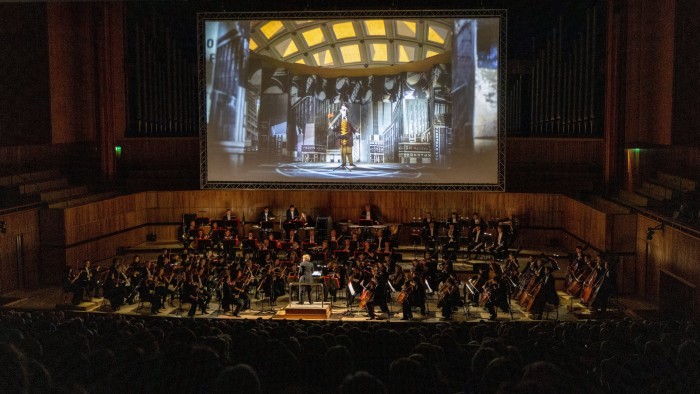
South African artist William Kentridge’s Oh To Believe in Another World was conceived as a visual accompaniment to Shostakovich’s Symphony No 10 and started life in Lucerne in 2022. The project has spawned drawings, sculptures, prints, a film installation and exhibitions.
It must surely be best, though, to see it as intended, in the company of Shostakovich’s mighty symphony. That was how Kentridge’s film was presented at this concert by the Philharmonia Orchestra, one of the high points in the Southbank Centre’s innovative Multitudes festival, in which orchestral music reaches out to other art forms.
Pairing a Shostakovich symphony with film is not such an improbable idea. The composer worked as a pianist accompanying silent films as a teenager and went on to write film scores himself. Even his biggest symphonies draw on those experiences, whether in passages of madcap energy or their mastery of atmosphere.
Collage has long been a favoured form in Kentridge’s work. In addition to puppets, this work blends dancers, archive film and silent-film captions, as a miniature camera makes its way round a cardboard set representing an abandoned museum. The idea of a whimsical art film glancing off that painful period of Russian history with a playful touch may seem questionable, but then its meaning is opaque in the extreme.
In essence, the film purports to present a retrospective of Russian history from the 1920s to 1953, the year that Stalin died and Shostakovich’s Symphony No 10 had its premiere. It progresses from early enthusiasm for communism to the disillusion of the later Stalin years, though even that is hard to follow.
Perhaps its very ambiguity makes the film strangely apt. There have long been claims that Shostakovich’s music speaks in code through these years, when any open deviation from the official line on socialist realism could be fatal. How far was he speaking out against Stalin in this symphony? We do not know and Kentridge does not try to tell us.
By itself the symphony is a hugely powerful work, the soundtrack of an era of crushing political forces and little sign of hope. No performance ever fails to give Shostakovich’s symphonic juggernaut its full stature and conductor Marin Alsop and the Philharmonia did not hold back, though the pace felt ponderous at times.
The symphony was preceded by Leonard Bernstein’s Chichester Psalms, contrastingly music of heartwarming optimism. This is home ground for Alsop, a Bernstein protégée, and she had the benefit of a confident treble soloist (unnamed), a fine quartet of solo cellists and the sturdy Philharmonia Chorus.
★★★★☆
‘Multitudes’ continues to May 3, southbankcentre.co.uk
Read the full article here