

This year marks the 30th Wimbledon without net-cord judges — those hunkered, vulnerable figures who sensed service lets through their fingertips. Martina Navratilova was unusual in her classy habit of patting them on the shoulder before reaching up to shake the umpire’s hand. There was no such camaraderie to be had with the small electronic sensors that took over the job.
Looking back, these net judges were canaries in the digital coal mine. This Wimbledon, the automation of court-level officials is complete: for the first time the tournament will swap human judges for electronic line calling (ELC), a network of cameras, tracking software and automated voices crying foul. I wonder if the chair umpires will feel their high towers teetering beneath them.
Many will miss the court being fringed with dapper linespeople. ELC might be less error-prone but, at this stage of its development, it does not have a human sense of occasion. The automated “outs” sound the same at 15-all in the first game as they do on the biggest points, so that sometimes players can’t hear them amid the noise from excited spectators. In contrast, ELC’s warm-blooded predecessors knew to scream “Fault!” over the crowd’s premature cheers, as what seemed like a match-winning ace was judged to be a whisker over the line.
Centre Court will certainly look emptier without its complement of keen-eyed, bent-kneed officials. But while this depopulating of the tennis court heralds our automated future, it also emphasises the traditional fantasy of singles tennis as a game of isolation, played between two solitary competitors separated by a net and cut off from human contact.
The singles court was designed to be a lonesome world apart, with its own strict boundaries and its own weird timezone. To hit the ball outside the lines is instant failure, a reward to your enemies. Crossing on to your opponent’s side during play, to check a mark for instance, or perhaps just for a bit of company, can result in a penalty.
Time flows differently there, getting caught in eddies as deuce becomes advantage becomes deuce again, in theory for eternity. As John Isner and Nicolas Mahut’s three-day 2010 Wimbledon match reached 68-68 in the deciding set, both players may have wondered if they would ever be free to return to their old lives. Even the new rules of final-set tiebreakers can’t eliminate the possibility of infinite competition, though that would require artificial players as well as judges.
These ideals of isolation and separation seemed to climax just before they would be most threatened. In a 2022 ad by Rolex, the purple voiceover declared that “inside these lines, you’re not so much facing adversaries as you are peering through a mirror, trying to outdo none other than yourself”.
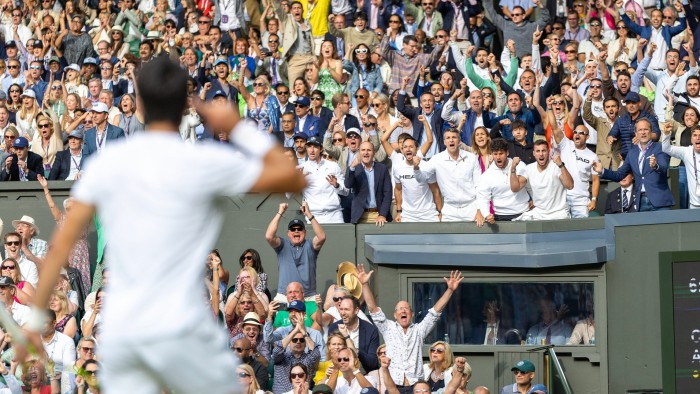
But this solipsistic vision was seriously undermined the following year, when all four Grand Slams first allowed players to communicate with their ever-expanding coaching teams during matches. Coaches are now permitted to give “discreet” advice when the player is at their end of the court, and if the action pauses for a bathroom break or injury timeout, full courtside conversations can take place. Ironically then, even as line judges are vanishing, the modern singles tennis court has never felt more crowded. It has become routinely busy with collaboration, evolving in step with our social-media age of relentless connectivity.
Chris Evert, whose famously icy game-face barely registered the score — never mind news from beyond the baseline — has been sceptical of this shift. She is of the stoic era of tennis individualists, where competitors had to “figure it out themselves”. Her concern is that players will become over-reliant on coaches. She has found it remarkable that Carlos Alcaraz looks to his team “after every point”.
And with data-crunching software being standard courtside kit, players can benefit from real-time stats on their opponents and themselves: serving patterns, shot speeds, return positioning. Professional matches now run along a glowing circuit between the court and the stands. The action unrolls, is analysed from outside, and in a repackaged, tactical form streams back into the arena. The court is linked in.
From its beginnings, tennis has been a battle between in and out. It was born on the outside, as a European folk game in which medieval peasants used their hands to bat a ball against the external walls of buildings. Sometimes the building was a church, and it was the clergy who grabbed the ball and brought it inside. This was tennis’s first cloistering. The outer and inner games developed in parallel.
Tennis historians Brad Hummel and Mark Dyreson note that “While the peasants continued to enjoy their folk versions of the sport, the move from outside to inside of monastic courtyards led the clergy to patronise a refined version that became popular among the upper classes.” A few centuries after the posh invention of indoor “real tennis”, lawn tennis was born.
Maybe I find the modern, chatty, networked court so jarring because I started following the sport when it was dominated by self-flagellating Steffi Graf, carrier of that old monastic flame. Graf’s fantasy was to play Navratilova in an empty Wimbledon Centre Court. “No one knows” about the match, she told Sports Illustrated in 1994, “it is just for us.”
Headlined “Do Not Disturb”, the profile painted Graf in a dim Gothic light: she hated the hotel suite where she was being interviewed because there were too many bright windows. Her bedroom decor, apparently, was black on black on black. “I need to be alone a lot,” she admitted. At her home club near Heidelberg, she practised on the remotest court, “on the edge of a forest, shielded from view”.
In this portrait at least, Graf embodies the archetypal tennis player locked in a lonely battle with self-perfection. Predicting, or perhaps inspiring, the Rolex ad, she described how: “I’m playing myself out there . . . the score is totally meaningless.”
But the hands of Rolex keep ticking, and now we’re in the 21st century. In place of Steffi Graf on finals weekend, there is the talented Coco Gauff, who was almost late to the trophy presentation of her first Grand Slam title — the 2023 US Open — because she was on the phone. “I gotta go, I gotta go,” she whispered, hanging up and hurrying towards the podium. After she won the French Open this month, Gauff propped her phone on her chair and took some selfies with the trophy.
On one hand I worry about the disappearance of a certain way of being a person, played out as allegory by the solitary tennis champion: someone separated from the world by a grid of white lines, thriving in silence. Quiet please! Spaces like these remind us of competing values to constant engagement, commercially driven action, reaction and distraction. We need to remember that places and people can exist beyond the data stream. During a match en route to the US Open title, Gauff clearly craved some of that old-school solitude, calling into the stands to tell her coach Brad Gilbert to “stop talking”.
But the world has always broken into the sanctum of the tennis court, and how it does so can tell a story of the times. At the start of the 1996 men’s Wimbledon final, we were down a net judge but gained one Melissa Johnson, who ran naked on to the court, blonde hair flying, her hands waving above her head. This was a cheeky act of rebellion fit for the heyday of western liberal democracy. The players smiled, the royals smiled, the crowd smiled. Two decades later, in darker times, a schoolteacher’s remote-controlled drone crashed into the stands of Louis Armstrong stadium during a 2015 US Open match. One of the players, Flavia Pennetta, heard the noise and thought it was a bomb. As she said afterwards: “With everything going on in the world . . . I thought, ‘OK, it’s over.’”
As I lament the loss of these sealed-off spaces — even the imaginary ones — the hurly-burly of the modern, connected court is acting out its own, more urgent allegory. When it comes to the marks we make on this planet, rather than the red clay, none of us exists in isolation. Smoke from forest fires drifts across guarded borders, and our carbon footprints trespass from pole to pole. Gauff’s 2023 US Open semi-final against Karolína Muchová was delayed for almost an hour by climate protesters, one of whom glued himself to the concrete floor of the stands. “I can’t really get upset at it,” Gauff said. During the Laver Cup in London in 2022, a man wearing a T-shirt printed with the words “End UK Private Jets” broke on to the court and set his arm alight.
Silence and separation versus transgression and revolution. These are the outs and ins of tennis’s double history. In 1789, members of France’s Third Estate, representatives of the non-privileged classes, formed a National Assembly. They hoped to wrest power from the crown and clergy, the country’s ruling factions as well as early gatekeepers of the young sport of real tennis.
When deputies from the Third Estate convened at Versailles on June 20 that year, they found their usual meeting hall locked. Interpreting this closure as royal hostility, they entered the next open room. There they made their pledge of collective action, vowing to stay united until France had a written constitution. Their communal, game-changing promise became known as the Tennis Court Oath, named after that open room where courtiers bandied their balls, and where from two sets of high, facing windows, some kind of light must have streamed in.
Laurence Scott is the author of ‘The Four-Dimensional Human’ and ‘Picnic Comma Lightning’
Find out about our latest stories first — follow FT Weekend on Instagram, Bluesky and X, and sign up to receive the FT Weekend newsletter every Saturday morning
Read the full article here