

Unlock the Editor’s Digest for free
Roula Khalaf, Editor of the FT, selects her favourite stories in this weekly newsletter.
Modern dance, like modern art, is actually very old indeed. But the great pioneers of contemporary movement are seldom seen by UK dance audiences. Does it matter? Director of Yorke Dance Project and former dancer Yolande Yorke-Edgell certainly thinks so, and her tiny company’s latest programme offers an exhilarating blend of heritage repertoire and new creations that gives an outline of modern dance’s family tree and puts contemporary choreography into context. As Yorke-Edgell sees it: “It’s vitally important to show these legacy works. Just as we go to museums or art galleries to witness the masters of their craft. If you’re only going to watch Wayne McGregor then you’re only going to explore a certain amount of styles. The less you see, the less you are able to give back because you can only do what you know”.
This wasn’t always a problem. Once upon a time, London Contemporary Dance Theatre (1967-1994) combined new commissions with modern classics — Martha Graham, Merce Cunningham, Paul Taylor, Robert Cohan — as did Rambert under the directorship of Mark Baldwin. But, in recent years, the emphasis (and funding) has increasingly been on new material. As a result, fine choreography by the likes of Siobhan Davies, Richard Alston, Michael Clark, Henri Oguike and many others tends to languish undanced. Even at Rambert, which celebrates its centenary this year, there are no plans for a retrospective. Current director Benoit Swan Pouffer prefers an oil-and-water mix of commercial dance theatre (Peaky Blinders) and French contemporary ((LA)Horde).
Keeping vintage pieces alive requires commitment — and cash. If left too late, a dance can wither and die along with the muscle memories of those who originally performed it. Richard Alston, choreographer and patron of Yorke Dance Project, feels that ballet is better served in this regard, citing the foundations that safeguard and promote the back catalogues of Frederick Ashton, George Balanchine and Jerome Robbins. Productions are regularly revived and their texts are notated using a written shorthand system that aligns the movement with the musical score. “In modern dance it’s a struggle” says Alston. “In America, the issue wasn’t really regarded until its main figures began to die”. Alston, whose own foundation was set up in 2021 (“for when I pop my clogs”) praises Van Cleef & Arpels’ “hugely important” support for veteran American moderns like Trisha Brown and Lucinda Childs through its London festival.
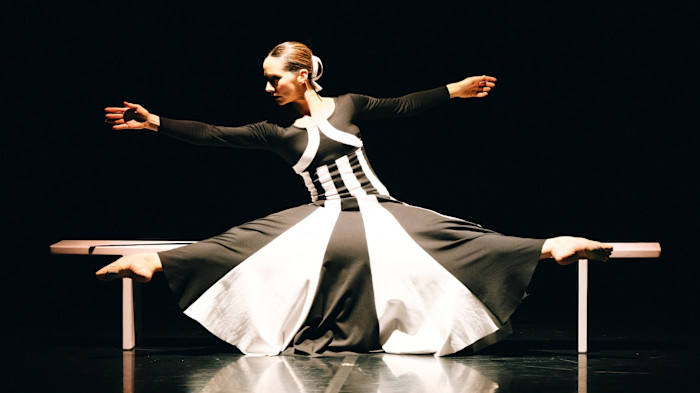
Female dance pioneers were the focus of Yorke Dance’s 2024 programme at Linbury Theatre, California Connections, which had Martha Graham’s 1947 retelling of the Minotaur myth, Errand Into the Maze, as its centrepiece. This year with Modern Milestones — its short run at the Linbury closes January 22 — we are taken still further back to 1937’s Deep Song, an abstract study of rage and grief inspired by the suffering of the Spanish civil war, restaged by former Graham dancer Elizabeth Auclair. The six-minute piece is set to Henry Cowell’s Sinister Resonance and was designed by Graham herself: a gored black-and-white gown flaring around the lone dancer who shares the space with a simple wooden bench (“It’s a good piece, but it’s also economical,” observes Alston). Forcefully performed by Amy Thake, Deep Song provides a concentrated aide-memoire of Graham’s rigorous technique, packed with nerveless balances, sudden jumps, frisky feet and convulsive contractions. Not for nothing did Robert Cohan — a Graham dancer in the 1940s and ’50s — dub her classes “the Temple of Pelvic Truth”.
Yorke-Edgell has worked extensively with Cohan and the Graham bloodline is discernible in Lacrymosa, a duet he made for Yorke Dance Project in 2015 at the age of 90. In it he tries to imagine the sorrow of the Virgin Mary as her teenage son matures into the Messiah.
The intensity of Deep Song and Lacrymosa is leavened by a strongly danced if directionless quartet by company Liam Francis set to Jethro Cooke’s unsettling snippets of film dialogue. There is also a splendidly danced revival of the zingy 1970 ensemble Kinaesonata by Californian dance pioneer Bella Lewitzky which is packed with run-and-catch-me lifts. The finale was the London premiere of Troubadour, by the 80-year-old Christopher Bruce — his first work in over a decade — set to six numbers from Leonard Cohen’s 2008 concert at London’s O2 Arena.
Popular song can be something of a bear trap for dancemakers but Bruce is an old hand at this. His Rolling Stones ballet, Rooster, was one of the biggest hits of the 1990s. Troubadour’s four couples, men in three-piece suits and trilbies, women in crimson satin, are given a noir, Edward Hopper’s “Nighthawks” vibe by Guy Hoare’s lighting. Cohen’s spoken intros are an excuse for some soft-shoe skills by the chaps and for each of the songs Bruce mines 20th-century social dance for moves that are deceptively everyday: a jitterbug lift here, a few tango kicks there. Jonathan Goddard and Harry Wilson both excel at this kind of throwaway virtuosity.
Yorke-Edgell, whose dance card has included all the modern greats, is determined to share every step. “As I get older I want to pass down the things I learned, it’s such a pleasure to pass that on”. While the 20th-century greats are all studied on A-level and BA syllabuses, it is no substitute for the real thing: “We invited some students to come along to a run-through the other day and I could see how they lit up at certain things they were watching. It gave them something to aspire to. Where else are they going to see that?”
To January 22, yorkedance.com
Read the full article here