

Stay informed with free updates
Simply sign up to the Fashion myFT Digest — delivered directly to your inbox.
During the month and a half that freelance fashion designer Maya Scarlette spent hand-sewing her costume for Notting Hill Carnival last year, she considered the weight and balance of each component. She experimented with resin-coated fabric to create coral-reef textures and wet-look effects. She pondered how best to portray her inspiration — Sandro Botticelli’s “The Birth of Venus” — via a costume in which she would walk the three and a half miles of the parade route. A rather more arduous journey than surfing ashore on a giant seashell.
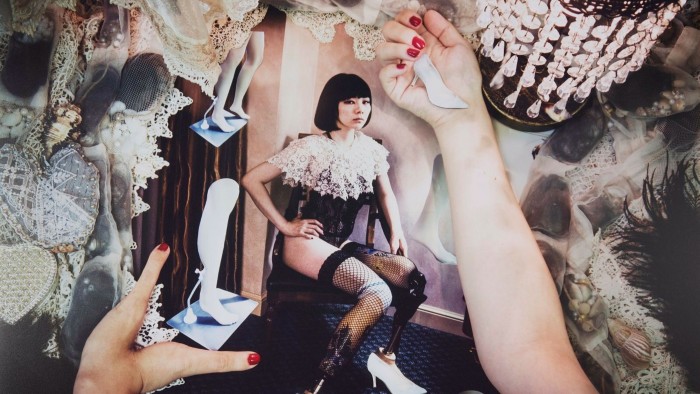
She never paused to imagine how her costume might look in a major international museum. Yet this weekend Scarlette, who specialises in custom outfits for photo shoots and music videos, will see her Carnival costume go on display in the Victoria and Albert Museum.
Scarlette, 33, has ectrodactyly, a limb difference affecting the fingers and toes, and her costume is one of 170 objects selected to appear in the new Design and Disability exhibition at V&A South Kensington. “Often when you’re the only person in a group who has a disability, you have to be your own inspiration,” Scarlette says. “I’m really excited for people with disabilities who might want to go into fashion design to have something tangible to go and see and be inspired by.”
“I love this object so much because it’s this stunningly beautiful, highly visible costume,” says Natalie Kane, curator of Design and Disability. “It’s a different way to look at fashion. Disabled people are everywhere, including at Notting Hill Carnival.”
Kane conceived of the exhibition as a way to highlight disability as an identity or culture through design. “Disabled culture has come from people subverting, bending and recreating the design world as something new when things haven’t considered us,” says Kane, who identifies as disabled. “Within the gaps and alternative cultures, disability has created its own new design realities. That’s a pretty generative space.”
The exhibition is divided into three sections: “Visibility”, “Living” and “Tools”. Fashion appears mostly in the first of these. Along with Scarlette’s costume, there are the Hi Lo shirt and Seated Wrap trousers for wheelchair users from Unhidden, the London-based adaptive fashion brand founded by disability campaigner and designer Victoria Jenkins. Visitors will also be able to listen to the first audio-described catwalk show, created as a way for blind and low-vision guests to experience Sinéad O’Dwyer’s spring-summer 2025 show at Copenhagen Fashion Week. Also included is a photograph of an elaborate dress painted by Ntiense Eno-Amooquay, a visual artist and member of Intoart, which champions artists with learning disabilities and autism.
A leopard-print wrap dress by adaptive fashion designer Kathy D Woods appears on a mannequin modelled on accessibility advocate Sinéad Burke, who donated the dress. So does Burke’s cover of British Vogue’s disability justice special issue from May 2023, part of a display of magazines with disabled cover stars. (Burke previously featured on one of British Vogue’s September 2019 “Forces for Change” covers.) “I’m really proud of the cover being something that exists in the museum that reflects a moment in time, but I hope people who come through will think about . . . what they can do,” says Burke, who is CEO of Tilting the Lens, a strategic accessibility consultancy which advised the V&A on the exhibition. “Visibility and representation is really important, but it cannot and must not be the only measurement of success.”
Some of the smallest items — such as hearing-aid jewellery from Deafmetal and a splint ring (which provides functional support without looking obviously medical) from Evabelle — seem among the most ingenious and expressive objects in the show.
Just as important as the objects on display is the design of the show itself. The exhibition includes self-regulation and resting zones, and features guides in a range of formats, including tactile, sensory, audio-described, BSL and large print. Adapting the spaces to make the Victorian building accessible to a wider range of visitors is just the beginning. “It’s kind of like a choose-your-own-access adventure,” Kane says. “We see this as an incubator for some of the things we want to do in the future.”
Kane and her colleagues have been planning Design and Disability for about four years, yet it feels particularly relevant for the current moment. Burke says we are in “an incredibly difficult time to be a disabled person”, citing changes to Pip (personal independence payments) in the UK, the ongoing dismantling of disability protections in the US and the demonisation of disabled people as non-contributors to or outright drains on society. “The ableism that exists in society has never felt more heightened or more tangible or more measurable,” she adds. “That’s why we need an exhibition like this.”
Kane’s wish is that visitors experience the exhibition as an expression of disabled joy. “I really hope that disabled people find affirmation and community in it. And that non-disabled people see themselves as allies and get on board.”
For her part, Scarlette, the fashion designer, can’t wait to share the joy with friends and family. “I’m probably going to go to this exhibition 20 times,” she says. “They’re going to get very used to seeing me there.”
‘Design and Disability’ is at V&A South Kensington from June 7 to February 15 2026
Follow us on Instagram and sign up for Fashion Matters, your weekly newsletter about the fashion industry
Read the full article here